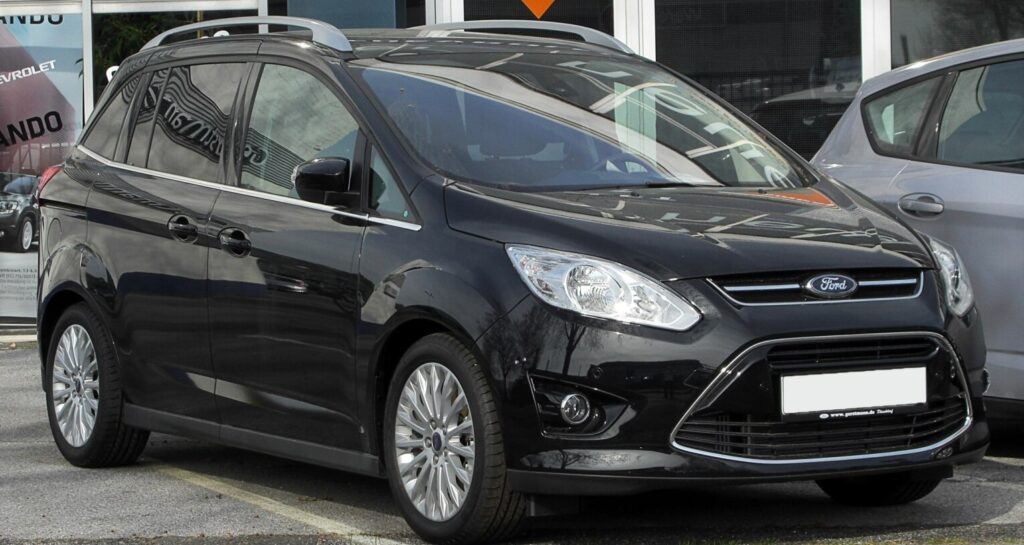
The Ford Grand C-MAX 1.6 Duratorq TDCi, producing 115 horsepower, was a popular variant of Ford’s compact multi-purpose vehicle (MPV) sold primarily in Europe from 2010 to 2015. Positioned as a mid-range offering within the Grand C-MAX lineup, it aimed to balance fuel efficiency, practicality, and affordability for families. This model represented Ford’s response to the growing demand for versatile, seven-seat vehicles in the European market, offering a more spacious alternative to traditional hatchbacks and smaller MPVs. It was built on the C2 platform, shared with the Ford Focus, and offered a compelling package for buyers needing flexible seating and cargo capacity.
Technical Specifications
| Brand | Ford |
| Model | C-MAX |
| Generation | Grand C-MAX |
| Type (Engine) | 1.6 Duratorq TDCi (115 Hp) DPF |
| Start of production | 2010 |
| End of production | 2015 |
| Powertrain Architecture | Internal Combustion engine |
| Body type | MPV |
| Seats | 7 |
| Doors | 5 |
| Fuel consumption (urban) | 5.5 l/100 km (42.8 US mpg, 51.4 UK mpg, 18.2 km/l) |
| Fuel consumption (extra urban) | 4.3 l/100 km (54.7 US mpg, 65.7 UK mpg, 23.3 km/l) |
| Fuel consumption (combined) | 4.7 l/100 km (50 US mpg, 60.1 UK mpg, 21.3 km/l) |
| CO2 emissions | 124 g/km |
| Fuel Type | Diesel |
| Acceleration 0 – 100 km/h | 12.3 sec |
| Acceleration 0 – 62 mph | 12.3 sec |
| Acceleration 0 – 60 mph | 11.7 sec |
| Maximum speed | 180 km/h (111.85 mph) |
| Emission standard | Euro 5 |
| Weight-to-power ratio | 13.1 kg/Hp, 76.5 Hp/tonne |
| Weight-to-torque ratio | 5.6 kg/Nm, 179.5 Nm/tonne |
| Power | 115 Hp |
| Torque | 270 Nm (199.14 lb.-ft.) |
| Engine layout | Front, Transverse |
| Engine Model/Code | T1DB |
| Engine configuration | Inline |
| Fuel injection system | Diesel Commonrail |
| Engine aspiration | Turbocharger, Intercooler |
| Engine oil capacity | 3.8 l (4.02 US qt, 3.34 UK qt) |
| Coolant capacity | 7.3 l (7.71 US qt, 6.42 UK qt) |
| Kerb Weight | 1504 kg (3315.75 lbs.) |
| Max. weight | 2200 kg (4850.17 lbs.) |
| Max load | 696 kg (1534.42 lbs.) |
| Trunk (boot) space – minimum | 56 l (1.98 cu. ft.) |
| Trunk (boot) space – maximum | 1706 l (60.25 cu. ft.) |
| Fuel tank capacity | 60 l (15.85 US gal, 13.2 UK gal) |
| Length | 4520 mm (177.95 in.) |
| Width | 1828 mm (71.97 in.) |
| Height | 1684 mm (66.3 in.) |
| Minimum turning circle | 11.2 m (36.75 ft.) |
| Drivetrain | Front wheel drive |
| Number of gears | 6 gears, manual transmission |
| Assisting systems | ABS (Anti-lock braking system) |
Powertrain & Engine Architecture
The heart of the Grand C-MAX 1.6 Duratorq TDCi was the T1DB engine, a 1.6-liter inline-four cylinder diesel. This engine was part of Ford’s Duratorq family, known for its robust construction and relatively good fuel economy. The T1DB utilized a common-rail direct fuel injection system, delivering fuel at extremely high pressure for improved combustion efficiency and reduced emissions. A turbocharger with an intercooler was employed to boost power output, providing 115 horsepower and 270 Nm (199 lb-ft) of torque. The engine featured four valves per cylinder and a single overhead camshaft. The six-speed manual transmission was the standard offering, chosen for its balance of fuel efficiency and driver engagement. While an automatic transmission was available on other C-MAX variants, it wasn’t commonly paired with this specific engine.
Driving Characteristics
The 1.6 Duratorq TDCi-powered Grand C-MAX offered a practical and economical driving experience. Acceleration was adequate for everyday driving, with a 0-60 mph time of around 11.7 seconds, but it wasn’t particularly sporty. The engine’s torque peak was relatively low in the rev range, providing good responsiveness for overtaking and climbing hills. The six-speed manual transmission allowed drivers to keep the engine in its optimal power band. Compared to the more powerful 1.6-liter EcoBoost petrol engine or the 2.0-liter TDCi diesel, the 1.6 Duratorq felt less refined and had more noticeable engine noise, but it excelled in fuel economy. The gear ratios were tuned for efficiency rather than outright performance.
Equipment & Trim Levels
The Grand C-MAX 1.6 Duratorq TDCi was typically offered in mid-range trim levels, such as Zetec or Titanium. Standard equipment generally included air conditioning, power windows, power mirrors, a basic audio system with USB connectivity, and alloy wheels. Higher trim levels added features like automatic headlights, rain-sensing wipers, a more advanced audio system, and parking sensors. Optional extras included a panoramic sunroof, leather upholstery, and a navigation system. The interior was generally well-built and functional, with a focus on practicality and durability. The seven-seat configuration offered flexible seating arrangements, with the third-row seats folding flat into the floor when not in use.
Chassis & Braking
The Grand C-MAX featured a MacPherson strut front suspension and a multi-link rear suspension, providing a comfortable ride and decent handling. The suspension was tuned for everyday use, prioritizing comfort over sporty handling. The front brakes were ventilated discs, while the rear brakes were typically solid discs on higher trim levels, but drums were common on base models. Anti-lock Braking System (ABS) was standard. The steering was a rack-and-pinion system, providing precise and responsive steering feel. Stabilizer bars were fitted to both the front and rear axles to reduce body roll during cornering.
Market Reception & Comparison
The Ford Grand C-MAX 1.6 Duratorq TDCi was well-received by critics for its practicality, fuel efficiency, and spacious interior. It was often praised as a sensible choice for families needing a versatile MPV. However, some reviewers noted that the 1.6-liter engine could feel underpowered when fully loaded with passengers and luggage. Compared to the more powerful diesel variants, the 1.6 TDCi offered significantly better fuel economy but lacked the same level of performance. It also provided a more affordable entry point into the Grand C-MAX range. Rivals included the Renault Grand Scenic, Citroën Grand C4 Picasso, and Volkswagen Touran.
Legacy
The 1.6 Duratorq TDCi engine, while generally reliable, has been known to exhibit some common issues, including potential problems with the diesel particulate filter (DPF) and the fuel injectors. Regular maintenance, including timely DPF regeneration and the use of high-quality diesel fuel, is crucial for ensuring long-term reliability. On the used car market, the Grand C-MAX 1.6 Duratorq TDCi remains a popular choice for budget-conscious buyers seeking a practical and spacious MPV. Its fuel efficiency and relatively low running costs make it an attractive option for families and individuals alike. Despite its age, the Grand C-MAX continues to offer a compelling blend of practicality, affordability, and reliability.