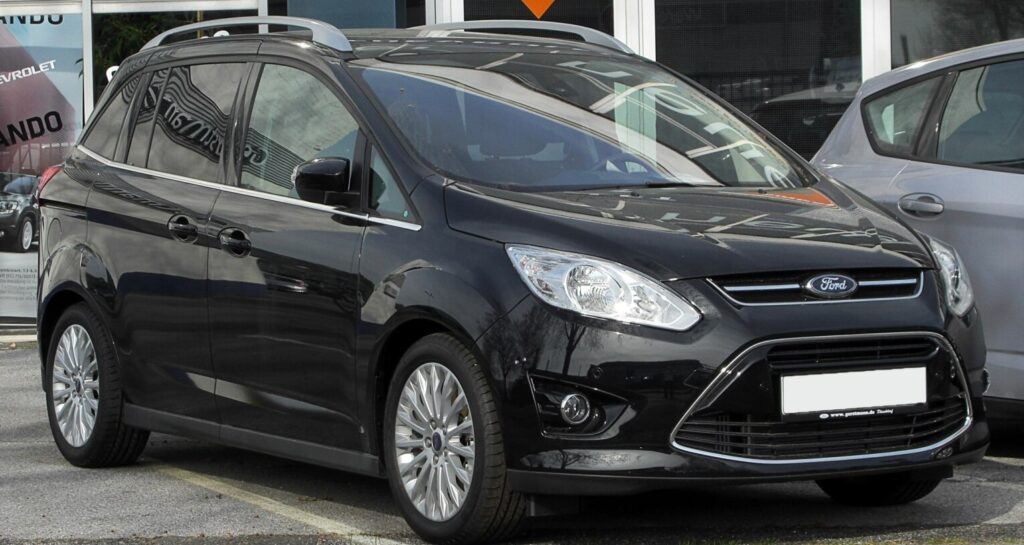
The Ford Grand C-MAX 2.0 Duratorq TDCi, producing 140 horsepower, was a significant variant within the second generation of the C-MAX compact multi-purpose vehicle (MPV) line. Introduced in 2010 and continuing through 2015, this model aimed to provide a practical and fuel-efficient seven-seat option for European families. Positioned as a mid-range offering, it bridged the gap between the lower-powered engine options and the more expensive, higher-performance trims. The Grand C-MAX, built on the Ford C2 platform, represented Ford’s attempt to capitalize on the growing demand for versatile, family-oriented vehicles in the European market. This particular engine and configuration was not widely available in North America, where the standard C-MAX was offered with gasoline engines.
Technical Specifications
| Brand | Ford |
| Model | C-MAX |
| Generation | Grand C-MAX |
| Type (Engine) | 2.0 Duratorq TDCi (140 Hp) DPF |
| Start of production | 2010 |
| End of production | 2015 |
| Powertrain Architecture | Internal Combustion engine |
| Body type | MPV |
| Seats | 7 |
| Doors | 5 |
| Fuel consumption (urban) | 6.3 l/100 km (37.3 US mpg, 44.8 UK mpg, 15.9 km/l) |
| Fuel consumption (extra urban) | 4.4 l/100 km (53.5 US mpg, 64.2 UK mpg, 22.7 km/l) |
| Fuel consumption (combined) | 5.1 l/100 km (46.1 US mpg, 55.4 UK mpg, 19.6 km/l) |
| CO2 emissions | 134 g/km |
| Fuel Type | Diesel |
| Acceleration 0 – 100 km/h | 10.1 sec |
| Acceleration 0 – 62 mph | 10.1 sec |
| Acceleration 0 – 60 mph | 9.6 sec |
| Maximum speed | 200 km/h (124.27 mph) |
| Emission standard | Euro 5 |
| Weight-to-power ratio | 11.3 kg/Hp, 88.9 Hp/tonne |
| Weight-to-torque ratio | 4.9 kg/Nm, 203.2 Nm/tonne |
| Power | 140 Hp |
| Torque | 320 Nm (236.02 lb.-ft.) |
| Engine layout | Front, Transverse |
| Engine Model/Code | UFDB |
| Engine configuration | Inline |
| Fuel injection system | Diesel Commonrail |
| Engine aspiration | Turbocharger, Intercooler |
| Engine oil capacity | 5.7 l (6.02 US qt, 5.02 UK qt) |
| Coolant capacity | 8.5 l (8.98 US qt, 7.48 UK qt) |
| Kerb Weight | 1575 kg (3472.28 lbs.) |
| Max. weight | 2300 kg (5070.63 lbs.) |
| Max load | 725 kg (1598.35 lbs.) |
| Trunk (boot) space – minimum | 56 l (1.98 cu. ft.) |
| Trunk (boot) space – maximum | 1706 l (60.25 cu. ft.) |
| Fuel tank capacity | 60 l (15.85 US gal, 13.2 UK gal) |
| Length | 4520 mm (177.95 in.) |
| Width | 1828 mm (71.97 in.) |
| Height | 1684 mm (66.3 in.) |
| Minimum turning circle | 11.2 m (36.75 ft.) |
| Drivetrain | Front wheel drive |
| Number of gears | 6 gears, manual transmission |
| Assisting systems | ABS (Anti-lock braking system) |
Powertrain & Engine Architecture
The heart of the Grand C-MAX 2.0 Duratorq TDCi was the UFDB engine, a 1998cc four-cylinder diesel. This engine belonged to Ford’s Duratorq family, known for its robust construction and relatively good fuel economy. The UFDB utilized a common rail direct injection system, delivering fuel at extremely high pressures for optimized combustion. A turbocharger with an intercooler was employed to boost power output and improve torque across the rev range. The engine featured four valves per cylinder (DOHC) and was designed to meet stringent Euro 5 emission standards, incorporating a diesel particulate filter (DPF) to trap soot. The six-speed manual transmission was the standard offering, providing a good balance between fuel efficiency and driver control. The transmission’s gear ratios were tuned to maximize the engine’s torque, offering reasonable acceleration and highway cruising ability.
Driving Characteristics
The 140 horsepower and 320 Nm (236 lb-ft) of torque provided by the 2.0 Duratorq TDCi engine offered a decent driving experience for the Grand C-MAX. While not particularly sporty, the engine provided sufficient power for everyday driving, even when fully loaded with passengers and luggage. Acceleration from 0-60 mph took around 9.6 seconds, which was adequate for merging onto highways and overtaking slower traffic. Compared to the lower-powered 1.6-liter TDCi versions, the 2.0-liter offered noticeably more punch, especially at lower engine speeds. However, it didn’t possess the outright performance of the higher-output 2.0-liter variants. The six-speed manual transmission allowed drivers to keep the engine in its optimal power band, enhancing responsiveness. The gear ratios were relatively long, prioritizing fuel economy over rapid acceleration.
Equipment & Trim Levels
The Grand C-MAX 2.0 Duratorq TDCi was typically offered in mid-range trim levels, such as Trend or Titanium. Standard equipment generally included air conditioning, power windows, power mirrors, a CD/radio system, and alloy wheels. Higher trim levels added features like automatic climate control, a navigation system, parking sensors, and upgraded interior upholstery. Interior materials were generally of good quality for the segment, with a focus on practicality and durability. The seven-seat configuration offered flexibility for families, although the third-row seats were best suited for children or shorter adults. Optional extras included a panoramic sunroof, leather seats, and a premium sound system.
Chassis & Braking
The Grand C-MAX featured a MacPherson strut front suspension and a multi-link rear suspension, providing a comfortable and controlled ride. The suspension was tuned to prioritize comfort over sporty handling. The front brakes were typically ventilated discs, while the rear brakes were often solid discs, depending on the specific trim level and market. Anti-lock Braking System (ABS) was standard, enhancing safety during emergency braking situations. The steering was a rack and pinion system, offering precise and responsive steering feel. Stabilizer bars were fitted to both the front and rear axles to reduce body roll during cornering.
Market Reception & Comparison
The Ford Grand C-MAX 2.0 Duratorq TDCi was generally well-received by automotive critics. It was praised for its spacious interior, versatile seating configuration, and fuel-efficient engine. However, some critics noted that the interior design was somewhat bland and that the ride could be a bit firm on rough roads. Compared to rivals like the Renault Grand Scenic and the Citroën Grand C4 Picasso, the Grand C-MAX offered a more driver-focused experience. The 2.0-liter TDCi engine provided a good balance between performance and fuel economy, although it wasn’t the most refined diesel engine on the market. Reliability was generally good, although some owners reported issues with the DPF system, a common problem with modern diesel engines.
Legacy
The Ford Grand C-MAX 2.0 Duratorq TDCi remains a popular choice in the used car market, particularly for families seeking a practical and affordable MPV. The Duratorq engine is known for its durability, although regular maintenance is essential to prevent issues with the DPF and other components. The availability of spare parts is generally good, and the Grand C-MAX is relatively easy to maintain. While newer MPVs offer more advanced technology and features, the Grand C-MAX 2.0 Duratorq TDCi continues to provide a compelling value proposition for buyers looking for a reliable and versatile family vehicle.