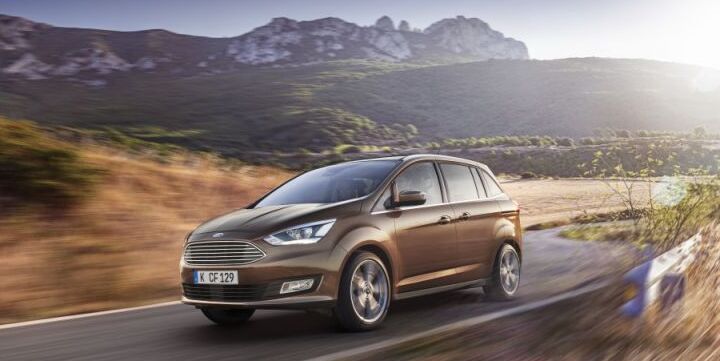
The Ford Grand C-MAX (facelift, introduced in April 2015 and produced through June 2019) 1.5 TDCi 120 horsepower variant with Start/Stop technology and seven seats represented a key offering in Ford’s European compact MPV lineup. Positioned as a mid-range option, it aimed to balance fuel efficiency, practicality, and affordability for families. This version of the Grand C-MAX, built on the Ford C-MAX/Focus platform (Mk2), was primarily marketed in Europe, offering a spacious interior and versatile seating configuration within a relatively compact footprint. It competed with vehicles like the Opel/Vauxhall Meriva, Citroën C4 Picasso, and Renault Scenic.
Technical Specifications
| Brand | Ford |
| Model | C-MAX |
| Generation | Grand C-MAX (facelift 2015) |
| Type | 1.5 TDCi (120 Hp) S&S 7 Seat |
| Start of production | April, 2015 |
| End of production | June, 2019 |
| Powertrain Architecture | Internal Combustion engine |
| Body type | MPV |
| Seats | 7 |
| Doors | 5 |
| Fuel consumption (urban) | 4.9 l/100 km (48 US mpg, 57.6 UK mpg, 20.4 km/l) |
| Fuel consumption (extra urban) | 4.1 l/100 km (57.4 US mpg, 68.9 UK mpg, 24.4 km/l) |
| Fuel consumption (combined) | 4.4 l/100 km (53.5 US mpg, 64.2 UK mpg, 22.7 km/l) |
| CO2 emissions | 113 g/km |
| Fuel Type | Diesel |
| Acceleration 0 – 100 km/h | 12.3 sec |
| Acceleration 0 – 62 mph | 12.3 sec |
| Acceleration 0 – 60 mph | 11.7 sec |
| Maximum speed | 180 km/h (111.85 mph) |
| Emission standard | Euro 6 |
| Weight-to-power ratio | 11.9 kg/Hp, 84.2 Hp/tonne |
| Weight-to-torque ratio | 5.3 kg/Nm, 189.3 Nm/tonne |
| Power | 120 Hp @ 3600 rpm |
| Power per litre | 80.1 Hp/l |
| Torque | 270 Nm @ 1750-2500 rpm (199.14 lb.-ft. @ 1750-2500 rpm) |
| Engine layout | Front, Transverse |
| Engine Model/Code | XWDA, XWDB, XWDC, XWDD, XWDE |
| Engine displacement | 1499 cm3 (91.47 cu. in.) |
| Number of cylinders | 4 |
| Engine configuration | Inline |
| Cylinder Bore | 73.5 mm (2.89 in.) |
| Piston Stroke | 88.3 mm (3.48 in.) |
| Compression ratio | 16:1 |
| Number of valves per cylinder | 2 |
| Fuel injection system | Diesel Commonrail |
| Engine aspiration | Turbocharger, Intercooler |
| Valvetrain | SOHC |
| Engine oil capacity | 3.85 l (4.07 US qt | 3.39 UK qt) |
| Coolant capacity | 7.3 l (7.71 US qt | 6.42 UK qt) |
| Kerb Weight | 1426 kg (3143.79 lbs.) |
| Max. weight | 2225 kg (4905.29 lbs.) |
| Max load | 799 kg (1761.49 lbs.) |
| Trunk (boot) space – minimum | 65 l (2.3 cu. ft.) |
| Trunk (boot) space – maximum | 1715 l (60.56 cu. ft.) |
| Fuel tank capacity | 60 l (15.85 US gal | 13.2 UK gal) |
| Max. roof load | 75 kg (165.35 lbs.) |
| Permitted trailer load with brakes (12%) | 1200 kg (2645.55 lbs.) |
| Permitted trailer load without brakes | 750 kg (1653.47 lbs.) |
| Permitted towbar download | 75 kg (165.35 lbs.) |
| Length | 4519 mm (177.91 in.) |
| Width | 1828 mm (71.97 in.) |
| Width with mirrors folded | 1858 mm (73.15 in.) |
| Width including mirrors | 2067 mm (81.38 in.) |
| Height | 1642 mm (64.65 in.) |
| Wheelbase | 2788 mm (109.76 in.) |
| Front track | 1557 mm (61.3 in.) |
| Rear track | 1569 mm (61.77 in.) |
| Minimum turning circle | 11.6 m (38.06 ft.) |
| Drivetrain | Front wheel drive |
| Number of gears | 6 |
| Gearbox type | Manual transmission |
| Front suspension | Independent, McPherson with coil spring and anti-roll bar |
| Rear suspension | Independent multi-link spring suspension with stabilizer |
| Front brakes | Ventilated discs, 300×25 mm |
| Rear brakes | Disc, 280×11 mm |
| Assisting systems | ABS (Anti-lock braking system) |
| Steering type | Steering rack and pinion |
| Power steering | Electric |
| Tires size | 205/55 R16; 215/55 R16; 215/50 R17; 235/40 R18 |
| Wheel rims size | 6.5J x 16; 7J x 16; 7J x 17; 8J x 18 |
Powertrain & Engine Architecture
The heart of this Grand C-MAX variant is the 1.5-liter TDCi diesel engine, part of Ford’s Duratorq engine family. Specifically, engine codes XWDA, XWDB, XWDC, XWDD, and XWDE were used. This engine utilizes a common-rail direct fuel injection system, delivering fuel at extremely high pressure for improved combustion efficiency and reduced emissions. The engine features a single overhead camshaft (SOHC) valvetrain operating two valves per cylinder. A turbocharger with an intercooler is employed to boost power output and improve torque across a wider rev range. The Start/Stop system, denoted by the “S&S” designation, automatically shuts off the engine when the vehicle is stationary (e.g., at traffic lights) to conserve fuel. The engine is transversely mounted at the front of the vehicle. The six-speed manual transmission was the standard offering, providing a balance between fuel economy and drivability.
Driving Characteristics
The 120 horsepower output, coupled with 270 Nm (199 lb-ft) of torque, provided adequate performance for everyday driving. Acceleration from 0-60 mph took around 11.7 seconds, and top speed was approximately 112 mph. While not particularly sporty, the engine delivered usable power for overtaking and highway cruising. The manual transmission’s gear ratios were tuned for fuel efficiency, with taller gearing in higher gears. Compared to the more powerful 1.6-liter EcoBoost petrol engine or the higher-output diesel variants, this 1.5 TDCi offered a more relaxed driving experience, prioritizing fuel economy over outright performance. The engine’s torque curve was relatively flat, providing good responsiveness at lower engine speeds.
Equipment & Trim Levels
The 1.5 TDCi 120 hp S&S 7-Seat trim typically included standard features such as air conditioning, power windows, power mirrors, a basic audio system with USB connectivity, and alloy wheels. Safety features included ABS, electronic stability control, and multiple airbags. Higher trim levels offered options like a touchscreen infotainment system with navigation, rear parking sensors, automatic headlights and wipers, and upgraded interior upholstery. The seven-seat configuration provided flexibility for families, although the third-row seats were best suited for children or shorter journeys.
Chassis & Braking
The Grand C-MAX featured independent suspension on all four wheels, with a McPherson strut setup at the front and a multi-link system at the rear. This provided a comfortable ride quality and decent handling characteristics. Front brakes were ventilated discs, while rear brakes were solid discs. The electric power steering offered light and precise steering feel. Stabilizer bars were fitted to both the front and rear axles to reduce body roll during cornering.
Market Reception & Comparison
The 1.5 TDCi 120 hp variant was generally well-received by critics for its fuel efficiency and practicality. It offered a compelling alternative to petrol-powered MPVs, particularly for drivers who covered high mileage. Fuel economy figures of around 53.5 US mpg (combined) were attractive to budget-conscious buyers. Compared to the more powerful diesel variants, this version offered lower running costs but sacrificed some performance. Reliability was generally good, although some owners reported issues with the diesel particulate filter (DPF) system, a common concern with modern diesel engines.
Legacy
The Ford Grand C-MAX 1.5 TDCi 120 hp S&S 7-Seat remains a popular choice in the used car market, particularly for families seeking a spacious and economical MPV. The Duratorq engine, while requiring regular maintenance (including DPF regeneration), is generally considered durable. The availability of affordable spare parts and a wide network of Ford dealerships contribute to its ongoing appeal. As with any used vehicle, a thorough inspection is recommended before purchase, paying particular attention to the engine’s service history and the condition of the DPF system.