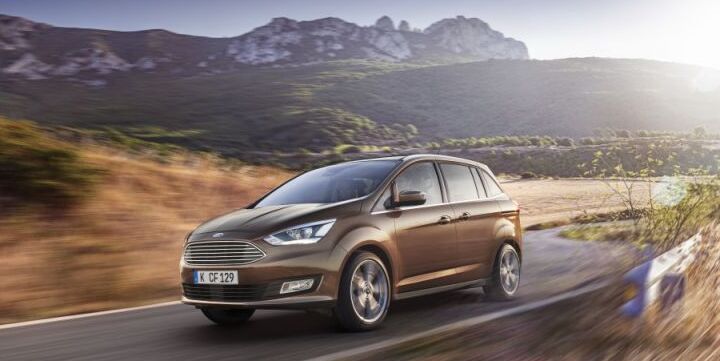
The Ford Grand C-MAX (facelift, introduced in April 2015 and produced through June 2019) offered a versatile and practical MPV (Multi-Purpose Vehicle) option for families in the European market. This particular variant, the 1.5 TDCi with 95 horsepower and seven-seat configuration, represented an entry-level powertrain choice within the Grand C-MAX lineup. Positioned as a fuel-efficient and affordable option, it catered to buyers prioritizing practicality and lower running costs over outright performance. The facelift brought styling updates and revised technology compared to the pre-2015 models, enhancing its appeal in a competitive segment.
Technical Specifications
| Brand | Ford |
| Model | C-MAX |
| Generation | Grand C-MAX (facelift 2015) |
| Type (Engine) | 1.5 TDCi (95 Hp) 7 Seat |
| Start of production | April, 2015 |
| End of production | June, 2019 |
| Powertrain Architecture | Internal Combustion engine |
| Body type | MPV |
| Seats | 7 |
| Doors | 5 |
| Fuel consumption (urban) | 5.3 l/100 km (44.4 US mpg, 53.3 UK mpg, 18.9 km/l) |
| Fuel consumption (extra urban) | 4.1 l/100 km (57.4 US mpg, 68.9 UK mpg, 24.4 km/l) |
| Fuel consumption (combined) | 4.6 l/100 km (51.1 US mpg, 61.4 UK mpg, 21.7 km/l) |
| CO2 emissions | 118 g/km |
| Fuel Type | Diesel |
| Acceleration 0 – 100 km/h | 14.4 sec |
| Acceleration 0 – 62 mph | 14.4 sec |
| Acceleration 0 – 60 mph | 13.7 sec |
| Maximum speed | 166 km/h (103.15 mph) |
| Emission standard | Euro 6 |
| Weight-to-power ratio | 15 kg/Hp, 66.6 Hp/tonne |
| Weight-to-torque ratio | 5.3 kg/Nm, 189.3 Nm/tonne |
| Power | 95 Hp @ 3600 rpm |
| Power per litre | 63.4 Hp/l |
| Torque | 270 Nm @ 1500-2000 rpm (199.14 lb.-ft. @ 1500-2000 rpm) |
| Engine layout | Front, Transverse |
| Engine Model/Code | XXDA, XXDC, XXDD |
| Engine displacement | 1499 cm3 (91.47 cu. in.) |
| Number of cylinders | 4 |
| Engine configuration | Inline |
| Cylinder Bore | 73.5 mm (2.89 in.) |
| Piston Stroke | 88.3 mm (3.48 in.) |
| Compression ratio | 16:1 |
| Number of valves per cylinder | 2 |
| Fuel injection system | Diesel Commonrail |
| Engine aspiration | Turbocharger, Intercooler |
| Valvetrain | SOHC |
| Engine oil capacity | 3.85 l (4.07 US qt | 3.39 UK qt) |
| Coolant capacity | 7.3 l (7.71 US qt | 6.42 UK qt) |
| Kerb Weight | 1426 kg (3143.79 lbs.) |
| Max. weight | 2225 kg (4905.29 lbs.) |
| Max load | 799 kg (1761.49 lbs.) |
| Trunk (boot) space – minimum | 65 l (2.3 cu. ft.) |
| Trunk (boot) space – maximum | 1715 l (60.56 cu. ft.) |
| Fuel tank capacity | 60 l (15.85 US gal | 13.2 UK gal) |
| Max. roof load | 75 kg (165.35 lbs.) |
| Permitted trailer load with brakes (12%) | 1200 kg (2645.55 lbs.) |
| Permitted trailer load without brakes | 750 kg (1653.47 lbs.) |
| Permitted towbar download | 75 kg (165.35 lbs.) |
| Length | 4519 mm (177.91 in.) |
| Width | 1828 mm (71.97 in.) |
| Width with mirrors folded | 1858 mm (73.15 in.) |
| Width including mirrors | 2067 mm (81.38 in.) |
| Height | 1642 mm (64.65 in.) |
| Wheelbase | 2788 mm (109.76 in.) |
| Front track | 1557 mm (61.3 in.) |
| Rear track | 1569 mm (61.77 in.) |
| Minimum turning circle | 11.6 m (38.06 ft.) |
| Drivetrain | Front wheel drive |
| Number of gears | 6 |
| Gearbox type | Manual transmission |
| Front suspension | Independent, McPherson with coil spring and anti-roll bar |
| Rear suspension | Independent multi-link spring suspension with stabilizer |
| Front brakes | Ventilated discs, 300×25 mm |
| Rear brakes | Disc, 280×11 mm |
| Assisting systems | ABS (Anti-lock braking system) |
| Steering type | Steering rack and pinion |
| Power steering | Electric |
| Tires size | 205/55 R16; 215/55 R16; 215/50 R17; 235/40 R18 |
| Wheel rims size | 6.5J x 16; 7J x 16; 7J x 17; 8J x 18 |
INTRODUCTION
The Ford Grand C-MAX facelift, launched in 2015, built upon the success of the original C-MAX and Grand C-MAX models, offering increased space and practicality for growing families. The 1.5 TDCi 95 horsepower, seven-seat variant was a key component of the range, designed to appeal to budget-conscious buyers who still required the versatility of a seven-seater. It falls within the second generation of the C-MAX, utilizing the Ford C-platform (also known as the 1HX0/A3 platform). This platform underpinned several Ford and other manufacturers’ vehicles, allowing for economies of scale and shared componentry. The facelift brought revised front-end styling, updated interior materials, and improvements to the infotainment system.
Powertrain & Engine Architecture
The heart of this Grand C-MAX variant is the 1.5-liter Duratorq TDCi diesel engine. Ford’s 1.5 TDCi engine family (engine codes XXDA, XXDC, and XXDD being common) represented a move towards smaller displacement, more efficient diesel engines. This four-cylinder engine utilizes a common-rail direct fuel injection system, delivering fuel directly into the combustion chamber at extremely high pressure for improved combustion and reduced emissions. The engine features a single overhead camshaft (SOHC) valvetrain operating two valves per cylinder. A turbocharger with an intercooler is employed to boost power and torque, providing 95 horsepower at 3600 rpm and 270 Nm (199 lb-ft) of torque between 1500 and 2000 rpm. The engine is transversely mounted at the front of the vehicle. The transmission is a six-speed manual gearbox, chosen for its fuel efficiency and affordability. While an automatic transmission was offered on other C-MAX variants, it wasn’t typically paired with this specific 95 hp engine.
Driving Characteristics
The 1.5 TDCi 95 hp engine, coupled with the six-speed manual transmission, provides adequate, but not exhilarating, performance. Acceleration from 0-60 mph takes around 13.7 seconds, and top speed is limited to 103.15 mph. The engine’s strength lies in its low-end torque, making it reasonably responsive for everyday driving situations. However, overtaking maneuvers require careful planning. The gear ratios are tuned for fuel economy, meaning the engine can feel strained when pushed hard. Compared to higher-output C-MAX variants, such as those with the 1.6 EcoBoost petrol engine or the more powerful 2.0 TDCi diesel, this version feels noticeably slower. The manual transmission allows for greater driver control, but requires more driver involvement than an automatic.
Equipment & Trim Levels
The 1.5 TDCi 95 hp Grand C-MAX typically came equipped with a reasonable level of standard features. These included air conditioning, power windows, power mirrors, a basic audio system with USB connectivity, and alloy wheels. Safety features such as ABS, electronic stability control, and multiple airbags were also standard. Higher trim levels, such as Titanium, offered additional features like automatic climate control, rear parking sensors, a larger touchscreen infotainment system, and upgraded interior trim. Optional extras included a panoramic sunroof, leather upholstery, and a navigation system.
Chassis & Braking
The Grand C-MAX utilizes an independent front suspension with McPherson struts and a coil spring, coupled with an independent multi-link rear suspension. This setup provides a comfortable ride quality, absorbing bumps and imperfections in the road surface effectively. A stabilizer bar is fitted to both the front and rear axles to reduce body roll during cornering. The braking system consists of ventilated discs on the front wheels (300x25mm) and solid discs on the rear wheels (280x11mm). ABS (Anti-lock Braking System) is standard, providing enhanced braking performance and stability.
Market Reception & Comparison
The 1.5 TDCi 95 hp Grand C-MAX was generally well-received by critics as a practical and economical family vehicle. Its fuel economy figures of around 51.1 US mpg combined were a major selling point. However, some reviewers noted its lack of outright performance. Compared to the 1.6 EcoBoost petrol variants, the diesel offered superior fuel economy but less power. The 2.0 TDCi diesel provided significantly more performance but came at a higher price point. The 1.5 TDCi was often seen as the sweet spot for buyers prioritizing running costs and practicality.
Legacy
The Ford 1.5 TDCi engine has proven to be a relatively reliable unit, although, like all diesel engines, it is susceptible to issues related to the diesel particulate filter (DPF) if not properly maintained. Regular servicing and the use of high-quality diesel fuel are crucial for ensuring long-term reliability. In the used car market, the 1.5 TDCi Grand C-MAX represents a good value proposition for buyers seeking an affordable and spacious MPV. Its fuel efficiency and practicality continue to make it a popular choice for families. However, potential buyers should be aware of the potential for DPF-related issues and ensure a thorough inspection before purchase.