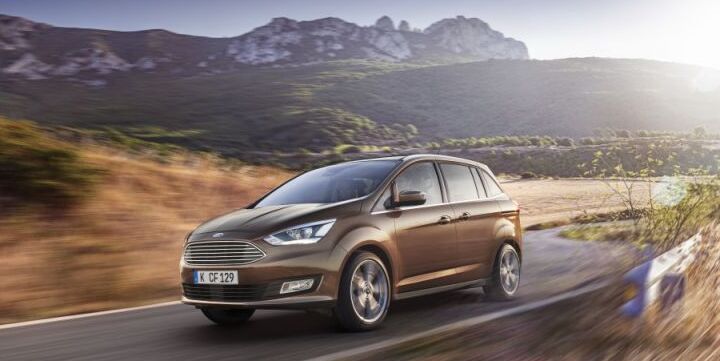
The Ford Grand C-MAX (facelift, introduced in 2015) 1.6 Ti-VCT 120 horsepower, 7-seat configuration represents a practical and versatile option within the compact MPV (Multi-Purpose Vehicle) segment. Produced from 2015 to 2019, this variant aimed to provide family-oriented transportation with a focus on fuel efficiency and affordability. It builds upon the original Grand C-MAX, benefiting from styling updates and technological enhancements introduced with the facelift. This model occupied a mid-range position in the Grand C-MAX lineup, offering a balance between performance, economy, and practicality, slotting below the more powerful EcoBoost variants and above the lower-spec base models.
Technical Specifications
| Brand | Ford |
| Model | C-MAX |
| Generation | Grand C-MAX (facelift 2015) |
| Type (Engine) | 1.6 Ti-VCT (120 Hp) 7 Seat |
| Start of production | 2015 |
| End of production | 2019 |
| Powertrain Architecture | Internal Combustion engine |
| Body type | MPV |
| Seats | 7 |
| Doors | 5 |
| Fuel consumption (urban) | 8.6 l/100 km (27.4 US mpg, 32.8 UK mpg, 11.6 km/l) |
| Fuel consumption (extra urban) | 5.5 l/100 km (42.8 US mpg, 51.4 UK mpg, 18.2 km/l) |
| Fuel consumption (combined) | 6.7 l/100 km (35.1 US mpg, 42.2 UK mpg, 14.9 km/l) |
| CO2 emissions | 154 g/km |
| Fuel Type | Petrol (Gasoline) |
| Acceleration 0 – 100 km/h | 12.3 sec |
| Acceleration 0 – 62 mph | 12.3 sec |
| Acceleration 0 – 60 mph | 11.7 sec |
| Maximum speed | 182 km/h (113.09 mph) |
| Emission standard | Euro 6 |
| Weight-to-power ratio | 11.7 kg/Hp, 85.6 Hp/tonne |
| Weight-to-torque ratio | 8.8 kg/Nm, 113.4 Nm/tonne |
| Power | 120 Hp @ 6000 rpm |
| Power per litre | 75.2 Hp/l |
| Torque | 159 Nm @ 4000 rpm (117.27 lb.-ft. @ 4000 rpm) |
| Engine layout | Front, Transverse |
| Engine Model/Code | MUDA, MUDD |
| Engine displacement | 1596 cm3 (97.39 cu. in.) |
| Number of cylinders | 4 |
| Engine configuration | Inline |
| Cylinder Bore | 79 mm (3.11 in.) |
| Piston Stroke | 81.4 mm (3.2 in.) |
| Compression ratio | 11:1 |
| Number of valves per cylinder | 4 |
| Fuel injection system | Multi-port manifold injection |
| Engine aspiration | Naturally aspirated engine |
| Valvetrain | DOHC |
| Engine oil capacity | 4.1 l (4.33 US qt | 3.61 UK qt) |
| Coolant capacity | 5.7 l (6.02 US qt | 5.02 UK qt) |
| Kerb Weight | 1402 kg (3090.88 lbs.) |
| Max. weight | 2135 kg (4706.87 lbs.) |
| Max load | 733 kg (1615.99 lbs.) |
| Trunk (boot) space – minimum | 65 l (2.3 cu. ft.) |
| Trunk (boot) space – maximum | 1715 l (60.56 cu. ft.) |
| Fuel tank capacity | 60 l (15.85 US gal | 13.2 UK gal) |
| Max. roof load | 75 kg (165.35 lbs.) |
| Permitted trailer load with brakes (12%) | 750 kg (1653.47 lbs.) |
| Permitted trailer load without brakes | 735 kg (1620.4 lbs.) |
| Permitted towbar download | 75 kg (165.35 lbs.) |
| Length | 4519 mm (177.91 in.) |
| Width | 1828 mm (71.97 in.) |
| Width with mirrors folded | 1858 mm (73.15 in.) |
| Width including mirrors | 2067 mm (81.38 in.) |
| Height | 1642 mm (64.65 in.) |
| Wheelbase | 2788 mm (109.76 in.) |
| Front track | 1557 mm (61.3 in.) |
| Rear (Back) track | 1569 mm (61.77 in.) |
| Minimum turning circle | 11.6 m (38.06 ft.) |
| Drivetrain | Front wheel drive |
| Number of gears and type of gearbox | 6 gears, manual transmission |
| Front suspension | Independent, type McPherson with coil spring and anti-roll bar |
| Rear suspension | Independent multi-link spring suspension with stabilizer |
| Front brakes | Ventilated discs, 300×25 mm |
| Rear brakes | Disc, 280×11 mm |
| Assisting systems | ABS (Anti-lock braking system) |
| Steering type | Steering rack and pinion |
| Power steering | Electric Steering |
| Tires size | 205/55 R16; 215/55 R16; 215/50 R17; 235/40 R18 |
| Wheel rims size | 6.5J x 16; 7J x 16; 7J x 17; 8J x 18 |
Powertrain & Engine Architecture
The 1.6-liter Ti-VCT engine, identified by engine codes MUDA or MUDD, is a naturally aspirated inline-four cylinder gasoline engine. “Ti-VCT” stands for Twin Independent Variable Camshaft Timing, a key feature that optimizes engine breathing for improved performance and fuel efficiency. The engine utilizes multi-port fuel injection, delivering fuel directly into the intake manifold. The valvetrain employs a double overhead camshaft (DOHC) design, further enhancing valve control. This engine is known for its relatively simple design and robust construction. The 6-speed manual transmission was standard, providing a good balance between fuel economy and driver engagement. The transmission’s gear ratios were tuned for everyday driving, prioritizing smooth shifts and reasonable acceleration rather than outright performance.
Driving Characteristics
The 120 horsepower output, coupled with the 6-speed manual transmission, provided adequate, though not exhilarating, performance. Acceleration from 0-60 mph took around 11.7 seconds, making it suitable for urban and highway driving, but not ideal for spirited driving. The engine delivered its peak torque of 159 Nm (117.27 lb-ft) at 4000 rpm, meaning drivers needed to rev the engine to access its full potential. Compared to the more powerful EcoBoost variants, this 1.6 Ti-VCT felt noticeably less responsive, particularly during overtaking maneuvers. However, it offered a smoother and more linear power delivery than the diesel options, and the manual transmission allowed for greater driver control.
Equipment & Trim Levels
The 1.6 Ti-VCT 7-seat Grand C-MAX typically came equipped with features such as air conditioning, power windows, power mirrors, a basic audio system with USB connectivity, and ABS brakes. Higher trim levels added features like alloy wheels, rear parking sensors, cruise control, and a more advanced infotainment system. Interior upholstery was typically cloth, with options for upgraded materials on higher trims. The seven-seat configuration offered flexibility for families, with the third-row seats folding flat to maximize cargo space when not in use.
Chassis & Braking
The Grand C-MAX featured an independent McPherson strut suspension at the front and an independent multi-link suspension at the rear, providing a comfortable ride quality. Stabilizer bars were fitted to both axles to reduce body roll during cornering. The braking system consisted of ventilated discs at the front and solid discs at the rear. ABS (Anti-lock Braking System) was standard, enhancing safety during emergency braking situations. The suspension tuning was geared towards comfort and practicality, rather than sporty handling.
Market Reception & Comparison
The 1.6 Ti-VCT 7-seat Grand C-MAX was generally well-received as a practical and affordable family vehicle. Critics praised its spacious interior, versatile seating configuration, and reasonable fuel economy. However, some reviewers noted that the engine lacked the punch of its turbocharged counterparts. Compared to the 1.5 EcoBoost variants, the 1.6 Ti-VCT offered lower performance but better fuel economy. Against the diesel options, it provided a smoother and quieter driving experience, but with slightly higher running costs.
Legacy
The Ford Grand C-MAX 1.6 Ti-VCT has proven to be a relatively reliable powertrain. The engine is known for its durability, and the manual transmission is generally trouble-free. Common maintenance items include regular oil changes, timing belt replacement (typically around 100,000 miles), and spark plug replacement. In the used car market, this variant represents a good value proposition for buyers seeking a spacious and practical MPV. While it may not offer the highest performance, its affordability, reliability, and fuel efficiency make it a compelling choice for families.