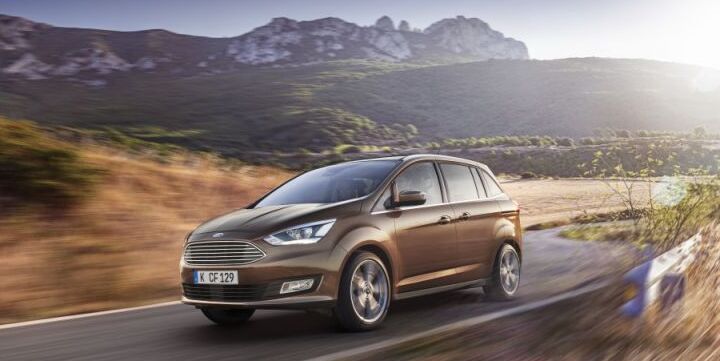
The Ford Grand C-MAX, particularly the facelifted version introduced in April 2015, represented Ford’s offering in the compact multi-purpose vehicle (MPV) segment. This variant, equipped with the 2.0 TDCi engine producing 170 horsepower and paired with the PowerShift six-speed automatic transmission, was offered through June 2019. Positioned as a mid-to-upper trim level within the Grand C-MAX range, it aimed to provide a balance of performance, fuel efficiency, and practicality for families. The facelift brought styling updates and refinements to the existing C-MAX platform (based on the Ford C-platform), enhancing its appeal in the European market where MPVs remained popular.
Technical Specifications
| Brand | Ford |
| Model | C-MAX |
| Generation | Grand C-MAX (facelift 2015) |
| Type (Engine) | 2.0 TDCi (170 Hp) PowerShift S&S |
| Start of production | April, 2015 |
| End of production | June, 2019 |
| Powertrain Architecture | Internal Combustion engine |
| Body type | MPV |
| Seats | 5 |
| Doors | 5 |
| Fuel consumption (urban) | 5.6 l/100 km (42 US mpg, 50.4 UK mpg, 17.9 km/l) |
| Fuel consumption (extra urban) | 4.6 l/100 km (51.1 US mpg, 61.4 UK mpg, 21.7 km/l) |
| Fuel consumption (combined) | 5 l/100 km (47 US mpg, 56.5 UK mpg, 20 km/l) |
| CO2 emissions | 129 g/km |
| Fuel Type | Diesel |
| Acceleration 0 – 100 km/h | 8.8 sec |
| Acceleration 0 – 62 mph | 8.8 sec |
| Acceleration 0 – 60 mph | 8.4 sec |
| Maximum speed | 209 km/h (129.87 mph) |
| Emission standard | Euro 6 |
| Weight-to-power ratio | 9 kg/Hp, 111.1 Hp/tonne |
| Weight-to-torque ratio | 3.8 kg/Nm, 261.4 Nm/tonne |
| Power | 170 Hp @ 3500 rpm |
| Power per litre | 85.1 Hp/l |
| Torque | 400 Nm @ 2000-2500 rpm (295.02 lb.-ft. @ 2000-2500 rpm) |
| Engine layout | Front, Transverse |
| Engine Model/Code | T8DE, T8DF |
| Engine displacement | 1997 cm3 (121.86 cu. in.) |
| Number of cylinders | 4 |
| Engine configuration | Inline |
| Cylinder Bore | 85 mm (3.35 in.) |
| Piston Stroke | 88 mm (3.46 in.) |
| Compression ratio | 16:1 |
| Number of valves per cylinder | 4 |
| Fuel injection system | Diesel Commonrail |
| Engine aspiration | Turbocharger, Intercooler |
| Valvetrain | DOHC |
| Engine oil capacity | 6.1 l (6.45 US qt | 5.37 UK qt) |
| Coolant capacity | 8 l (8.45 US qt | 7.04 UK qt) |
| Kerb Weight | 1530 kg (3373.07 lbs.) |
| Max. weight | 2300 kg (5070.63 lbs.) |
| Max load | 770 kg (1697.56 lbs.) |
| Trunk (boot) space – minimum | 520 l (18.36 cu. ft.) |
| Trunk (boot) space – maximum | 1787 l (63.11 cu. ft.) |
| Fuel tank capacity | 60 l (15.85 US gal | 13.2 UK gal) |
| Max. roof load | 75 kg (165.35 lbs.) |
| Permitted trailer load with brakes (12%) | 1800 kg (3968.32 lbs.) |
| Permitted trailer load without brakes | 750 kg (1653.47 lbs.) |
| Permitted towbar download | 90 kg (198.42 lbs.) |
| Length | 4519 mm (177.91 in.) |
| Width | 1828 mm (71.97 in.) |
| Width with mirrors folded | 1858 mm (73.15 in.) |
| Width including mirrors | 2067 mm (81.38 in.) |
| Height | 1642 mm (64.65 in.) |
| Wheelbase | 2788 mm (109.76 in.) |
| Front track | 1543 mm (60.75 in.) |
| Rear track | 1554 mm (61.18 in.) |
| Minimum turning circle | 11.6 m (38.06 ft.) |
| Drivetrain | Front wheel drive |
| Number of gears | 6 |
| Gearbox type | Automatic transmission PowerShift |
| Front suspension | Independent, type McPherson with coil spring and anti-roll bar |
| Rear suspension | Independent multi-link spring suspension with stabilizer |
| Front brakes | Ventilated discs, 300×25 mm |
| Rear brakes | Disc, 280×11 mm |
| Assisting systems | ABS (Anti-lock braking system) |
| Steering type | Steering rack and pinion |
| Power steering | Electric Steering |
| Tires size | 205/55 R16; 215/55 R16; 215/50 R17; 235/40 R18 |
| Wheel rims size | 6.5J x 16; 7J x 16; 7J x 17; 8J x 18 |
Powertrain & Engine Architecture
The heart of this Grand C-MAX variant is the 2.0-liter TDCi diesel engine, specifically utilizing the T8DE or T8DF engine code. This engine is a four-cylinder, inline configuration, featuring a common-rail direct fuel injection system. The common-rail system, operating at very high pressures, ensures precise fuel delivery for optimized combustion. A turbocharger with an intercooler is employed to boost power output and improve efficiency. The engine also incorporates a double overhead camshaft (DOHC) valvetrain with four valves per cylinder, enhancing breathing and contributing to the 170 horsepower peak at 3500 rpm and 400 Nm (295 lb-ft) of torque available between 2000 and 2500 rpm. The PowerShift six-speed automatic transmission is a dual-clutch transmission (DCT), offering quicker and smoother gear changes compared to a traditional torque-converter automatic. The inclusion of a Start & Stop system further contributes to fuel savings by automatically shutting off the engine when the vehicle is stationary.
Driving Characteristics
The 170 hp 2.0 TDCi with the PowerShift transmission provided a noticeable step up in performance compared to lower-powered Grand C-MAX variants. While not a sports car, it offered sufficient power for comfortable highway cruising and overtaking maneuvers. The PowerShift transmission, while generally responsive, could exhibit some hesitation at low speeds or during initial acceleration, a characteristic sometimes noted in early DCT implementations. The gear ratios were tuned for a balance between fuel economy and usability, with a relatively long final drive contributing to good MPG figures. Compared to the manual transmission versions, the PowerShift offered convenience, but some drivers preferred the more direct feel and control of the manual gearbox. The torque output made the engine feel strong in the mid-range, providing ample pulling power for a fully loaded vehicle.
Equipment & Trim Levels
The 2.0 TDCi PowerShift Grand C-MAX typically came equipped with a generous level of standard features. These included air conditioning, power windows and mirrors, a basic audio system with USB connectivity, and alloy wheels. Higher trim levels added features such as a larger touchscreen infotainment system with navigation, automatic climate control, parking sensors, and upgraded interior upholstery. Optional extras included a panoramic sunroof, leather seats, and advanced driver-assistance systems like adaptive cruise control and lane-keeping assist. Interior materials were generally of good quality for the segment, with a focus on practicality and durability.
Chassis & Braking
The Grand C-MAX utilized an independent suspension setup at all four wheels. The front suspension employed a McPherson strut design with a coil spring and anti-roll bar, while the rear featured a multi-link setup, also with a stabilizer bar. This configuration provided a comfortable ride quality and decent handling characteristics. Braking duties were handled by ventilated discs at the front and solid discs at the rear. Anti-lock Braking System (ABS) was standard. The suspension tuning was geared towards comfort rather than outright sportiness, prioritizing a smooth ride over sharp handling.
Market Reception & Comparison
The Ford Grand C-MAX 2.0 TDCi PowerShift received generally positive reviews. Critics praised its spacious interior, practical design, and fuel efficiency. The PowerShift transmission was sometimes criticized for its occasional hesitation, but overall, it was considered a competent automatic gearbox. Compared to rivals like the Volkswagen Touran and Citroën C4 Picasso, the Grand C-MAX offered a competitive package in terms of price, features, and driving experience. Fuel economy was comparable to other diesel-powered MPVs in its class, and reliability was generally considered good, although some owners reported issues with the PowerShift transmission over the long term.
Legacy
The 2.0 TDCi PowerShift powertrain, while generally reliable, has seen some reports of issues with the PowerShift dual-clutch transmission, particularly concerning clutch wear and occasional software glitches. However, many examples have proven durable with regular maintenance. On the used car market, the Grand C-MAX 2.0 TDCi PowerShift represents a practical and affordable option for families seeking a spacious and fuel-efficient MPV. Its combination of performance, practicality, and features continues to make it a viable choice, provided potential buyers are aware of the potential issues with the PowerShift transmission and ensure a thorough inspection before purchase.