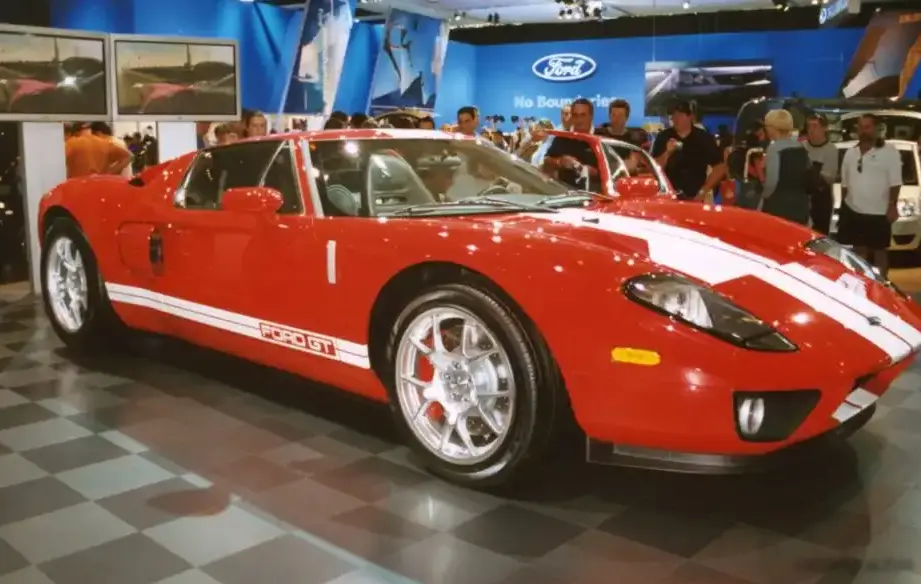
The Ford GT, specifically the 5.4 i V8 32V (507 Hp) variant, represents a modern interpretation of Ford’s legendary GT40 race cars. Produced from 2004 to 2006, this mid-engine, rear-wheel-drive coupe was a limited-production vehicle intended to evoke the spirit of the original GT40’s victories at Le Mans. It marked Ford’s re-entry into the high-performance supercar arena, competing directly with established European marques like Ferrari and Porsche. The GT was built on a dedicated platform, showcasing Ford’s engineering capabilities and design prowess. This particular 507 horsepower version was the sole engine and transmission configuration offered during its production run.
Technical Specifications
| Brand | Ford |
| Model | GT |
| Generation | GT |
| Type (Engine) | 5.4 i V8 32V (507 Hp) |
| Start of production | 2004 |
| End of production | 2006 |
| Powertrain Architecture | Internal Combustion engine |
| Body type | Coupe |
| Seats | 2 |
| Doors | 2 |
| Fuel consumption (urban) | 30 l/100 km (7.8 US mpg) |
| Fuel consumption (extra urban) | 14 l/100 km (16.8 US mpg) |
| Fuel Type | Petrol (Gasoline) |
| Acceleration 0 – 100 km/h | 3.8 sec |
| Acceleration 0 – 62 mph | 3.8 sec |
| Acceleration 0 – 60 mph | 3.6 sec |
| Maximum speed | 322 km/h (200.08 mph) |
| Weight-to-power ratio | 2.9 kg/Hp |
| Weight-to-torque ratio | 2.1 kg/Nm |
| Power | 507 Hp @ 6000 rpm |
| Power per litre | 93.7 Hp/l |
| Torque | 678 Nm @ 4500 rpm (500.07 lb.-ft. @ 4500 rpm) |
| Engine layout | Middle, Longitudinal |
| Engine Model/Code | C54SDSM |
| Engine displacement | 5409 cm3 (330.08 cu. in.) |
| Number of cylinders | 8 |
| Engine configuration | V-engine |
| Cylinder Bore | 90.2 mm (3.55 in.) |
| Piston Stroke | 105.8 mm (4.17 in.) |
| Compression ratio | 8.4:1 |
| Number of valves per cylinder | 4 |
| Fuel injection system | Multi-port manifold injection |
| Engine aspiration | Supercharger, Intercooler |
| Engine oil capacity | 9 l (9.51 US qt | 7.92 UK qt) |
| Coolant | 25 l (26.42 US qt | 22 UK qt) |
| Kerb Weight | 1450 kg (3196.7 lbs.) |
| Fuel tank capacity | 66 l (17.44 US gal | 14.52 UK gal) |
| Length | 4645 mm (182.87 in.) |
| Width | 1955 mm (76.97 in.) |
| Height | 1125 mm (44.29 in.) |
| Wheelbase | 2710 mm (106.69 in.) |
| Front track | 1600 mm (62.99 in.) |
| Rear track | 1620 mm (63.78 in.) |
| Drivetrain Architecture | Rear wheel drive |
| Number of gears | 6 |
| Gearbox type | Manual transmission |
| Front suspension | Wishbone |
| Rear suspension | Wishbone |
| Front brakes | Ventilated discs |
| Rear brakes | Ventilated discs |
| Assisting systems | ABS (Anti-lock braking system) |
| Steering type | Steering rack and pinion |
| Tires size | 235/45 ZR18; 315/40 ZR19 |
| Wheel rims size | 9J z 18; 11.5J x 19 |
Powertrain & Engine Architecture
The heart of the Ford GT is its 5.4-liter Modular V8 engine, designated the C54SDSM. This engine is a heavily modified version of the Ford Triton engine family, but significantly upgraded for high performance. The key enhancement is a Lysholm twin-screw supercharger, providing forced induction and boosting power output. The engine features a cast-iron block with aluminum cylinder heads, four valves per cylinder, and a multi-port fuel injection system. The supercharger is intercooled to reduce intake air temperature, further enhancing performance. The 6-speed manual transmission was sourced from Ricardo, a British engineering firm, and specifically designed to handle the engine’s substantial torque. The transmission features a limited-slip differential to optimize traction during acceleration.
Driving Characteristics
The Ford GT delivers a raw and visceral driving experience. The supercharged V8 provides immediate throttle response and a relentless surge of power throughout the rev range. Acceleration is breathtaking, with 0-60 mph times consistently in the mid-3-second range. The manual transmission requires a firm hand and precise shifts, contributing to the engaging driving feel. The relatively short wheelbase and stiff chassis contribute to sharp handling and excellent cornering ability. Compared to a hypothetical GT with a naturally aspirated engine, the supercharged version offers significantly more low-end torque, making it more tractable in everyday driving situations, despite its focus on performance. While not as refined as some contemporary supercars, the GT’s direct and unfiltered driving experience is a key part of its appeal.
Equipment & Trim Levels
Given its limited production and focus on performance, the Ford GT offered a relatively sparse options list. Standard equipment included air conditioning, a premium sound system, leather upholstery, and power-adjustable seats. Optional extras were limited to stripes, different wheel finishes, and upgraded interior trim packages. The interior design was functional and driver-focused, with a simple dashboard layout and aluminum accents. The GT did not offer many of the luxury features found in other supercars of the era, prioritizing weight reduction and performance over creature comforts.
Chassis & Braking
The Ford GT utilizes a space frame chassis constructed from aluminum, providing a rigid and lightweight platform. The suspension features independent double wishbone setups at both the front and rear, with coil springs and adjustable dampers. Braking duties are handled by ventilated disc brakes at all four corners, equipped with ABS. The braking system is robust and provides excellent stopping power, essential for a car of this performance level. The GT’s relatively low weight (around 3200 lbs) contributes to its agility and handling prowess.
Market Reception & Comparison
The Ford GT was widely praised by automotive critics for its performance, handling, and retro-inspired design. It was seen as a successful revival of a legendary nameplate and a bold statement from Ford. However, some critics noted its relatively harsh ride quality and limited practicality. Compared to other supercars of the time, such as the Porsche 911 Turbo or Ferrari 360, the GT offered a more raw and visceral driving experience at a competitive price point. Fuel economy was predictably poor, reflecting the car’s high-performance nature. Reliability was generally good, although the supercharger and complex engine management system required careful maintenance.
Legacy
The Ford GT has become a highly sought-after collector’s car. Its limited production run and iconic status have driven up values significantly in the used car market. The powertrain, while powerful, is known to require diligent maintenance, particularly regarding the supercharger and cooling system. The 5.4-liter Modular V8, while robust, can be susceptible to issues if not properly cared for. Despite these potential maintenance concerns, the Ford GT remains a highly desirable and rewarding vehicle for enthusiasts who appreciate its unique blend of performance, heritage, and American muscle.