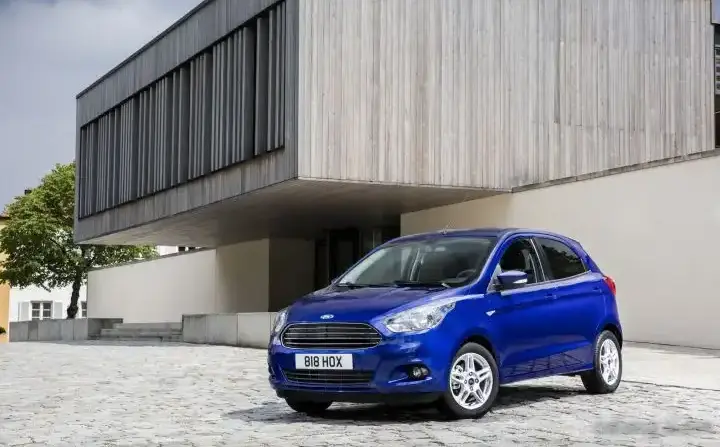
The Ford KA+ 1.2 Ti-VCT (70 hp) was a subcompact hatchback produced by Ford between 2016 and 2018, primarily aimed at the European market. It represented an entry-level offering within the broader KA+ range, positioned as a budget-friendly and practical city car. This variant utilized Ford’s 1.2-liter Ti-VCT three-cylinder engine paired with a five-speed manual transmission. It was designed to appeal to buyers seeking low running costs and ease of maneuverability in urban environments. The KA+ itself was a significant model for Ford, representing a return to the subcompact segment after the original KA was discontinued.
Technical Specifications
| Brand | Ford |
| Model | KA |
| Generation | KA+ |
| Type (Engine) | 1.2 Ti-VCT (70 Hp) |
| Start of production | 2016 |
| End of production | 2018 |
| Powertrain Architecture | Internal Combustion engine |
| Body type | Hatchback |
| Seats | 5 |
| Doors | 5 |
| Fuel consumption (urban) | 6.6 l/100 km (35.6 US mpg, 42.8 UK mpg, 15.2 km/l) |
| Fuel consumption (extra urban) | 4 l/100 km (58.8 US mpg, 70.6 UK mpg, 25 km/l) |
| Fuel consumption (combined) | 5 l/100 km (47 US mpg, 56.5 UK mpg, 20 km/l) |
| CO2 emissions | 114 g/km |
| Fuel Type | Petrol (Gasoline) |
| Acceleration 0 – 100 km/h | 15.3 sec |
| Acceleration 0 – 62 mph | 15.3 sec |
| Acceleration 0 – 60 mph | 14.5 sec |
| Maximum speed | 159 km/h (98.8 mph) |
| Emission standard | Euro 6 |
| Weight-to-power ratio | 13.3 kg/Hp, 74.9 Hp/tonne |
| Weight-to-torque ratio | 8.9 kg/Nm, 112.4 Nm/tonne |
| Power | 70 Hp @ 6000 rpm |
| Power per litre | 58.5 Hp/l |
| Torque | 105 Nm @ 4000 rpm (77.44 lb.-ft. @ 4000 rpm) |
| Engine layout | Front, Transverse |
| Engine Model/Code | B2KA |
| Engine displacement | 1196 cm3 (72.98 cu. in.) |
| Number of cylinders | 4 |
| Engine configuration | Inline |
| Number of valves per cylinder | 4 |
| Fuel injection system | Multi-port manifold injection |
| Engine aspiration | Naturally aspirated engine |
| Engine oil capacity | 4.05 l (4.28 US qt, 3.56 UK qt) |
| Coolant capacity | 6.3 l (6.66 US qt, 5.54 UK qt) |
| Kerb Weight | 934 kg (2059.12 lbs) |
| Trunk (boot) space – minimum | 270 l (9.53 cu. ft) |
| Fuel tank capacity | 42 l (11.1 US gal, 9.24 UK gal) |
| Length | 3929 mm (154.69 in) |
| Width | 1695 mm (66.73 in) |
| Height | 1524 mm (60 in) |
| Wheelbase | 2489 mm (97.99 in) |
| Drivetrain Architecture | Front wheel drive |
| Number of gears and type of gearbox | 5 gears, manual transmission |
| Front suspension | Independent, type McPherson with coil spring and anti-roll bar |
| Rear suspension | Semi-independent, coil spring |
| Front brakes | Ventilated discs |
| Rear brakes | Drum |
| Assisting systems | ABS (Anti-lock braking system) |
| Steering type | Steering rack and pinion |
| Power steering | Electric Steering |
| Tires size | 195/55 R15 |
| Wheel rims size | 15 |
Powertrain & Engine Architecture
The heart of the KA+ 1.2 Ti-VCT was Ford’s B2KA engine, a 1.2-liter inline-four cylinder petrol engine. This engine belonged to the Ti-VCT (Twin Independent Variable Camshaft Timing) family, designed to balance fuel efficiency with adequate performance. The Ti-VCT system allowed for independent control of intake and exhaust valve timing, optimizing engine breathing across a wider range of engine speeds. The engine utilized a multi-point fuel injection system, delivering fuel directly into the intake ports. The B2KA engine produced 70 horsepower at 6000 rpm and 105 Nm (77.44 lb-ft) of torque at 4000 rpm. This power was delivered to the front wheels through a standard five-speed manual transmission. The engine’s relatively simple design contributed to its reliability and ease of maintenance.
Driving Characteristics
The 1.2 Ti-VCT engine in the KA+ provided adequate, though not exhilarating, performance. Acceleration from 0-60 mph took around 14.5 seconds, and the top speed was approximately 98.8 mph. The five-speed manual transmission was well-matched to the engine’s characteristics, offering a reasonable spread of gears for both city driving and highway cruising. However, the engine felt strained when fully loaded or attempting brisk acceleration. Compared to potential higher-spec KA+ models (had they been offered with larger engines), this variant prioritized fuel economy over outright performance. The gear ratios were tuned for efficiency, resulting in a slightly ‘geared-up’ feel, meaning the engine speed was relatively low at highway speeds. This contributed to quieter cruising but required more frequent downshifts when overtaking.
Equipment & Trim Levels
The KA+ 1.2 Ti-VCT typically came with a fairly basic level of standard equipment, reflecting its position as an entry-level model. Standard features generally included power steering, ABS brakes, a driver’s airbag, and electric front windows. Interior upholstery was typically cloth, and the dashboard featured a simple, functional design. Optional extras could include air conditioning, a radio/CD player, and central locking. Higher trim levels, if available, might have added features like alloy wheels, body-colored door mirrors and handles, and upgraded interior trim. The focus was on providing essential features at an affordable price point.
Chassis & Braking
The KA+ utilized a McPherson strut front suspension and a semi-independent coil spring rear suspension. This setup provided a comfortable ride quality, particularly on smoother roads. The front brakes were ventilated discs, offering adequate stopping power, while the rear brakes were drums. The steering was electrically assisted, providing light and easy steering feel, ideal for maneuvering in tight urban spaces. The car’s relatively light weight (934 kg or 2059.12 lbs) helped to compensate for the modest engine power, contributing to reasonable handling characteristics. Stabilizer bars were included to reduce body roll during cornering.
Market Reception & Comparison
The Ford KA+ 1.2 Ti-VCT was generally well-received as a practical and affordable city car. Critics praised its low running costs, ease of driving, and surprisingly spacious interior for its size. However, the engine’s lack of power was a common criticism, particularly when compared to competitors offering more powerful engines. In terms of fuel economy, the KA+ 1.2 Ti-VCT offered competitive figures, achieving around 47 US mpg on the combined cycle. Reliability was generally good, with the Ti-VCT engine proving to be a durable unit. Compared to other trims within the KA+ range (if offered), this variant represented the most budget-friendly option, appealing to buyers prioritizing affordability over performance.
Legacy
The Ford KA+ 1.2 Ti-VCT has established a reputation as a reliable and economical used car. The 1.2 Ti-VCT engine is known for its durability, and maintenance costs are relatively low. Parts availability is generally good, as the engine was used in several other Ford models. While not a performance car, the KA+ 1.2 Ti-VCT remains a practical choice for buyers seeking a small, affordable, and fuel-efficient hatchback for city driving. Its simple design and robust engine contribute to its continued appeal in the used car market.