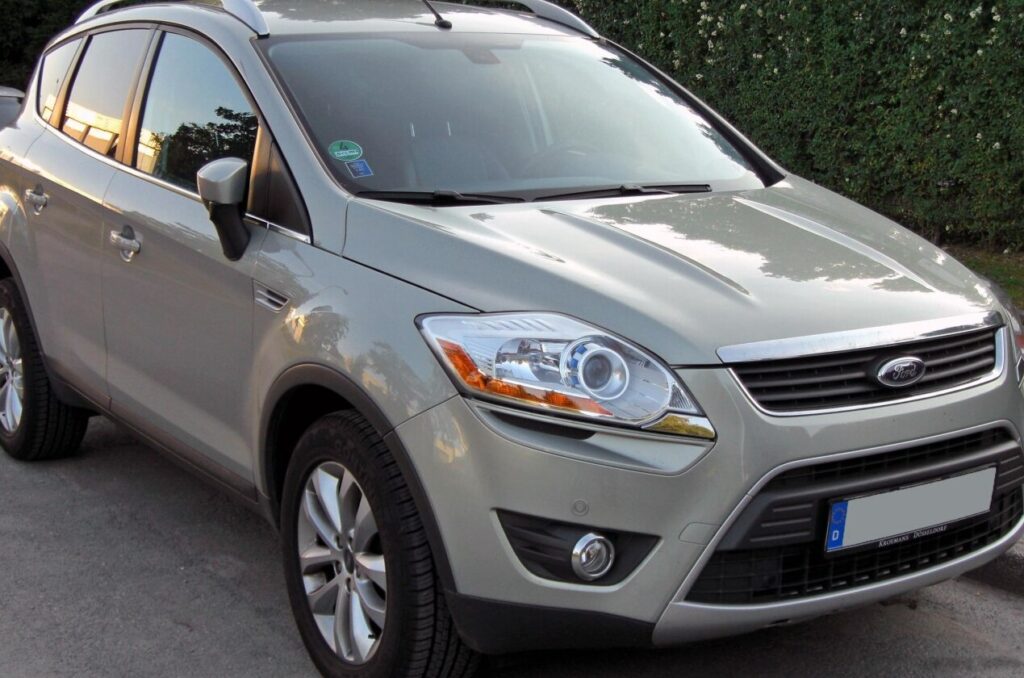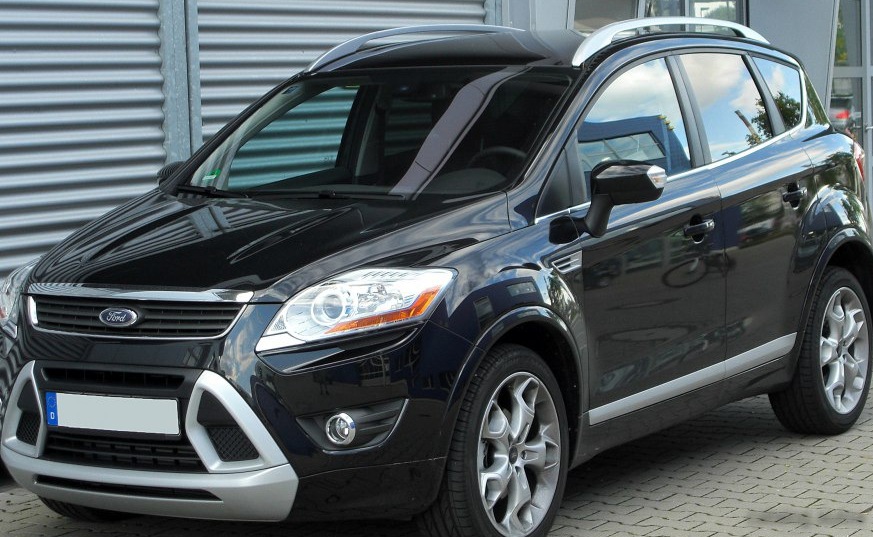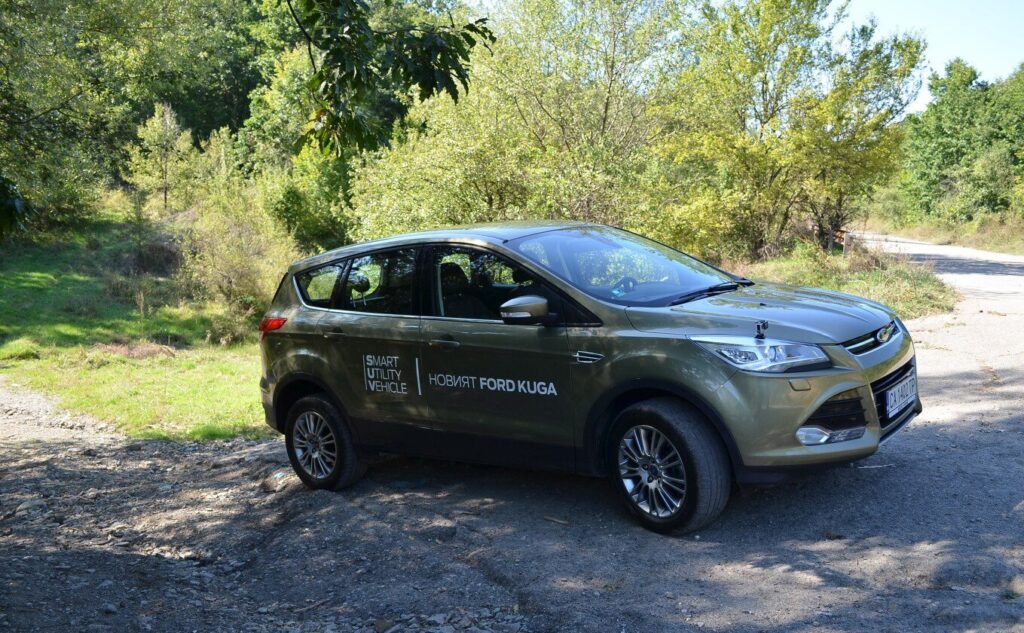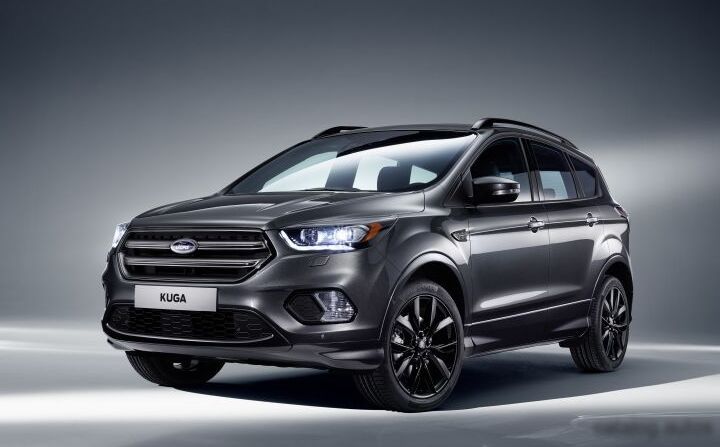
The Ford Kuga II (facelift, produced 2016-2018) 1.5 EcoBoost 182 horsepower all-wheel drive automatic represents a significant iteration of Ford’s popular compact SUV, aimed at the European and increasingly, the North American market. Introduced as part of a mid-cycle refresh, this variant offered a balance of performance, fuel efficiency, and practicality within the Kuga II range, which itself was based on the global Ford C-segment platform (also known as the 1HX0/A3 platform). Positioned as a mid-range offering, it slotted between the lower-powered 1.5 EcoBoost variants and the more expensive, higher-performance options.
Technical Specifications
| Brand | Ford |
| Model | Kuga |
| Generation | Kuga II (facelift 2016) |
| Type (Engine) | 1.5 EcoBoost (182 Hp) 4×4 Automatic |
| Start of production | 2016 |
| End of production | 2018 |
| Powertrain Architecture | Internal Combustion engine |
| Body type | SUV |
| Seats | 5 |
| Doors | 5 |
| Fuel consumption (urban) | 9.4 l/100 km (25 US mpg, 30.1 UK mpg, 10.6 km/l) |
| Fuel consumption (extra urban) | 6.3 l/100 km (37.3 US mpg, 44.8 UK mpg, 15.9 km/l) |
| Fuel consumption (combined) | 7.5 l/100 km (31.4 US mpg, 37.7 UK mpg, 13.3 km/l) |
| CO2 emissions | 173 g/km |
| Fuel Type | Petrol (Gasoline) |
| Acceleration 0 – 100 km/h | 10.1 sec |
| Acceleration 0 – 62 mph | 10.1 sec |
| Acceleration 0 – 60 mph | 9.6 sec |
| Maximum speed | 200 km/h (124.27 mph) |
| Emission standard | Euro 6 |
| Weight-to-power ratio | 9.3 kg/Hp, 107.9 Hp/tonne |
| Weight-to-torque ratio | 7 kg/Nm, 142.3 Nm/tonne |
| Power | 182 Hp @ 6000 rpm |
| Power per litre | 121.5 Hp/l |
| Torque | 240 Nm @ 1600-5000 rpm (177.01 lb.-ft. @ 1600-5000 rpm) |
| Engine layout | Front, Transverse |
| Engine Model/Code | M9MA, M9MB, M9MC |
| Engine displacement | 1498 cm3 (91.41 cu. in.) |
| Number of cylinders | 4 |
| Engine configuration | Inline |
| Cylinder Bore | 79 mm (3.11 in.) |
| Piston Stroke | 76.4 mm (3.01 in.) |
| Compression ratio | 10:1 |
| Number of valves per cylinder | 4 |
| Fuel injection system | Direct injection |
| Engine aspiration | Turbocharger, Intercooler |
| Valvetrain | DOHC |
| Engine oil capacity | 4.05 l (4.28 US qt | 3.56 UK qt) |
| Coolant | 9.5 l (10.04 US qt | 8.36 UK qt) |
| Kerb Weight | 1686 kg (3716.99 lbs.) |
| Max. weight | 2200 kg (4850.17 lbs.) |
| Max load | 514 kg (1133.18 lbs.) |
| Trunk (boot) space – minimum | 456 l (16.1 cu. ft.) |
| Trunk (boot) space – maximum | 1603 l (56.61 cu. ft.) |
| Fuel tank capacity | 60 l (15.85 US gal | 13.2 UK gal) |
| Max. roof load | 75 kg (165.35 lbs.) |
| Permitted trailer load with brakes (12%) | 1850 kg (4078.55 lbs.) |
| Permitted trailer load without brakes | 750 kg (1653.47 lbs.) |
| Permitted towbar download | 100 kg (220.46 lbs.) |
| Length | 4531 mm (178.39 in.) |
| Width | 1838 mm (72.36 in.) |
| Width with mirrors folded | 1911 mm (75.24 in.) |
| Width including mirrors | 2086 mm (82.13 in.) |
| Height | 1703 mm (67.05 in.) |
| Wheelbase | 2690 mm (105.91 in.) |
| Front track | 1573 mm (61.93 in.) |
| Rear (Back) track | 1583 mm (62.32 in.) |
| Minimum turning circle | 11.1 m (36.42 ft.) |
| Drive wheel | All wheel drive (4×4) |
| Number of gears and type of gearbox | 6 gears, automatic transmission |
| Front suspension | Independent type McPherson |
| Rear suspension | Independent multi-link suspension |
| Front brakes | Ventilated discs |
| Rear brakes | Disc |
| Assisting systems | ABS (Anti-lock braking system) |
| Steering type | Steering rack and pinion |
| Power steering | Electric Steering |
| Tires size | 235/50 R18 |
| Wheel rims size | 7.5 J x 18 |
Powertrain & Engine Architecture
The heart of this Kuga variant is the 1.5-liter EcoBoost inline-four cylinder engine, specifically utilizing engine codes M9MA, M9MB, or M9MC depending on the specific market and calibration. This engine is a member of Ford’s EcoBoost family, characterized by direct fuel injection and turbocharging. The 1.5L engine employs a twin-scroll turbocharger to minimize turbo lag and improve responsiveness. The engine features a 10:1 compression ratio and a double overhead camshaft (DOHC) valvetrain with four valves per cylinder. The fuel system utilizes Ford’s high-pressure direct injection technology, optimizing fuel atomization for improved combustion efficiency. Paired with the engine is a six-speed automatic transmission, chosen for its smooth operation and ease of use, catering to a broader customer base than the available manual transmission. The automatic transmission is designed to work seamlessly with the engine’s torque curve, providing adequate acceleration and drivability.
Driving Characteristics
The 182 hp, all-wheel-drive Kuga II offers a comfortable and capable driving experience. Acceleration from 0-60 mph takes approximately 9.6 seconds, which is respectable for a compact SUV, but noticeably slower than the higher-powered 2.0-liter EcoBoost variants. The automatic transmission provides smooth gear changes, although it can sometimes feel hesitant during quick overtaking maneuvers. The all-wheel-drive system provides enhanced traction in various weather conditions, making it a practical choice for drivers in regions with inclement weather. The gear ratios are tuned for a balance of fuel economy and performance, prioritizing mid-range torque over outright acceleration. Compared to the manual transmission versions, the automatic offers convenience but sacrifices some driver engagement and fuel efficiency.
Equipment & Trim Levels
The 1.5 EcoBoost 182 hp 4×4 Automatic Kuga II typically came equipped with a reasonable level of standard features. These included air conditioning, power windows and mirrors, a basic audio system with USB connectivity, and alloy wheels. Higher trim levels, such as Titanium, added features like leather upholstery, a larger touchscreen infotainment system with navigation, parking sensors, and a rearview camera. Optional extras included a panoramic sunroof, heated seats, and advanced driver-assistance systems like adaptive cruise control and lane-keeping assist.
Chassis & Braking
The Kuga II utilizes an independent McPherson strut suspension at the front and an independent multi-link suspension at the rear, providing a comfortable ride and good handling characteristics. The all-wheel-drive system employs a clutch-based system to distribute torque between the front and rear axles as needed. Braking duties are handled by ventilated discs at the front and solid discs at the rear, equipped with ABS (Anti-lock Braking System). The suspension tuning is geared towards comfort, with a focus on absorbing bumps and providing a stable ride. Stabilizer bars are fitted to both the front and rear axles to reduce body roll during cornering.
Market Reception & Comparison
The 1.5 EcoBoost 182 hp 4×4 Automatic Kuga II was generally well-received by automotive critics. It was praised for its comfortable ride, spacious interior, and practical all-wheel-drive system. However, some reviewers noted that the engine could feel underpowered when fully loaded or tackling steep hills. Compared to the 1.5 EcoBoost variants with lower horsepower, this version offered a noticeable performance improvement. Compared to the 2.0-liter EcoBoost models, it provided a more affordable entry point into the Kuga II range, albeit with a trade-off in performance. Fuel economy was considered average for its class, with combined figures around 31.4 US mpg.
Legacy
The 1.5 EcoBoost engine, while generally reliable, has been known to exhibit some issues with timing belt durability and potential carbon buildup on the intake valves. Regular maintenance, including timely oil changes and the use of quality fuel, is crucial for ensuring long-term reliability. The six-speed automatic transmission has proven to be relatively robust, but like any automatic, it requires regular fluid changes. In the used car market, the 1.5 EcoBoost 182 hp 4×4 Automatic Kuga II represents a good value proposition for buyers seeking a practical and comfortable compact SUV. Its blend of features, performance, and affordability makes it a popular choice among used car shoppers.