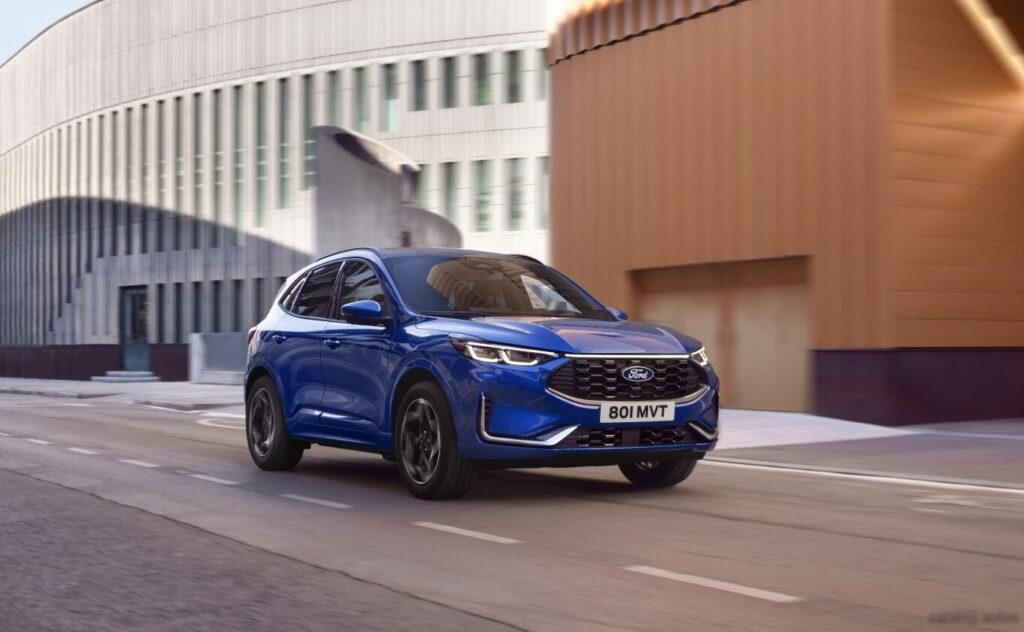
The Ford Kuga III, specifically the ST Line 1.5 EcoBoost variant producing 150 horsepower, represents a key offering in Ford’s European compact SUV lineup. Introduced with the facelift in January 2024, this model builds upon the success of the Kuga III (introduced in 2019) and aims to provide a balance of sporty styling, fuel efficiency, and practicality. Positioned as a mid-range trim, the ST Line 1.5 EcoBoost caters to buyers seeking a more dynamic appearance and driving experience than the base models, without the higher price tag of the fully-equipped Titanium or plug-in hybrid options. It’s a significant model for Ford in Europe, competing directly with vehicles like the Nissan Qashqai, Volkswagen Tiguan, and Peugeot 3008.
Technical Specifications
| Brand | Ford |
| Model | Kuga |
| Generation | Kuga III (facelift 2024) |
| Type (Engine) | ST Line 1.5 EcoBoost (150 Hp) |
| Start of production | January, 2024 |
| Powertrain Architecture | Internal Combustion engine |
| Body type | SUV |
| Seats | 5 |
| Doors | 5 |
| Combined fuel consumption (WLTP) | 6.3-7.2 l/100 km (37.3 – 32.7 US mpg, 44.8 – 39.2 UK mpg, 15.9 – 13.9 km/l) |
| CO2 emissions (WLTP) | 144-163 g/km |
| Fuel Type | Petrol (Gasoline) |
| Acceleration 0 – 100 km/h | 9.5 sec |
| Acceleration 0 – 62 mph | 9.5 sec |
| Acceleration 0 – 60 mph | 9 sec |
| Maximum speed | 195 km/h (121.17 mph) |
| Emission standard | Euro 6d |
| Power | 150 Hp @ 6000 rpm |
| Power per litre | 100.2 Hp/l |
| Torque | 240 Nm @ 1600-4000 rpm (177.01 lb.-ft. @ 1600-4000 rpm) |
| Engine layout | Front, Transverse |
| Engine Model/Code | YZDA, YZDB |
| Engine displacement | 1497 cm3 (91.35 cu. in.) |
| Number of cylinders | 3 |
| Engine configuration | Inline |
| Cylinder Bore | 84 mm (3.31 in.) |
| Piston Stroke | 90 mm (3.54 in.) |
| Compression ratio | 11:1 |
| Number of valves per cylinder | 4 |
| Fuel injection system | Direct injection |
| Engine aspiration | Turbocharger, Intercooler |
| Valvetrain | DOHC, Ti-VCT |
| Engine oil capacity | 5.05 l (5.34 US qt | 4.44 UK qt) |
| Coolant | 7.2 l (7.61 US qt | 6.34 UK qt) |
| Trunk (boot) space – minimum | 412 l (14.55 cu. ft.) |
| Trunk (boot) space – maximum | 1534 l (54.17 cu. ft.) |
| Max. roof load | 75 kg (165.35 lbs.) |
| Permitted trailer load with brakes (12%) | 1730 kg (3814 lbs.) |
| Permitted trailer load without brakes | 750 kg (1653.47 lbs.) |
| Length | 4615 mm (181.69 in.) |
| Width | 1882 mm (74.09 in.) |
| Width with mirrors folded | 2000 mm (78.74 in.) |
| Width including mirrors | 2177 mm (85.71 in.) |
| Height | 1651 mm (65 in.) |
| Wheelbase | 2711 mm (106.73 in.) |
| Front track | 1599 mm (62.95 in.) |
| Rear (Back) track | 1590 mm (62.6 in.) |
| Ride height (ground clearance) | 152-176 mm (5.98 – 6.93 in.) |
| Minimum turning circle (turning diameter) | 11.38 m (37.34 ft.) |
| Approach angle | 18.4° |
| Departure angle | 23.5° |
| Drivetrain Architecture | The Internal combustion engine (ICE) drives the front wheels of the vehicle. |
| Drive wheel | Front wheel drive |
| Number of gears and type of gearbox | 6 gears, manual transmission |
| Front suspension | Independent type McPherson, Transverse stabilizer |
| Rear suspension | Torsion |
| Front brakes | Ventilated discs, 308×27 mm |
| Rear brakes | Disc, 302×11 mm |
| Assisting systems | ABS (Anti-lock braking system) |
| Steering type | Steering rack and pinion |
| Power steering | Electric Steering |
| Tires size | 225/60 R18 |
| Wheel rims size | 7.5J x 18 |
INTRODUCTION
The Ford Kuga ST Line 1.5 EcoBoost (150 hp) is a front-wheel-drive compact SUV that debuted in January 2024 as part of the Kuga III facelift. The Kuga III, built on the Ford C2 platform (also known as the 1HX0/A3 platform shared with the Focus), represents Ford’s attempt to capture a larger share of the increasingly popular European SUV market. The ST Line trim level, introduced with the Kuga III, adds a sporty aesthetic package to the standard Kuga, including unique exterior styling elements and interior trim. This 150 horsepower version of the 1.5 EcoBoost engine is positioned as a sweet spot in the range, offering a reasonable balance between performance and fuel economy.
Powertrain & Engine Architecture
At the heart of the Kuga ST Line 1.5 EcoBoost is the Ford 1.5L EcoBoost turbocharged inline-three cylinder engine. Engine codes YZDA and YZDB are commonly associated with this powerplant. This engine utilizes direct fuel injection, a single scroll turbocharger, and Ford’s Ti-VCT (Twin Independent Variable Camshaft Timing) technology to optimize performance and efficiency. The 1.5 EcoBoost engine is part of Ford’s EcoBoost family, known for combining turbocharging with direct injection and variable valve timing. The engine produces 150 horsepower at 6000 rpm and 240 Nm (177 lb-ft) of torque between 1600 and 4000 rpm. This particular variant is paired with a six-speed manual transmission, delivering power to the front wheels. While an eight-speed automatic transmission is available on other Kuga models, it is not offered with this specific engine and trim combination.
Driving Characteristics
The 150 hp 1.5 EcoBoost engine, coupled with the six-speed manual transmission, provides adequate performance for everyday driving. Acceleration from 0 to 100 km/h (0-62 mph) takes approximately 9.5 seconds. While not particularly sporty, the engine delivers a usable amount of torque at low to mid-range revs, making it suitable for overtaking and navigating city traffic. Compared to the more powerful 1.5 EcoBoost variants (180 hp) or the diesel options, this version feels less eager to accelerate. The manual transmission offers a more engaging driving experience than an automatic, but the gear ratios are tuned for fuel efficiency rather than outright performance. The front-wheel-drive configuration provides predictable handling, but it lacks the all-weather capability of the optional all-wheel-drive system available on other Kuga models.
Equipment & Trim Levels
The ST Line trim adds a number of sporty styling cues to the Kuga. Standard features include a unique ST Line body kit (including front and rear bumpers, side skirts, and a rear spoiler), 18-inch alloy wheels, sports suspension, and a dark interior trim with sports seats. Inside, the ST Line typically features a leather-wrapped steering wheel and gear knob. Infotainment is provided by Ford’s SYNC 4 system, with an 8-inch touchscreen display as standard. Available options include a larger 13.2-inch touchscreen, a digital instrument cluster, a panoramic sunroof, and a premium sound system. Safety features such as automatic emergency braking, lane-keeping assist, and adaptive cruise control are also available, often as part of optional packages.
Chassis & Braking
The Kuga ST Line 1.5 EcoBoost utilizes an independent McPherson strut front suspension and a torsion beam rear suspension. The ST Line trim features a slightly stiffer suspension setup compared to the standard Kuga, providing improved handling and body control. The braking system consists of ventilated discs at the front (308x27mm) and solid discs at the rear (302x11mm). Anti-lock braking system (ABS) and electronic stability control (ESC) are standard features. The steering is an electric power-assisted rack and pinion system, providing light and precise steering feel.
Market Reception & Comparison
The Kuga ST Line 1.5 EcoBoost has been generally well-received by automotive critics. It’s praised for its stylish design, comfortable ride, and reasonable fuel economy. However, some reviewers have noted that the 150 hp engine can feel underpowered when the vehicle is fully loaded or when driving uphill. Compared to the higher-output 1.5 EcoBoost variants, this version offers a lower price point but sacrifices some performance. The diesel options provide better fuel economy, but they come with a higher initial cost and potential concerns about emissions regulations. The manual transmission is appreciated by driving enthusiasts, but it may not appeal to all buyers.
Legacy
The 1.5 EcoBoost engine has proven to be a relatively reliable powerplant in Ford vehicles, although some early models experienced issues with timing belt failures. The Kuga III, in general, has a good reputation for build quality and reliability. The ST Line trim has become a popular choice for buyers seeking a sporty and stylish SUV. As the Kuga III continues to age, the 1.5 EcoBoost variants are likely to remain desirable on the used car market due to their balance of performance, fuel economy, and affordability. Regular maintenance, including oil changes and timing belt replacements (if applicable), will be crucial to ensuring the long-term reliability of this powertrain.