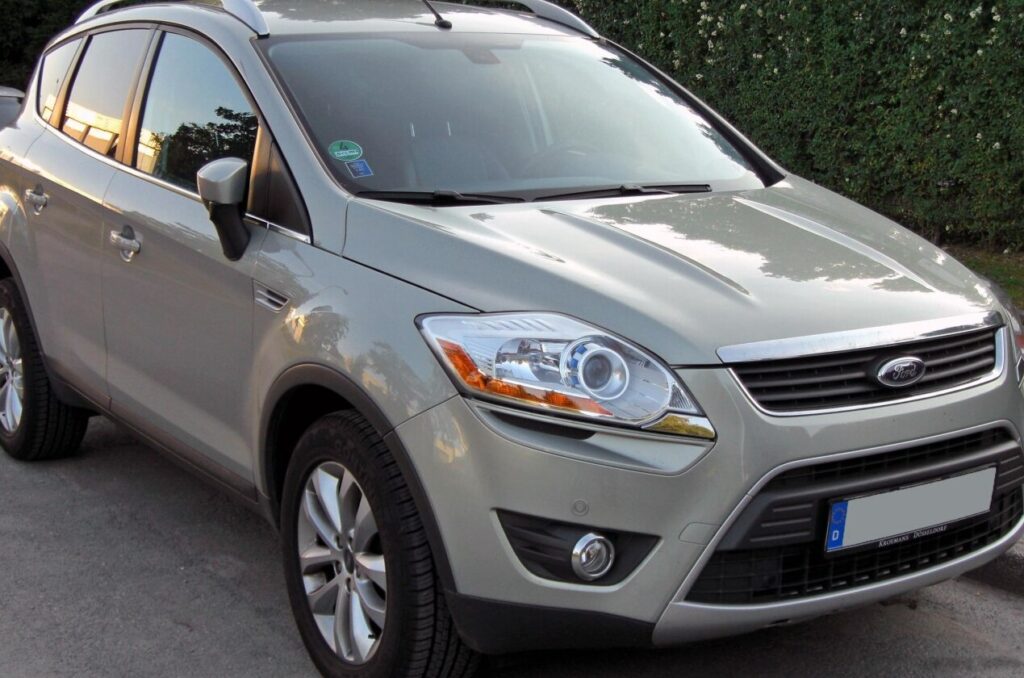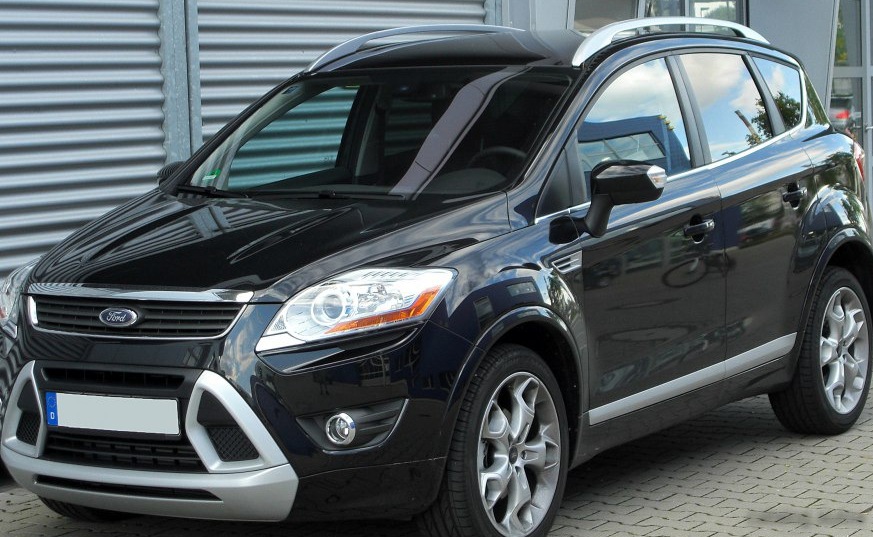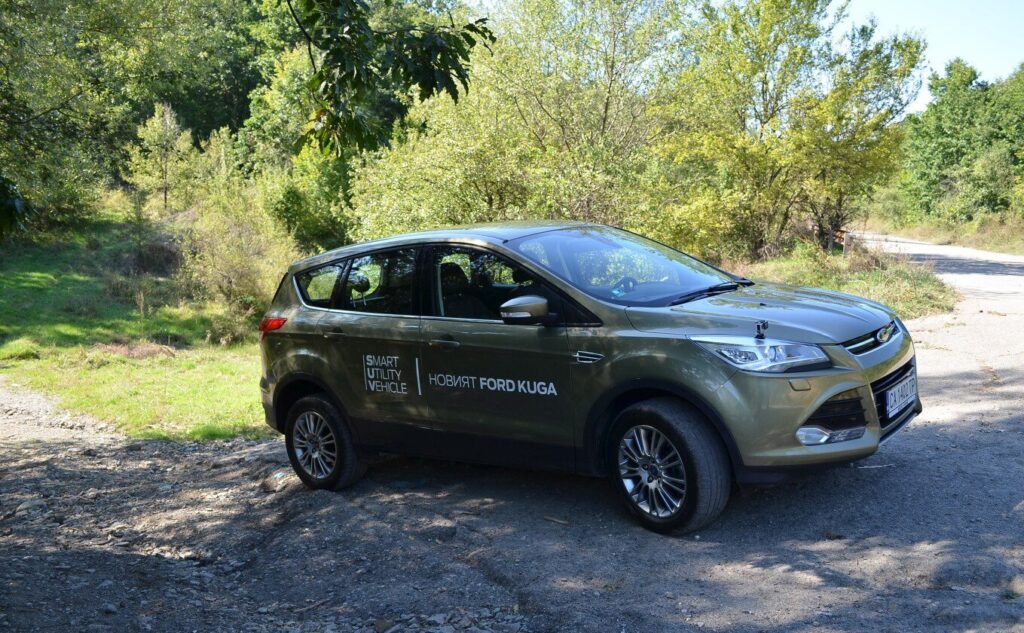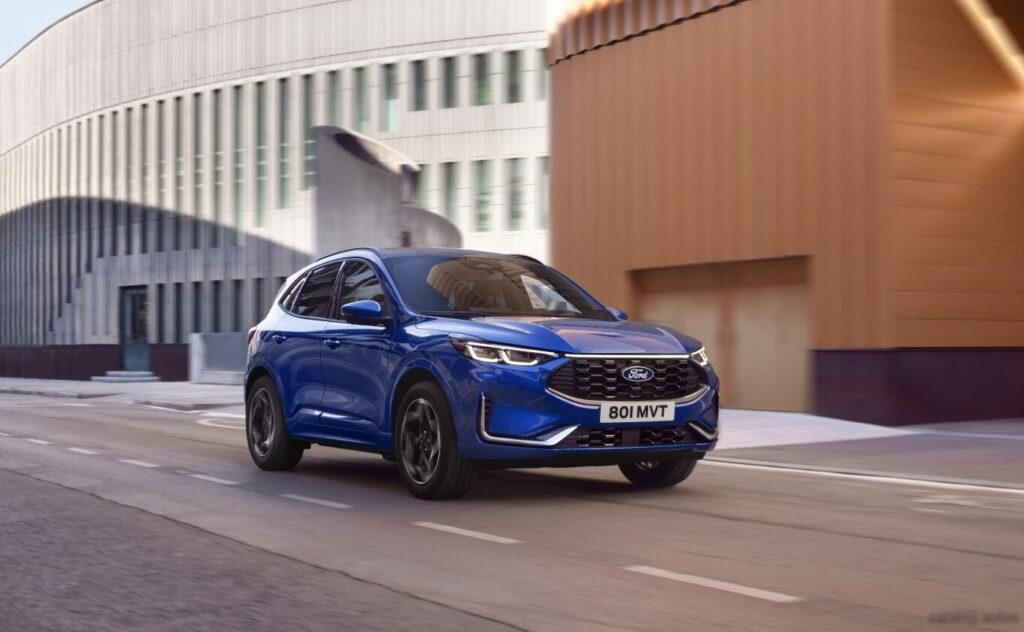
The Ford Kuga III (facelift, introduced in January 2024) ST-Line 2.5 (180 Hp) Full Hybrid CVT represents a significant iteration of Ford’s popular compact SUV, positioned as a stylish and fuel-efficient option within the Kuga lineup. This variant, built on the Kuga III platform (also known as the fourth generation globally), aims to blend sporty aesthetics with the benefits of a full hybrid powertrain. It caters to buyers seeking a practical, modern SUV with a focus on reduced emissions and improved fuel economy. The ST-Line trim, in particular, emphasizes a more dynamic appearance and driving experience compared to lower-spec models.
Technical Specifications
| Brand | Ford |
| Model | Kuga |
| Generation | Kuga III (facelift 2024) |
| Type (Engine) | ST-Line 2.5 (180 Hp) Full Hybrid CVT |
| Start of production | January, 2024 |
| Powertrain Architecture | FHEV (Full Hybrid Electric Vehicle) |
| Body type | SUV |
| Seats | 5 |
| Doors | 5 |
| Combined fuel consumption (WLTP) | 5.3-6.2 l/100 km (44.4 – 37.9 US mpg, 53.3 – 45.6 UK mpg, 18.9 – 16.1 km/l) |
| CO2 emissions (WLTP) | 121-143 g/km |
| Fuel Type | Petrol (Gasoline) |
| Acceleration 0 – 100 km/h | 9.1 sec |
| Acceleration 0 – 62 mph | 9.1 sec |
| Acceleration 0 – 60 mph | 8.6 sec |
| Maximum speed | 196 km/h (121.79 mph) |
| Emission standard | Euro 6d |
| Gross battery capacity | 1.1 kWh |
| Battery technology | Lithium-ion (Li-Ion) |
| System power | 180 Hp @ 5500 rpm |
| Engine layout | Front, Transverse |
| Engine Model/Code | BGDA |
| Engine displacement | 2488 cm3 (151.83 cu. in.) |
| Number of cylinders | 4 |
| Engine configuration | Inline |
| Cylinder Bore | 89 mm (3.5 in.) |
| Piston Stroke | 100 mm (3.94 in.) |
| Compression ratio | 13:1 |
| Number of valves per cylinder | 4 |
| Fuel injection system | Multi-port manifold injection |
| Engine aspiration | Naturally aspirated engine |
| Valvetrain | DOHC, VCT |
| Engine oil capacity | 5.4 l (5.71 US qt | 4.75 UK qt) |
| Trunk (boot) space – minimum | 412 l (14.55 cu. ft.) |
| Trunk (boot) space – maximum | 1534 l (54.17 cu. ft.) |
| Fuel tank capacity | 54 l (14.27 US gal | 11.88 UK gal) |
| Max. roof load | 75 kg (165.35 lbs.) |
| Permitted trailer load with brakes (12%) | 1600 kg (3527.4 lbs.) |
| Permitted trailer load without brakes | 750 kg (1653.47 lbs.) |
| Length | 4615 mm (181.69 in.) |
| Width | 1882 mm (74.09 in.) |
| Width with mirrors folded | 2000 mm (78.74 in.) |
| Width including mirrors | 2177 mm (85.71 in.) |
| Height | 1651 mm (65 in.) |
| Wheelbase | 2711 mm (106.73 in.) |
| Front track | 1599 mm (62.95 in.) |
| Rear (Back) track | 1590 mm (62.6 in.) |
| Ride height (ground clearance) | 152-176 mm (5.98 – 6.93 in.) |
| Minimum turning circle (turning diameter) | 11.38 m (37.34 ft.) |
| Front suspension | Independent type McPherson, Transverse stabilizer |
| Rear suspension | Torsion |
| Front brakes | Ventilated discs, 308×27 mm |
| Rear brakes | Disc, 302×11 mm |
| Drive wheel | Front wheel drive |
| Number of gears and type of gearbox | automatic transmission CVT |
| Tires size | 225/60 R18 |
| Wheel rims size | 7.5J x 18 |
Introduction
The Ford Kuga ST-Line 2.5 Full Hybrid CVT, launched in early 2024, builds upon the success of the Kuga III, a model that has become a key player in the European and increasingly North American compact SUV market. The facelift brings updated styling, enhanced technology, and refinements to the powertrain. This particular variant occupies a mid-range position within the Kuga lineup, offering a balance between performance, fuel efficiency, and equipment. It’s designed to appeal to buyers who want a stylish and practical SUV without the higher price tag of the more powerful or fully-loaded trims. The Kuga, known as the Escape in North America, competes with vehicles like the Toyota RAV4, Honda CR-V, and Nissan Rogue.
Powertrain & Engine Architecture
At the heart of the Kuga ST-Line 2.5 Full Hybrid is the BGDA engine, a 2.5-liter naturally aspirated inline-four cylinder gasoline engine. This engine is part of Ford’s hybrid powertrain family and is paired with an electric motor and a 1.1 kWh lithium-ion battery pack. The engine utilizes multi-port fuel injection and a double overhead camshaft (DOHC) valvetrain with variable camshaft timing (VCT) to optimize efficiency and performance. The hybrid system allows for electric-only driving at low speeds and assists the gasoline engine during acceleration, resulting in improved fuel economy. The continuously variable transmission (CVT) is specifically tuned to work seamlessly with the hybrid system, providing smooth and efficient power delivery. Unlike some competitors that employ more complex multi-gear hybrid systems, Ford opted for a simpler, yet effective, CVT setup.
Driving Characteristics
The 180 horsepower combined output (from the engine and electric motor) provides adequate performance for everyday driving. Acceleration from 0-60 mph takes approximately 8.6 seconds, which is competitive within its class, though not particularly sporty. The CVT, while efficient, can sometimes feel less responsive than a traditional automatic transmission, exhibiting the characteristic “rubber band” effect during hard acceleration. However, Ford has made efforts to minimize this sensation through software tuning. The hybrid system prioritizes fuel efficiency, and the vehicle generally operates in a quiet and refined manner, especially during electric-only driving. The ST-Line trim features a slightly firmer suspension setup compared to standard Kuga models, offering improved handling and body control, but without sacrificing ride comfort.
Equipment & Trim Levels
The ST-Line trim comes standard with a generous array of features, including a large touchscreen infotainment system with Apple CarPlay and Android Auto compatibility, a digital instrument cluster, automatic climate control, and a suite of advanced driver-assistance systems (ADAS) such as lane-keeping assist, adaptive cruise control, and automatic emergency braking. Interior upholstery typically consists of sport cloth seats with unique ST-Line badging. Optional extras include a panoramic sunroof, leather upholstery, a premium sound system, and a hands-free power liftgate. The exterior styling is enhanced with a sporty body kit, including unique front and rear bumpers, side skirts, and a rear spoiler.
Chassis & Braking
The Kuga ST-Line utilizes an independent McPherson strut suspension at the front and a torsion beam suspension at the rear. The front suspension incorporates a transverse stabilizer bar to reduce body roll during cornering. Braking duties are handled by ventilated discs at the front and solid discs at the rear. The braking system is equipped with ABS (Anti-lock Braking System) and electronic brake-force distribution (EBD) for enhanced safety. The ST-Line trim often features slightly larger brake rotors compared to lower-spec models, providing improved stopping power.
Market Reception & Comparison
The Kuga ST-Line 2.5 Full Hybrid CVT has been generally well-received by automotive critics, who praise its fuel efficiency, comfortable ride, and stylish design. Compared to the non-hybrid Kuga variants, the hybrid model offers significantly improved fuel economy, although it comes at a higher initial cost. Against competitors like the Toyota RAV4 Hybrid, the Kuga offers a more engaging driving experience, but the RAV4 typically boasts a stronger reputation for long-term reliability. The CVT transmission has been a point of contention for some reviewers, with some preferring the responsiveness of a traditional automatic.
Legacy
The long-term reliability of the BGDA engine and the hybrid system remains to be fully established, as the 2024 facelift is a relatively recent introduction. However, Ford has a generally good track record with its hybrid technology. The Kuga III, and specifically the ST-Line 2.5 Full Hybrid CVT, is expected to hold its value reasonably well in the used car market, particularly as demand for fuel-efficient vehicles continues to grow. The combination of practicality, style, and hybrid efficiency positions this variant as a compelling option for buyers seeking a modern and versatile compact SUV.