Technical Specifications
| Brand | Ford |
| Model | Kuga |
| Generation | Kuga III (facelift 2024) |
| Type (Engine) | Titanium 1.5 EcoBoost (186 Hp) Automatic |
| Start of production | June, 2024 |
| Powertrain Architecture | Internal Combustion engine |
| Body type | SUV |
| Seats | 5 |
| Doors | 5 |
| Combined fuel consumption (WLTP) | 6.8-7.8 l/100 km (34.6 – 30.2 US mpg, 41.5 – 36.2 UK mpg, 14.7 – 12.8 km/l) |
| CO2 emissions (WLTP) | 154-178 g/km |
| Fuel Type | Petrol (Gasoline) |
| Acceleration 0 – 100 km/h | 9.9 sec |
| Acceleration 0 – 62 mph | 9.9 sec |
| Acceleration 0 – 60 mph | 9.4 sec |
| Maximum speed | 195 km/h (121.17 mph) |
| Emission standard | Euro 6e-bis |
| Power | 186 Hp @ 6000 rpm |
| Power per litre | 124.3 Hp/l |
| Torque | 240 Nm @ 1600-4000 rpm (177.01 lb.-ft. @ 1600-4000 rpm) |
| Engine layout | Front, Transverse |
| Engine Model/Code | CRDA |
| Engine displacement | 1496 cm3 (91.29 cu. in.) |
| Number of cylinders | 3 |
| Engine configuration | Inline |
| Number of valves per cylinder | 4 |
| Fuel injection system | Direct injection |
| Engine aspiration | Turbocharger, Intercooler |
| Engine oil capacity | 6.25 l (6.6 US qt | 5.5 UK qt) |
| Coolant | 7.3 l (7.71 US qt | 6.42 UK qt) |
| Trunk (boot) space – minimum | 412-553 l (14.55 – 19.53 cu. ft.) |
| Trunk (boot) space – maximum | 1534 l (54.17 cu. ft.) |
| Fuel tank capacity | 54 l (14.27 US gal | 11.88 UK gal) |
| Max. roof load | 75 kg (165.35 lbs.) |
| Permitted trailer load with brakes (12%) | 1800 kg (3968.32 lbs.) |
| Permitted trailer load without brakes | 750 kg (1653.47 lbs.) |
| Permitted towbar download | 100 kg (220.46 lbs.) |
| Length | 4604 mm (181.26 in.) |
| Width | 1882 mm (74.09 in.) |
| Width with mirrors folded | 2000 mm (78.74 in.) |
| Width including mirrors | 2177 mm (85.71 in.) |
| Height | 1680 mm (66.14 in.) |
| Wheelbase | 2710 mm (106.69 in.) |
| Front track | 1599 mm (62.95 in.) |
| Rear (Back) track | 1590 mm (62.6 in.) |
| Front overhang | 947 mm (37.28 in.) |
| Rear overhang | 946 mm (37.24 in.) |
| Ride height (ground clearance) | 136-159 mm (5.35 – 6.26 in.) |
| Minimum turning circle (turning diameter) | 11.4 m (37.4 ft.) |
| Approach angle | 19° |
| Departure angle | 25° |
| Drivetrain Architecture | The Internal combustion engine (ICE) drives the front wheels of the vehicle. |
| Drive wheel | Front wheel drive |
| Number of gears and type of gearbox | 8 gears, automatic transmission |
| Front suspension | Independent type McPherson, Transverse stabilizer |
| Rear suspension | Torsion |
| Front brakes | Ventilated discs |
| Rear brakes | Disc |
| Assisting systems | ABS (Anti-lock braking system) |
| Steering type | Steering rack and pinion |
| Power steering | Electric Steering |
| Tires size | 225/65 R17 106H XL; 225/60 R18 104V XL |
| Wheel rims size | 7J x 17 ET50; 7.5J x 18 ET50 |
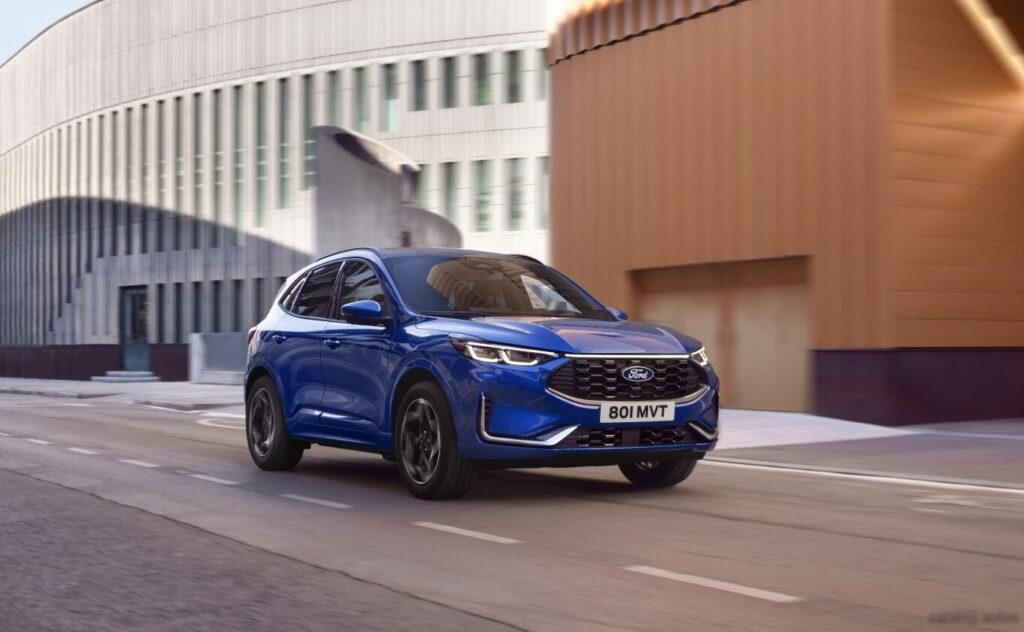
The Kuga III, launched in 2019 and facelifted in 2024, is Ford’s entry in the highly competitive compact SUV segment. The Titanium trim level, positioned above the base models, adds a layer of comfort and convenience features. The 1.5 EcoBoost engine, paired with an eight-speed automatic transmission, is a popular choice for buyers prioritizing ease of use and fuel economy. This specific configuration aims to provide a balanced driving experience, suitable for both urban commutes and longer journeys. The facelift brought updated front-end styling, a revised interior with a larger touchscreen, and enhanced safety technology.
Powertrain & Engine Architecture
The heart of the Kuga Titanium is the 1.5-liter EcoBoost inline-three cylinder engine, bearing the code CRDA. This engine utilizes direct fuel injection and a single turbocharger with an intercooler to deliver a respectable 186 horsepower at 6000 rpm and 240 Nm (177 lb-ft) of torque between 1600 and 4000 rpm. The engine employs variable valve timing to optimize performance and efficiency across the rev range. The eight-speed automatic transmission, sourced from a supplier like Aisin, is designed for smooth and efficient gear changes. It features a torque converter and offers selectable drive modes to tailor the driving experience. This transmission replaced the older six-speed unit found in earlier Kuga models, contributing to improved fuel economy and refinement.
Driving Characteristics
The 1.5 EcoBoost automatic Kuga delivers a comfortable and predictable driving experience. Acceleration from 0-100 km/h (0-62 mph) takes approximately 9.9 seconds, which is adequate for everyday driving but doesn’t offer particularly sporty performance. The automatic transmission generally shifts smoothly, although occasional hesitation can be felt during quick acceleration. Compared to the more powerful 2.5-liter EcoBoost engine option, this variant feels less responsive, but it offers significantly better fuel economy. The gear ratios are tuned for efficiency, prioritizing lower engine speeds at highway cruising. The front-wheel-drive configuration provides decent grip in normal conditions, but it lacks the all-weather capability of the available all-wheel-drive system.
Equipment & Trim Levels
The Titanium trim level comes standard with a generous array of features. Interior appointments include comfortable cloth seats (leather upholstery is optional), a leather-wrapped steering wheel, and a modern dashboard layout. Key standard equipment includes a large touchscreen infotainment system with Apple CarPlay and Android Auto compatibility, a rearview camera, parking sensors, automatic climate control, and a suite of driver-assistance systems such as lane-keeping assist and automatic emergency braking. Optional extras include a panoramic sunroof, adaptive cruise control, and a premium audio system. The interior design emphasizes practicality and user-friendliness, with ample storage compartments and a spacious cabin.
Chassis & Braking
The Kuga III utilizes a front-wheel-drive platform with independent McPherson strut suspension at the front and a torsion beam setup at the rear. This configuration provides a good balance between ride comfort and handling. The steering is electrically assisted, offering light and precise control. The braking system consists of ventilated discs at the front and solid discs at the rear, coupled with ABS and electronic stability control. The suspension is tuned for comfort, absorbing bumps and imperfections in the road surface effectively. Stabilizer bars are fitted to both axles to reduce body roll during cornering.
Market Reception & Comparison
The Kuga III Titanium 1.5 EcoBoost Automatic has been generally well-received by automotive critics. It’s praised for its comfortable ride, spacious interior, and fuel efficiency. However, some reviewers have noted that the engine can feel strained under hard acceleration, and the interior materials, while well-assembled, aren’t as premium as some competitors. Compared to the diesel-powered Kuga variants, the 1.5 EcoBoost offers lower CO2 emissions but slightly higher running costs. Against rivals like the Nissan Qashqai and Volkswagen Tiguan, the Kuga offers a competitive package with a strong emphasis on practicality and value.
Legacy
The 1.5 EcoBoost engine has proven to be a relatively reliable unit in other Ford models, though long-term durability data for this specific Kuga configuration is still emerging. The eight-speed automatic transmission is also generally considered robust. Potential owners should be mindful of regular maintenance, including oil changes and timing belt replacements. In the used car market, the Kuga Titanium 1.5 EcoBoost Automatic is expected to hold its value reasonably well, appealing to buyers seeking a well-equipped and fuel-efficient compact SUV. Its blend of practicality, comfort, and technology positions it as a strong contender in its segment.