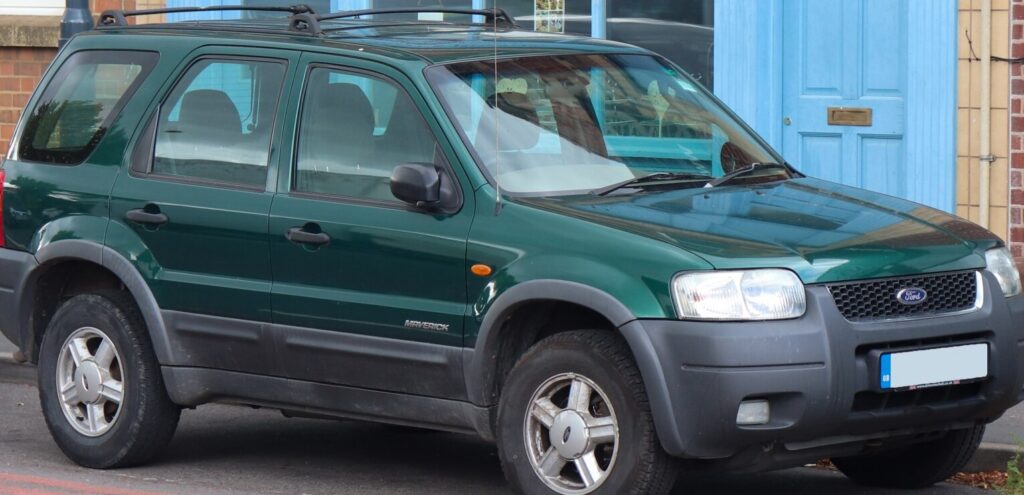
The Ford Maverick II, specifically the 3.0 i V6 24V AWD variant, was produced between 2000 and 2004. This model represented Ford’s entry into the compact SUV market, aiming to provide a blend of practicality, comfort, and all-weather capability. Positioned as a mid-range offering within the Maverick II lineup, it slotted above the base 2.0L models and below potential higher-specification trims (depending on regional availability). The Maverick II was primarily marketed in Europe, offering an alternative to established Japanese and European competitors in the growing SUV segment.
Technical Specifications
| Brand | Ford |
| Model | Maverick |
| Generation | Maverick II |
| Type (Engine) | 3.0 i V6 24V AWD (197 Hp) |
| Start of production | 2000 year |
| End of production | 2004 year |
| Powertrain Architecture | Internal Combustion engine |
| Body type | SUV |
| Seats | 5 |
| Doors | 5 |
| Fuel consumption (economy) – urban | 18.9 l/100 km (12.4 US mpg, 14.9 UK mpg, 5.3 km/l) |
| Fuel consumption (economy) – extra urban | 9.3 l/100 km (25.3 US mpg, 30.4 UK mpg, 10.8 km/l) |
| Fuel consumption (economy) – combined | 12.8 l/100 km (18.4 US mpg, 22.1 UK mpg, 7.8 km/l) |
| Fuel Type | Petrol (Gasoline) |
| Acceleration 0 – 100 km/h | 10.5 sec |
| Acceleration 0 – 62 mph | 10.5 sec |
| Acceleration 0 – 60 mph | 10 sec |
| Maximum speed | 190 km/h (118.06 mph) |
| Weight-to-power ratio | 8.5 kg/Hp, 118.3 Hp/tonne |
| Weight-to-torque ratio | 6.3 kg/Nm, 159.2 Nm/tonne |
| Power | 197 Hp @ 6000 rpm |
| Power per litre | 66.4 Hp/l |
| Torque | 265 Nm @ 4750 rpm (195.45 lb.-ft. @ 4750 rpm) |
| Engine layout | Front, Transverse |
| Engine Model/Code | AJ |
| Engine displacement | 2967 cm3 (181.06 cu. in.) |
| Number of cylinders | 6 |
| Engine configuration | V-engine |
| Cylinder Bore | 89 mm (3.5 in.) |
| Piston Stroke | 79.5 mm (3.13 in.) |
| Compression ratio | 10:1 |
| Number of valves per cylinder | 4 |
| Fuel injection system | Multi-port manifold injection |
| Engine aspiration | Naturally aspirated engine |
| Valvetrain | DOHC |
| Engine oil capacity | 5.2 l (5.49 US qt | 4.58 UK qt) |
| Coolant | 10 l (10.57 US qt | 8.8 UK qt) |
| Kerb Weight | 1665 kg (3670.7 lbs.) |
| Max. weight | 2145 kg (4728.92 lbs.) |
| Max load | 480 kg (1058.22 lbs.) |
| Trunk (boot) space – minimum | 985 l (34.78 cu. ft.) |
| Trunk (boot) space – maximum | 1940 l (68.51 cu. ft.) |
| Fuel tank capacity | 62 l (16.38 US gal | 13.64 UK gal) |
| Length | 4394 mm (172.99 in.) |
| Width | 1781 mm (70.12 in.) |
| Height | 1722 mm (67.8 in.) |
| Wheelbase | 2619 mm (103.11 in.) |
| Front track | 1554 mm (61.18 in.) |
| Rear (Back) track | 1550 mm (61.02 in.) |
| Drive wheel | All wheel drive (4×4) |
| Number of gears and type of gearbox | 4 gears, automatic transmission |
| Front suspension | Wishbone |
| Rear suspension | Double wishbone |
| Front brakes | Ventilated discs |
| Rear brakes | Disc |
| Assisting systems | ABS (Anti-lock braking system) |
| Steering type | Steering rack and pinion |
| Power steering | Hydraulic Steering |
| Tires size | 235/70 R15 |
Powertrain & Engine Architecture
The heart of the Maverick II 3.0 i V6 AWD is the Ford AJ engine, a 2.967-liter (181.06 cubic inch) naturally aspirated V6. This engine, part of Ford’s Duratec family, features a 60-degree V-angle and a double overhead camshaft (DOHC) valvetrain with four valves per cylinder. The engine utilizes multi-port fuel injection, delivering fuel directly into the intake ports. The AJ engine was known for its relatively smooth operation and decent power output for its displacement. Paired with this engine is a four-speed automatic transmission, designed to provide comfortable and convenient shifting. This transmission was a standard offering for this trim level, prioritizing ease of use over outright performance. The all-wheel-drive system employed a viscous coupling, automatically distributing torque between the front and rear axles as needed, enhancing traction in slippery conditions.
Driving Characteristics
The 3.0L V6 automatic Maverick II offered a comfortable and capable driving experience. While not particularly sporty, the 197 horsepower and 195 lb-ft of torque provided adequate acceleration for everyday driving. The four-speed automatic transmission, while smooth, wasn’t known for its quick shifts or aggressive downshifting. Compared to the manual transmission versions, the automatic offered less driver engagement and slightly slower acceleration times. The AWD system provided enhanced stability and grip, particularly on loose surfaces, making it a suitable vehicle for regions with inclement weather. The gear ratios were tuned for fuel efficiency and relaxed cruising, rather than spirited performance. The power delivery was linear, with a noticeable surge in torque around 4750 rpm.
Equipment & Trim Levels
The 3.0 i V6 AWD Maverick II typically came equipped with a reasonable level of standard features. These included air conditioning, power windows and locks, central locking, and an AM/FM radio. Interior upholstery was typically cloth, with options for leather upgrades. Dashboard configuration was functional and straightforward, prioritizing usability over aesthetic flair. Optional extras available for this trim included alloy wheels, a sunroof, upgraded audio systems, and parking sensors. Safety features included ABS (Anti-lock Braking System) as standard, with airbags available depending on the specific market and year of production.
Chassis & Braking
The Maverick II utilized a front wishbone and rear double wishbone suspension setup, providing a comfortable ride quality. The suspension was tuned for a balance between comfort and handling, leaning towards the former. Braking duties were handled by ventilated discs at the front and solid discs at the rear. The ABS system helped to maintain steering control during hard braking. Stabilizer bars were fitted to both the front and rear axles to reduce body roll during cornering. The chassis was designed to provide a stable and predictable driving experience, prioritizing safety and comfort over sporty handling.
Market Reception & Comparison
The Ford Maverick II 3.0 i V6 AWD received mixed reviews from automotive critics. While praised for its comfortable ride, spacious interior, and all-weather capability, it was often criticized for its relatively uninspired styling and somewhat lackluster performance compared to some of its competitors. Fuel economy was also a point of concern, with the 3.0L V6 engine consuming a significant amount of fuel, especially in urban driving conditions. Compared to the base 2.0L models, the 3.0L V6 offered a noticeable improvement in performance, but at the cost of increased fuel consumption. Compared to diesel-powered rivals, the 3.0L V6 offered less torque and lower fuel economy.
Legacy
The Ford Maverick II, including the 3.0 i V6 AWD variant, has developed a modest following among enthusiasts. The AJ engine, while not known for being particularly high-performance, is generally considered to be reliable and relatively easy to maintain. However, like many vehicles of this era, age-related issues such as corrosion and wear and tear on suspension components can be common. In the used car market, the 3.0L V6 AWD models tend to command a slightly higher price than the base 2.0L versions, reflecting their increased performance and all-wheel-drive capability. The Maverick II represents a transitional period for Ford, as the company moved towards more sophisticated and refined SUV designs.