Technical Specifications
| Brand | Ford |
| Model | Mondeo |
| Generation | Mondeo I Hatchback |
| Type (Engine) | 1.6 i 16V (90 Hp) |
| Start of production | 1993 |
| End of production | 1996 |
| Powertrain Architecture | Internal Combustion engine |
| Body type | Hatchback |
| Seats | 5 |
| Doors | 5 |
| Fuel consumption (urban) | 10.1 l/100 km (23.3 US mpg / 28 UK mpg) |
| Fuel consumption (extra urban) | 5.5 l/100 km (42.8 US mpg / 51.4 UK mpg) |
| Fuel consumption (combined) | 7.1 l/100 km (33.1 US mpg / 39.8 UK mpg) |
| Fuel Type | Petrol (Gasoline) |
| Acceleration 0 – 100 km/h | 13.5 sec |
| Acceleration 0 – 62 mph | 13.5 sec |
| Acceleration 0 – 60 mph | 12.8 sec |
| Maximum speed | 180 km/h (111.85 mph) |
| Weight-to-power ratio | 14.5 kg/Hp |
| Weight-to-torque ratio | 9.7 kg/Nm |
| Power | 90 Hp @ 5500 rpm |
| Torque | 134 Nm @ 3000 rpm (98.83 lb.-ft. @ 3000 rpm) |
| Engine layout | Front, Transverse |
| Engine Model/Code | L1F |
| Engine displacement | 1597 cm3 (97.45 cu. in.) |
| Number of cylinders | 4 |
| Engine configuration | Inline |
| Cylinder Bore | 76 mm (2.99 in.) |
| Piston Stroke | 88 mm (3.46 in.) |
| Compression ratio | 10.3:1 |
| Number of valves per cylinder | 4 |
| Fuel injection system | Multi-port manifold injection |
| Engine aspiration | Naturally aspirated |
| Valvetrain | DOHC |
| Engine oil capacity | 4.25 l (4.49 US qt | 3.74 UK qt) |
| Coolant capacity | 6.6 l (6.97 US qt | 5.81 UK qt) |
| Kerb Weight | 1305 kg (2877.03 lbs.) |
| Max. weight | 1790 kg (3946.27 lbs.) |
| Max load | 485 kg (1069.24 lbs.) |
| Trunk (boot) space – minimum | 470 l (16.6 cu. ft.) |
| Trunk (boot) space – maximum | 965 l (34.08 cu. ft.) |
| Fuel tank capacity | 61 l (16.11 US gal | 13.42 UK gal) |
| Length | 4481 mm (176.42 in.) |
| Width | 1749 mm (68.86 in.) |
| Height | 1424 mm (56.06 in.) |
| Wheelbase | 2704 mm (106.46 in.) |
| Front track | 1503 mm (59.17 in.) |
| Rear track | 1487 mm (58.54 in.) |
| Drivetrain Architecture | Front wheel drive |
| Number of gears | 4 (Automatic) |
| Front suspension | Wishbone |
| Rear suspension | Coil spring |
| Front brakes | Ventilated discs |
| Rear brakes | Drum |
| Assisting systems | ABS (Anti-lock braking system) |
| Steering type | Steering rack and pinion |
| Power steering | Hydraulic |
| Tires size | 185/65 R14 |
| Wheel rims size | 6J x 14 |
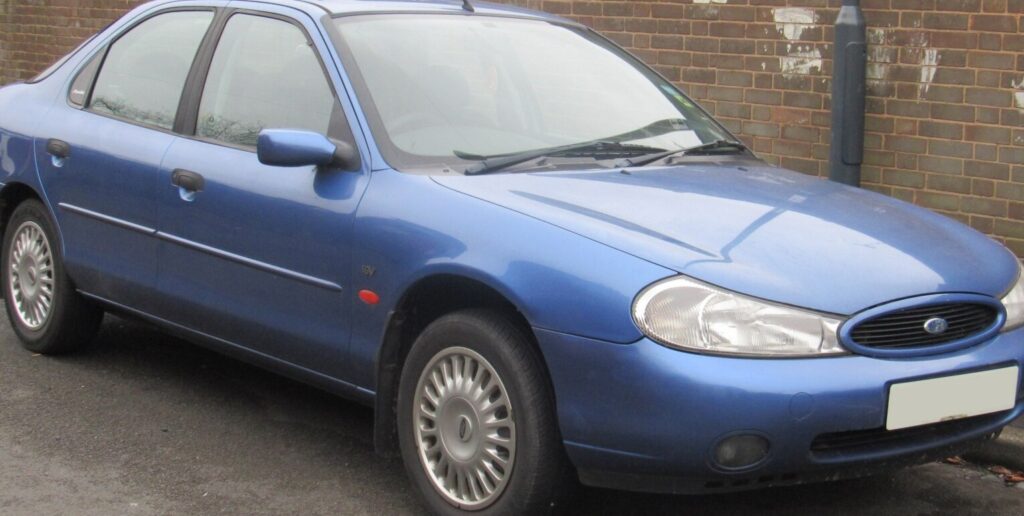
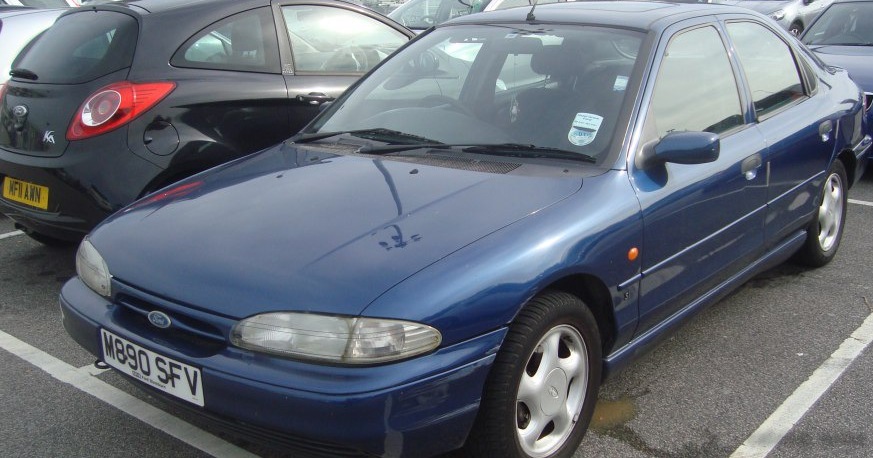
The Ford Mondeo I Hatchback 1.6 i 16V (90 hp) was a significant variant in the initial Mondeo lineup, produced between 1993 and 1996. Positioned as an entry-level offering, it aimed to provide affordable family transportation within the newly launched Mondeo range, which represented a substantial advancement for Ford of Europe. The Mondeo replaced the Sierra and Cortina, and was a globally designed vehicle, with the hatchback body style gaining popularity in European markets. This 1.6L variant, coupled with a four-speed automatic transmission, offered a balance of economy and usability, though it wasn’t the performance-focused choice within the Mondeo family.
Powertrain & Engine Architecture
The 1.6-liter, 16-valve engine, internally designated the L1F, was a naturally aspirated inline-four cylinder unit. It featured multi-port fuel injection and a double overhead camshaft (DOHC) valvetrain, contributing to its relatively efficient operation for the era. The engine’s 10.3:1 compression ratio helped generate a respectable 90 horsepower. Paired with this engine was a four-speed automatic transmission, a popular choice for drivers prioritizing convenience. This transmission, while providing smooth shifts, did impact acceleration compared to the available five-speed manual gearbox. The automatic transmission was tuned for comfortable cruising rather than aggressive driving. It was a fairly conventional automatic for the time, relying on hydraulic control rather than electronic management.
Driving Characteristics
The Mondeo 1.6 Automatic offered a comfortable, if not particularly exhilarating, driving experience. Acceleration from 0-60 mph took approximately 12.8 seconds, making it noticeably slower than the manual transmission versions or those equipped with larger engines like the 2.0L. The automatic transmission’s gear ratios were optimized for fuel efficiency and smooth cruising, resulting in a somewhat delayed response during overtaking. However, for daily commuting and family transport, the 1.6L automatic provided sufficient power and a relaxed driving experience. The steering was light and precise, characteristic of Ford’s vehicles of that period. The suspension provided a comfortable ride, absorbing road imperfections well, but didn’t offer the sporty handling found in some competitor vehicles.
Equipment & Trim Levels
The 1.6L automatic Mondeo typically came with a reasonable level of standard equipment. This included central locking, power steering, and an adjustable steering column. Interior upholstery was generally cloth, with a functional, if somewhat basic, dashboard layout. Optional extras included air conditioning, electric windows, and an upgraded sound system. The trim level sat towards the base of the Mondeo range, making it an attractive option for budget-conscious buyers. It was often viewed as a step up from the very basic models, offering a good balance of features for the price. Higher trim levels added features like alloy wheels, upgraded interior trim, and more sophisticated audio systems.
Chassis & Braking
The Mondeo I featured independent front suspension with wishbones and a coil spring rear suspension. This setup provided a comfortable ride, effectively absorbing bumps and road imperfections. Braking was handled by ventilated discs on the front wheels and drum brakes on the rear. Anti-lock Braking System (ABS) was included as standard, enhancing safety. The chassis was designed to provide good handling characteristics, although the 1.6L engine’s power output didn’t fully utilize the car’s potential in this area. Stabilizer bars were fitted to both the front and rear axles to minimize body roll during cornering. The drum brakes on the rear were a cost-saving measure common in this class of vehicle at the time.
Market Reception & Comparison
The Mondeo 1.6 Automatic received mixed reviews. Critics acknowledged its practicality and affordability but often criticized its lack of performance. Compared to the higher-spec Mondeos, such as those with the 2.0L or V6 engines, the 1.6L automatic felt underpowered. However, it offered significantly better fuel economy than its more powerful counterparts. The 1.9 TDI diesel version was also a popular alternative, offering superior fuel efficiency and torque, but at a higher initial cost. The 1.6L automatic appealed to buyers who prioritized comfort and economy over sporty driving dynamics. It was seen as a sensible choice for families and commuters.
Legacy
The Ford Mondeo I 1.6L automatic, while not the most desirable variant today, remains a relatively reliable and affordable classic car. The L1F engine is known for its durability, and the automatic transmission, while not particularly advanced, is generally robust. Finding well-maintained examples can be challenging due to age and mileage, but parts availability is generally good. In the used car market, these models are often seen as a cost-effective way to experience the Mondeo’s comfortable ride and spacious interior. They represent a significant step forward in Ford’s family car offerings and a testament to the Mondeo’s enduring appeal. The Mondeo established itself as a strong competitor in the family car segment, and the 1.6L automatic played a role in making it accessible to a wider range of buyers.