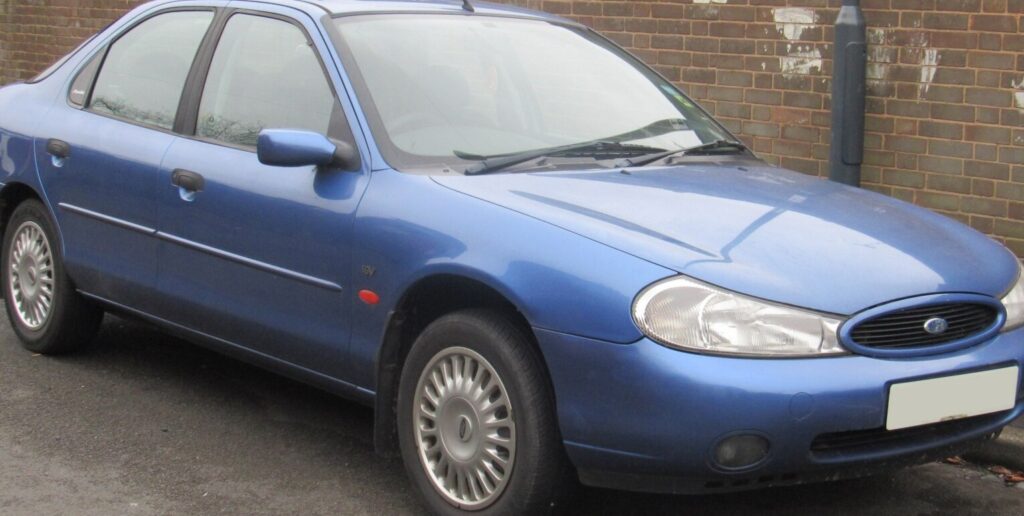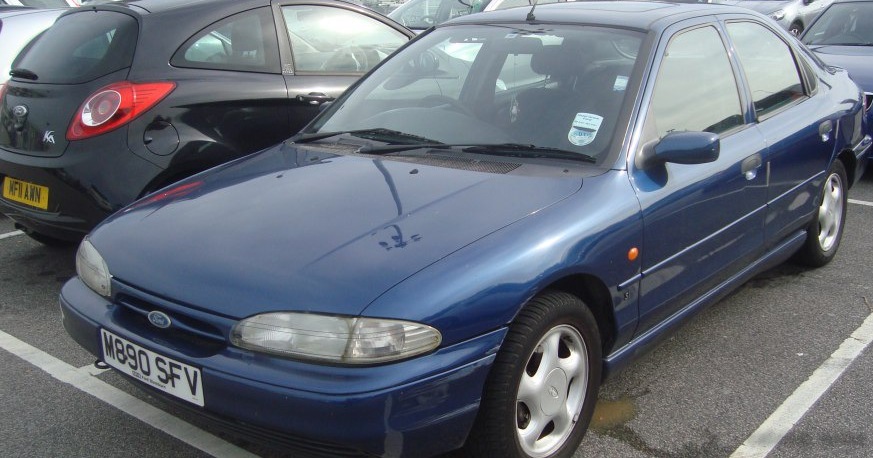
The Ford Mondeo I Hatchback 1.8 TD, produced between 1993 and 1996, represented a significant entry in Ford of Europe’s mid-size family car lineup. Positioned as an economical and practical option, this variant utilized a turbocharged diesel engine paired with a five-speed manual transmission. It was a key component of the initial Mondeo range (designated the 1HX0/A3 platform), designed to replace the aging Ford Sierra and Escort models, offering a more modern and spacious alternative. The 1.8 TD aimed to appeal to buyers prioritizing fuel efficiency and lower running costs, particularly in European markets where diesel engines were gaining popularity.
Technical Specifications
| Brand | Ford |
| Model | Mondeo |
| Generation | Mondeo I Hatchback |
| Type (Engine) | 1.8 TD (88 Hp) |
| Start of production | 1993 |
| End of production | 1996 |
| Powertrain Architecture | Internal Combustion engine |
| Body type | Hatchback |
| Seats | 5 |
| Doors | 5 |
| Fuel consumption (urban) | 7.4 l/100 km (31.8 US mpg) |
| Fuel consumption (extra urban) | 4.3 l/100 km (54.7 US mpg) |
| Fuel consumption (combined) | 6.1 l/100 km (38.6 US mpg) |
| Fuel Type | Diesel |
| Acceleration 0 – 100 km/h | 13.7 sec |
| Acceleration 0 – 62 mph | 13.7 sec |
| Acceleration 0 – 60 mph | 13 sec |
| Maximum speed | 181 km/h (112.47 mph) |
| Weight-to-power ratio | 15.1 kg/Hp |
| Weight-to-torque ratio | 7.4 kg/Nm |
| Power | 88 Hp @ 4500 rpm |
| Power per litre | 50.2 Hp/l |
| Torque | 178 Nm @ 2200 rpm (131.29 lb.-ft. @ 2200 rpm) |
| Engine layout | Front, Transverse |
| Engine Model/Code | RFM, RFN |
| Engine displacement | 1753 cm3 (106.97 cu. in.) |
| Number of cylinders | 4 |
| Engine configuration | Inline |
| Cylinder Bore | 82.5 mm (3.25 in.) |
| Piston Stroke | 82 mm (3.23 in.) |
| Compression ratio | 21.5:1 |
| Number of valves per cylinder | 2 |
| Fuel injection system | Precombustion chamber injection |
| Engine aspiration | Turbocharger |
| Valvetrain | OHC |
| Engine oil capacity | 5.1 l (5.39 US qt | 4.49 UK qt) |
| Coolant capacity | 9.5 l (10.04 US qt | 8.36 UK qt) |
| Kerb Weight | 1325 kg (2921.12 lbs.) |
| Max. weight | 1875 kg (4133.67 lbs.) |
| Max load | 550 kg (1212.54 lbs.) |
| Trunk (boot) space – minimum | 470 l (16.6 cu. ft.) |
| Trunk (boot) space – maximum | 965 l (34.08 cu. ft.) |
| Fuel tank capacity | 61 l (16.11 US gal | 13.42 UK gal) |
| Length | 4481 mm (176.42 in.) |
| Width | 1749 mm (68.86 in.) |
| Height | 1424 mm (56.06 in.) |
| Wheelbase | 2704 mm (106.46 in.) |
| Front track | 1503 mm (59.17 in.) |
| Rear track | 1487 mm (58.54 in.) |
| Drivetrain Architecture | Front wheel drive |
| Number of gears | 5 |
| Gearbox type | Manual transmission |
| Front suspension | Wishbone |
| Rear suspension | Coil spring |
| Front brakes | Ventilated discs |
| Rear brakes | Drum |
| Assisting systems | ABS (Anti-lock braking system) |
| Steering type | Steering rack and pinion |
| Power steering | Hydraulic |
| Tires size | 185/65 R14 |
| Wheel rims size | 6J x 14 |
Powertrain & Engine Architecture
The heart of the Mondeo 1.8 TD was the Ford RFM or RFN engine, a 1.8-liter inline-four cylinder diesel. This engine utilized precombustion chamber injection, a system common in European diesels of the era. This system involved injecting fuel into a precombustion chamber connected to the main cylinder, promoting more complete combustion and reducing noise. The engine was turbocharged, boosting power output to 88 horsepower at 4500 rpm and 178 Nm (131 lb-ft) of torque at 2200 rpm. The five-speed manual transmission was a standard feature, offering a relatively long gearing aimed at maximizing fuel economy. The engine’s overhead camshaft (OHC) configuration was typical for its time, balancing simplicity with reasonable performance.
Driving Characteristics
The 1.8 TD Mondeo offered a distinctly different driving experience compared to its gasoline-powered siblings. Acceleration was modest, taking approximately 13.7 seconds to reach 62 mph (100 km/h). However, the engine’s strong low-end torque made it feel more responsive in everyday driving situations. The long gearing of the five-speed manual transmission contributed to good fuel economy, particularly on the highway. Compared to the higher-output gasoline engines, the 1.8 TD prioritized fuel efficiency over outright performance. The manual transmission provided more driver engagement than an automatic would have, but also required more effort in stop-and-go traffic.
Equipment & Trim Levels
The 1.8 TD Mondeo typically came with a fairly basic level of equipment, reflecting its position as an entry-level or mid-range trim. Standard features generally included power steering, central locking, and an adjustable steering column. Interior upholstery was typically cloth, and the dashboard featured a functional, if somewhat utilitarian, design. Optional extras could include air conditioning, electric windows, and an upgraded audio system. The Mondeo offered a relatively spacious interior for its class, with ample room for passengers and luggage. Trim levels varied slightly depending on the specific market, but the 1.8 TD generally represented a good value proposition for buyers seeking a practical and economical family car.
Chassis & Braking
The Mondeo I featured independent front suspension with wishbones and a coil spring rear suspension. This setup provided a comfortable ride quality, although handling was not as sharp as some of its competitors. The front brakes were ventilated discs, offering good stopping power, while the rear brakes were drums. Anti-lock braking system (ABS) was available as an option, enhancing safety. The chassis was designed to provide a good balance between ride comfort and handling, catering to the needs of family car buyers. Stabilizer bars were fitted to reduce body roll during cornering.
Market Reception & Comparison
The Ford Mondeo 1.8 TD was generally well-received by critics as a practical and economical family car. Its fuel efficiency was a major selling point, particularly in Europe where diesel fuel was often cheaper than gasoline. Compared to the gasoline-powered Mondeo variants, the 1.8 TD offered significantly better fuel economy but lacked the same level of performance. It was often compared to other mid-size diesel cars, such as the Volkswagen Passat TDI and the Opel/Vauxhall Vectra CDTi. The Mondeo’s spacious interior and comfortable ride were also praised by reviewers.
Legacy
The Ford Mondeo I 1.8 TD powertrain proved to be relatively reliable, although, like any diesel engine of its era, it was susceptible to wear and tear on components such as the turbocharger and fuel injection system. Today, these cars are relatively rare and are often sought after by enthusiasts and collectors. The RFM and RFN engines are known for their durability, but require regular maintenance to ensure long-term reliability. The Mondeo I 1.8 TD represents a significant milestone in Ford’s history, marking the beginning of a successful and popular family car line. Finding well-maintained examples can be challenging, but they offer a unique and affordable entry into classic European motoring.