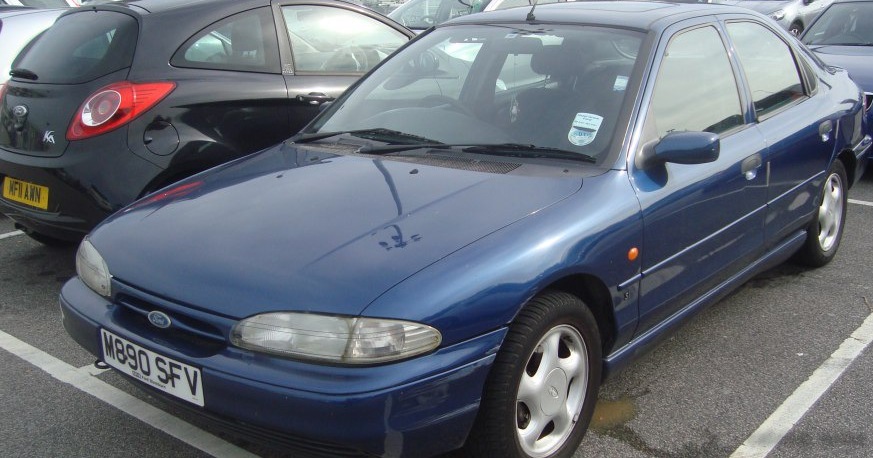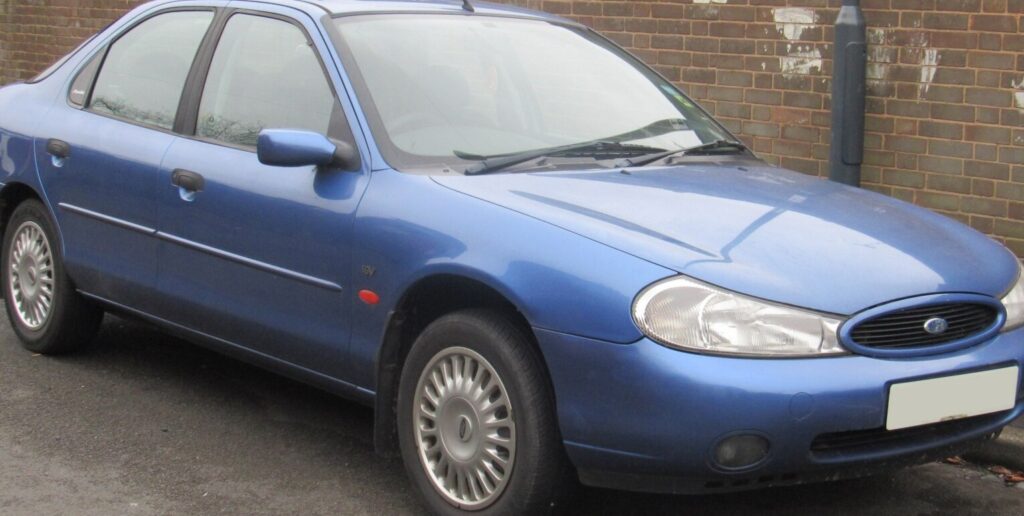
The Ford Mondeo I Hatchback (facelift 1996) 2.5 ST 200, produced from 1999 to 2001, represented the performance pinnacle of the first-generation Mondeo range. Positioned as the flagship model, the ST 200 aimed to deliver a more engaging driving experience than the standard Mondeo trims, competing with rivals like the Vauxhall/Opel Vectra GSi and offering a distinctly sporty alternative within the mid-size family car segment. It was a key model in establishing the Mondeo’s reputation for being a driver-focused vehicle, a characteristic that would continue in subsequent generations. The ST 200 was exclusively offered as a five-door hatchback, capitalizing on the Mondeo’s already practical body style while adding a performance edge.
Technical Specifications
| Brand | Ford |
| Model | Mondeo |
| Generation | Mondeo I Hatchback (facelift 1996) |
| Type (Engine) | 2.5 ST 200 (205 Hp) |
| Start of production | 1999 |
| End of production | 2001 |
| Powertrain Architecture | Internal Combustion engine |
| Body type | Hatchback |
| Seats | 5 |
| Doors | 5 |
| Fuel consumption (urban) | 14.4 l/100 km (16.3 US mpg, 19.6 UK mpg) |
| Fuel consumption (extra urban) | 7.1 l/100 km (33.1 US mpg, 39.8 UK mpg) |
| Fuel Type | Petrol (Gasoline) |
| Acceleration 0 – 100 km/h | 7.7 sec |
| Acceleration 0 – 62 mph | 7.7 sec |
| Acceleration 0 – 60 mph | 7.3 sec |
| Maximum speed | 231 km/h (143.54 mph) |
| Weight-to-power ratio | 6.6 kg/Hp, 152.4 Hp/tonne |
| Weight-to-torque ratio | 5.7 kg/Nm, 174 Nm/tonne |
| Power | 205 Hp @ 6500 rpm |
| Power per litre | 82.2 Hp/l |
| Torque | 234 Nm @ 5500 rpm (172.59 lb.-ft. @ 5500 rpm) |
| Engine layout | Front, Transverse |
| Engine Model/Code | Duratec / SGA |
| Engine displacement | 2495 cm3 (152.25 cu. in.) |
| Number of cylinders | 6 |
| Engine configuration | V-engine |
| Cylinder Bore | 81.6 mm (3.21 in.) |
| Piston Stroke | 79.5 mm (3.13 in.) |
| Compression ratio | 10.3:1 |
| Number of valves per cylinder | 4 |
| Fuel injection system | Multi-port manifold injection |
| Engine aspiration | Naturally aspirated engine |
| Valvetrain | DOHC |
| Engine oil capacity | 5.5 l (5.81 US qt | 4.84 UK qt) |
| Coolant capacity | 9.5 l (10.04 US qt | 8.36 UK qt) |
| Kerb Weight | 1345 kg (2965.22 lbs.) |
| Max. weight | 1870 kg (4122.64 lbs.) |
| Max load | 525 kg (1157.43 lbs.) |
| Trunk (boot) space – minimum | 450 l (15.89 cu. ft.) |
| Trunk (boot) space – maximum | 1290 l (45.56 cu. ft.) |
| Fuel tank capacity | 61 l (16.11 US gal | 13.42 UK gal) |
| Length | 4556 mm (179.37 in.) |
| Width | 1751 mm (68.94 in.) |
| Height | 1424 mm (56.06 in.) |
| Wheelbase | 2704 mm (106.46 in.) |
| Front track | 1503 mm (59.17 in.) |
| Rear track | 1487 mm (58.54 in.) |
| Drivetrain Architecture | Front wheel drive |
| Number of gears | 5 |
| Gearbox type | Manual transmission |
| Front suspension | Wishbone |
| Rear suspension | Coil spring |
| Front brakes | Ventilated discs |
| Rear brakes | Ventilated discs |
| Assisting systems | ABS (Anti-lock braking system) |
| Steering type | Steering rack and pinion |
| Power steering | Hydraulic Steering |
| Tires size | 215/45 R17 |
| Wheel rims size | 7J |
Powertrain & Engine Architecture
The heart of the Mondeo ST 200 was the Duratec 2.5-liter V6 engine, internally designated as the SGA code. This engine was a naturally aspirated, 60-degree V6, featuring a dual overhead camshaft (DOHC) valvetrain with four valves per cylinder. It utilized multi-port fuel injection to deliver fuel directly into the intake ports, optimizing combustion efficiency. The engine’s 205 horsepower output at 6500 rpm and 234 Nm (172.59 lb-ft) of torque at 5500 rpm were substantial for its time, providing a noticeable performance boost over the standard Mondeo engines. The engine was transversely mounted, driving the front wheels through a robust five-speed manual transmission – an automatic transmission was not offered with the ST 200. The Duratec V6 was known for its smooth power delivery and relatively refined character, making it a pleasant engine to use in everyday driving situations.
Driving Characteristics
The Mondeo ST 200 offered a significantly more engaging driving experience than its more pedestrian siblings. The 2.5-liter V6 provided strong acceleration, with a 0-60 mph time of around 7.3 seconds. While not a sports car by modern standards, this performance was competitive within its class in the late 1990s and early 2000s. The five-speed manual transmission was well-matched to the engine’s powerband, allowing drivers to effectively utilize the available torque. The gear ratios were tuned for a balance between acceleration and cruising efficiency. Compared to the 1.8-liter and 2.0-liter Mondeos, the ST 200 felt considerably more responsive and capable, particularly during overtaking maneuvers. The chassis, while shared with other Mondeo models, benefited from a slightly stiffer suspension setup, reducing body roll and improving handling precision.
Equipment & Trim Levels
The ST 200 came generously equipped, reflecting its position as the range-topping model. Standard features included alloy wheels (typically 7×17 inch), sports suspension, ABS anti-lock brakes, and a leather-wrapped steering wheel. The interior featured sport seats with unique upholstery, often incorporating a combination of cloth and leather. Air conditioning, electric windows, and a radio/cassette player were also standard. Optional extras included a sunroof, upgraded audio systems, and metallic paint finishes. The dashboard and interior trim were generally similar to other Mondeo models but featured subtle styling cues to differentiate the ST 200.
Chassis & Braking
The Mondeo ST 200 utilized a MacPherson strut front suspension and a multi-link rear suspension, providing a good balance of ride comfort and handling performance. The suspension was slightly stiffer than that of the standard Mondeo models, reducing body roll and improving steering response. Braking duties were handled by ventilated disc brakes on all four wheels, providing ample stopping power. The ABS system helped to maintain steering control during hard braking. The ST 200’s chassis was well-engineered for its weight class, offering a stable and predictable driving experience.
Market Reception & Comparison
The Mondeo ST 200 was generally well-received by automotive critics, who praised its performance, handling, and overall value. It was often lauded as one of the most engaging and enjoyable family cars available at the time. Compared to other trims in the Mondeo lineup, the ST 200 offered a significant performance upgrade, but at the cost of slightly increased fuel consumption. The 1.8-liter and 2.0-liter Mondeos were more fuel-efficient and affordable, appealing to buyers prioritizing practicality and economy. The ST 200 targeted drivers who wanted a more spirited driving experience without sacrificing the practicality of a family car.
Legacy
The Ford Mondeo ST 200 has developed a strong following among enthusiasts. The Duratec V6 engine is known for its reliability, although regular maintenance is essential. The ST 200’s relatively simple mechanical design makes it relatively easy to maintain and repair. Today, well-maintained examples are becoming increasingly collectible, as enthusiasts recognize the car’s significance as a driver-focused family car from a bygone era. The ST 200 helped to establish the Mondeo’s reputation as a capable and enjoyable vehicle, paving the way for future performance models.