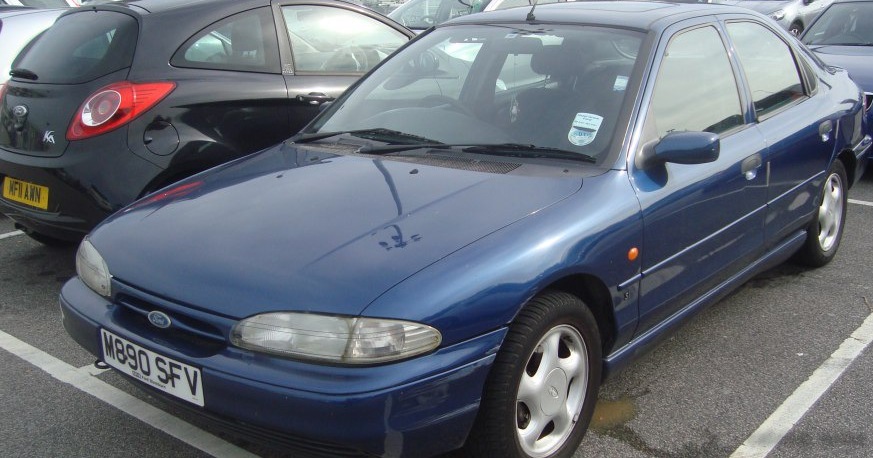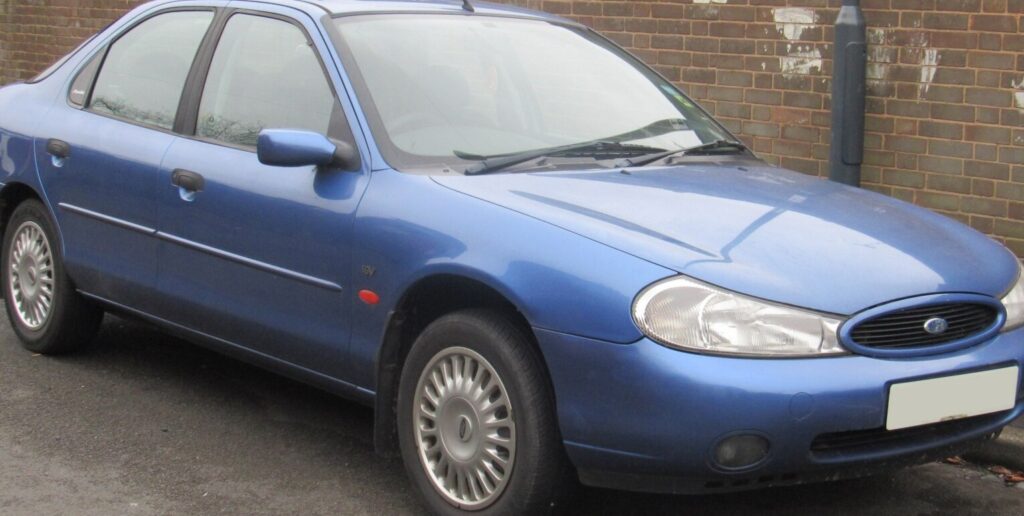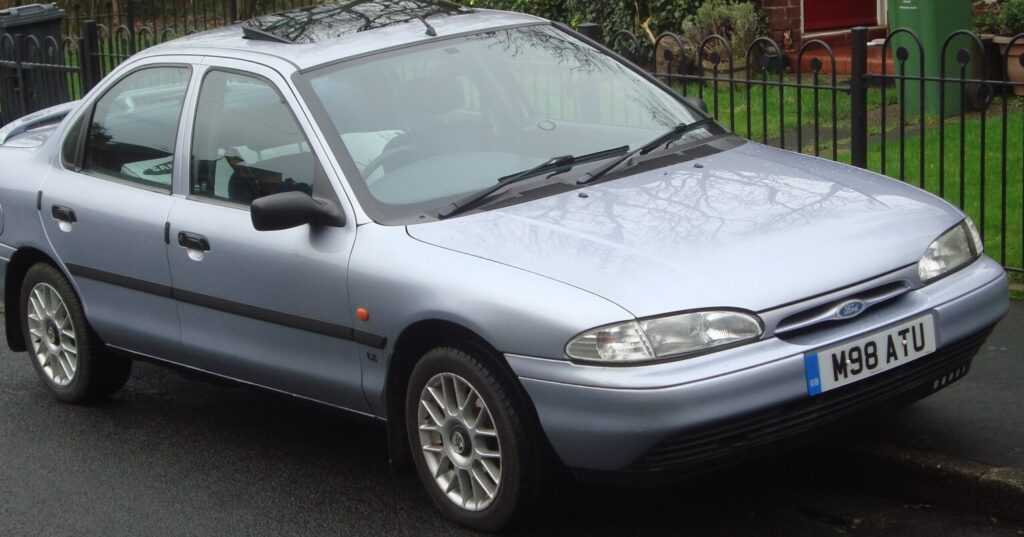
The Ford Mondeo I Sedan 1.8 i 16V Automatic, produced between 1993 and 1994, represented a significant step forward for Ford’s mid-size offerings in Europe. Part of the Mondeo I generation (1993-1996), this variant aimed to provide a comfortable and refined driving experience, targeting buyers who prioritized ease of use over outright performance. It was positioned as a mid-range trim within the Mondeo sedan lineup, slotting below the more powerful 2.0L and V6 models, and above the base 1.6L engine option. The Mondeo I was Ford’s replacement for the Sierra, and represented a move upmarket in terms of design, build quality, and technology.
Technical Specifications
| Brand | Ford |
| Model | Mondeo |
| Generation | Mondeo I Sedan |
| Type (Engine) | 1.8 i 16V (115 Hp) Automatic |
| Start of production | 1993 |
| End of production | 1994 |
| Powertrain Architecture | Internal Combustion engine |
| Body type | Sedan |
| Seats | 5 |
| Doors | 4 |
| Fuel consumption (combined) | 7.7 l/100 km (30.5 US mpg, 36.7 UK mpg, 13 km/l) |
| Fuel Type | Petrol (Gasoline) |
| Acceleration 0 – 100 km/h | 11.1 sec |
| Acceleration 0 – 62 mph | 11.1 sec |
| Acceleration 0 – 60 mph | 10.5 sec |
| Maximum speed | 195 km/h (121.17 mph) |
| Emission standard | Euro 2 |
| Weight-to-power ratio | 10.8 kg/Hp, 92.7 Hp/tonne |
| Weight-to-torque ratio | 7.8 kg/Nm, 127.4 Nm/tonne |
| Power | 115 Hp @ 5750 rpm |
| Power per litre | 64 Hp/l |
| Torque | 158 Nm @ 3750 rpm (116.53 lb.-ft. @ 3750 rpm) |
| Engine layout | Front, Transverse |
| Engine Model/Code | RKA |
| Engine displacement | 1796 cm3 (109.6 cu. in.) |
| Number of cylinders | 4 |
| Engine configuration | Inline |
| Cylinder Bore | 80.6 mm (3.17 in.) |
| Piston Stroke | 88 mm (3.46 in.) |
| Compression ratio | 10:1 |
| Number of valves per cylinder | 4 |
| Fuel injection system | Multi-port manifold injection |
| Engine aspiration | Naturally aspirated engine |
| Valvetrain | DOHC |
| Engine oil capacity | 4.25 l (4.49 US qt | 3.74 UK qt) |
| Coolant | 7.1 l (7.5 US qt | 6.25 UK qt) |
| Kerb Weight | 1240 kg (2733.73 lbs.) |
| Max. weight | 1800 kg (3968.32 lbs.) |
| Max load | 560 kg (1234.59 lbs.) |
| Trunk (boot) space – minimum | 480 l (16.95 cu. ft.) |
| Fuel tank capacity | 61 l (16.11 US gal | 13.42 UK gal) |
| Length | 4481 mm (176.42 in.) |
| Width | 1749 mm (68.86 in.) |
| Height | 1428 mm (56.22 in.) |
| Wheelbase | 2704 mm (106.46 in.) |
| Front track | 1503 mm (59.17 in.) |
| Rear (Back) track | 1487 mm (58.54 in.) |
| Drivetrain Architecture | The Internal combustion engine (ICE) drives the front wheels of the vehicle. |
| Drive wheel | Front wheel drive |
| Number of gears and type of gearbox | 4 gears, automatic transmission |
| Front suspension | Wishbone |
| Rear suspension | Coil spring |
| Front brakes | Ventilated discs |
| Rear brakes | Drum |
| Assisting systems | ABS (Anti-lock braking system) |
| Steering type | Steering rack and pinion |
| Power steering | Hydraulic Steering |
| Tires size | 185/65 R14 |
| Wheel rims size | 14 |
Powertrain & Engine Architecture
The 1.8 i 16V engine, designated with the Ford engine code RKA, is a naturally aspirated, inline-four cylinder gasoline engine. It features a dual overhead camshaft (DOHC) valvetrain operating four valves per cylinder, contributing to its relatively high power output for its displacement. The engine utilizes multi-port fuel injection, a common technology in the early 1990s, which improved fuel atomization and efficiency compared to earlier carburetor systems. The 1796cc displacement was achieved with a bore of 80.6mm and a stroke of 88mm. The 10:1 compression ratio was a standard figure for the time, balancing performance and fuel economy. Paired with this engine was a four-speed automatic transmission, designed to provide smooth and effortless gear changes. This transmission wasn’t known for being particularly sporty, prioritizing comfort and ease of driving over rapid acceleration.
Driving Characteristics
The Mondeo 1.8 Automatic offered a comfortable, if not particularly exhilarating, driving experience. With 115 horsepower and 158 Nm (116.53 lb-ft) of torque, acceleration from 0-60 mph took around 10.5 seconds, and 0-100 km/h in 11.1 seconds. Compared to the manual transmission version of the same engine, the automatic suffered a slight performance penalty due to the inherent losses in the torque converter. The automatic transmission’s gear ratios were tuned for fuel efficiency and smooth cruising, rather than aggressive acceleration. This made it well-suited for city driving and long highway journeys, but less appealing to drivers seeking a more engaging experience. Compared to the higher-output 2.0L and V6 models, the 1.8 Automatic felt noticeably slower, especially when overtaking or climbing hills.
Equipment & Trim Levels
The 1.8 i 16V Automatic trim typically included features such as power steering, central locking, electric front windows, and an AM/FM radio. Interior upholstery was generally cloth, with a relatively simple dashboard layout. Optional extras included air conditioning, a sunroof, and upgraded audio systems. The Mondeo I offered a reasonable level of standard equipment for its price point, aiming to compete with other mainstream mid-size sedans. The automatic transmission was often bundled with additional comfort features, making it a popular choice for buyers prioritizing convenience.
Chassis & Braking
The Mondeo I featured independent front suspension with wishbones and a coil spring rear suspension. This setup provided a good balance of ride comfort and handling. The front brakes were ventilated discs, offering good stopping power, while the rear brakes were drums, a cost-saving measure common in this class of vehicle. Anti-lock Braking System (ABS) was included as standard, enhancing safety. The chassis was designed to provide a stable and predictable driving experience, although it wasn’t particularly sporty. Stabilizer bars were fitted to both the front and rear axles to reduce body roll during cornering.
Market Reception & Comparison
The Ford Mondeo I was generally well-received by automotive critics, who praised its spacious interior, comfortable ride, and improved build quality compared to the Sierra. The 1.8 i 16V Automatic variant was seen as a sensible and practical choice, offering a good balance of fuel economy and usability. However, some critics noted that the automatic transmission detracted from the engine’s performance, and that the overall driving experience wasn’t as engaging as some of its rivals. Fuel economy was respectable for the time, averaging around 7.7 l/100 km (30.5 US mpg). Compared to the 1.6L engine, the 1.8 offered a noticeable performance improvement, while the 2.0L and V6 models provided significantly more power but at the cost of increased fuel consumption.
Legacy
The Ford Mondeo I 1.8 i 16V Automatic, while not the most exciting variant in the lineup, proved to be a reliable and durable powertrain. The RKA engine is generally considered to be a robust unit, capable of high mileage with proper maintenance. The automatic transmission, while not known for its sportiness, is also relatively reliable. Today, these cars are becoming increasingly rare, and well-maintained examples are sought after by enthusiasts and collectors. The Mondeo I established the Mondeo nameplate as a strong contender in the mid-size segment, and paved the way for subsequent generations that continued to build on its success. Finding parts can be challenging, but many components are still available through specialist suppliers and online marketplaces.