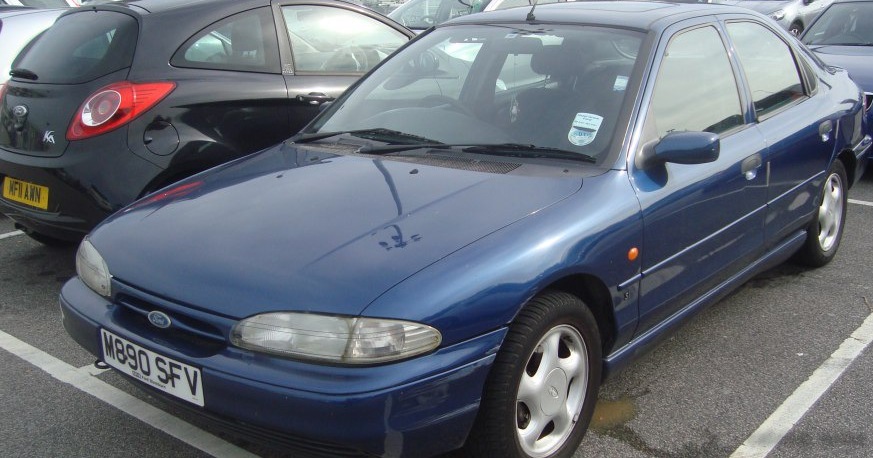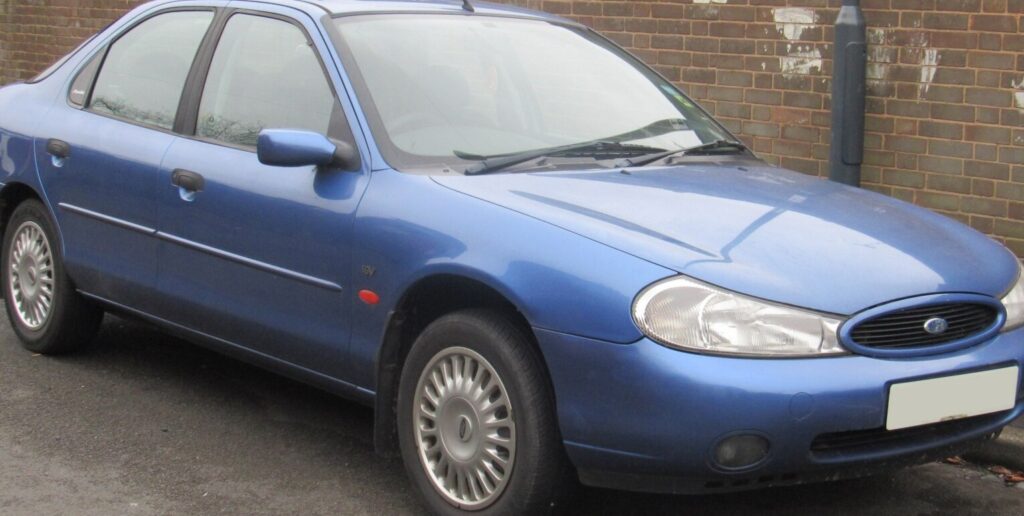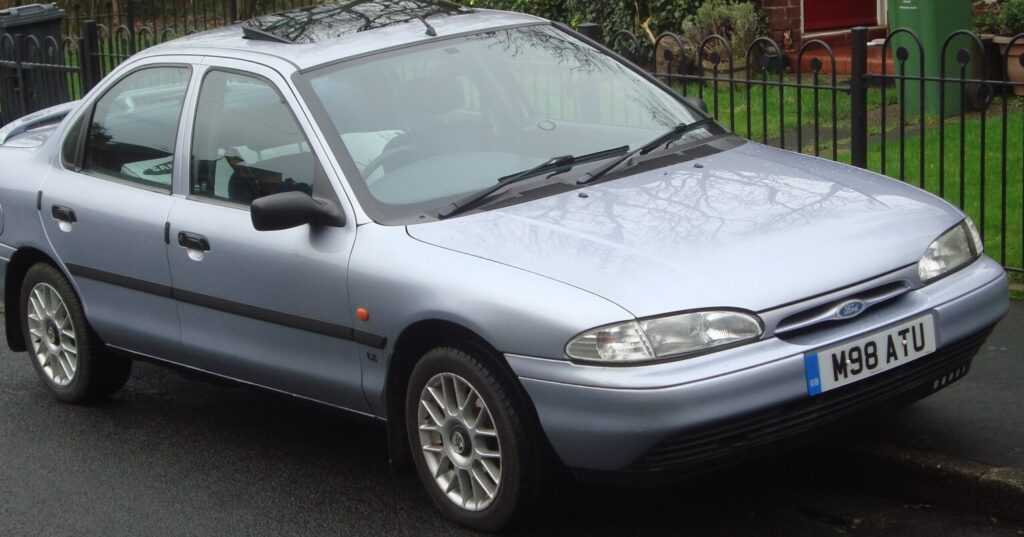
The Ford Mondeo I Sedan 1.8 TD, produced between 1993 and 1996, represented Ford’s entry into the mid-size family car segment with a diesel offering. Positioned as a more economical alternative to the gasoline-powered Mondeo variants, the 1.8 TD aimed to appeal to drivers prioritizing fuel efficiency and long-distance comfort. It was a key component of the initial Mondeo lineup, built on the CDW27 platform (internally known as the 1HX0 for the sedan), which aimed to provide a modern and spacious package for European families. This variant was particularly popular in Europe, where diesel engines held a significant market share due to favorable taxation and fuel costs.
Technical Specifications
| Brand | Ford |
| Model | Mondeo |
| Generation | Mondeo I Sedan |
| Type (Engine) | 1.8 TD (88 Hp) |
| Start of production | 1993 |
| End of production | 1996 |
| Powertrain Architecture | Internal Combustion engine |
| Body type | Sedan |
| Seats | 5 |
| Doors | 4 |
| Fuel consumption (urban) | 7.4 l/100 km (31.8 US mpg) |
| Fuel consumption (extra urban) | 4.3 l/100 km (54.7 US mpg) |
| Fuel consumption (combined) | 6.1 l/100 km (38.6 US mpg) |
| Fuel Type | Diesel |
| Acceleration 0 – 100 km/h | 13.5 sec |
| Acceleration 0 – 62 mph | 13.5 sec |
| Acceleration 0 – 60 mph | 12.8 sec |
| Maximum speed | 183 km/h (113.71 mph) |
| Weight-to-power ratio | 14.6 kg/Hp |
| Weight-to-torque ratio | 7.2 kg/Nm |
| Power | 88 Hp @ 4500 rpm |
| Power per litre | 50.2 Hp/l |
| Torque | 178 Nm @ 2200 rpm (131.29 lb.-ft. @ 2200 rpm) |
| Engine layout | Front, Transverse |
| Engine Model/Code | RFM, RFN |
| Engine displacement | 1753 cm3 (106.97 cu. in.) |
| Number of cylinders | 4 |
| Engine configuration | Inline |
| Cylinder Bore | 82.5 mm (3.25 in.) |
| Piston Stroke | 82 mm (3.23 in.) |
| Compression ratio | 21.5:1 |
| Number of valves per cylinder | 2 |
| Fuel injection system | Precombustion chamber injection |
| Engine aspiration | Turbocharger |
| Valvetrain | OHC |
| Engine oil capacity | 5.1 l (5.39 US qt | 4.49 UK qt) |
| Coolant capacity | 9.5 l (10.04 US qt | 8.36 UK qt) |
| Kerb Weight | 1285 kg (2832.94 lbs.) |
| Max. weight | 1800 kg (3968.32 lbs.) |
| Max load | 515 kg (1135.38 lbs.) |
| Trunk (boot) space – minimum | 480 l (16.95 cu. ft.) |
| Fuel tank capacity | 61 l (16.11 US gal | 13.42 UK gal) |
| Length | 4480 mm (176.38 in.) |
| Width | 1750 mm (68.9 in.) |
| Height | 1430 mm (56.3 in.) |
| Wheelbase | 2705 mm (106.5 in.) |
| Front track | 1505 mm (59.25 in.) |
| Rear track | 1485 mm (58.46 in.) |
| Drivetrain Architecture | Front wheel drive |
| Number of gears | 5 |
| Gearbox type | Manual transmission |
| Front suspension | Wishbone |
| Rear suspension | Coil spring |
| Front brakes | Disc |
| Rear brakes | Drum |
| Assisting systems | ABS (Anti-lock braking system) |
| Steering type | Steering rack and pinion |
| Power steering | Hydraulic |
| Tires size | 185/65 R14 |
| Wheel rims size | 6J x 14 |
Powertrain & Engine Architecture
The 1.8 TD Mondeo utilized the Ford RFM or RFN engine, a 1.8-liter inline-four cylinder diesel engine. This engine employed precombustion chamber injection, a system common in European diesels of the era. This system involved injecting fuel into a precombustion chamber connected to the main cylinder, promoting more complete combustion and reducing noise. The engine was turbocharged, boosting power output to 88 horsepower and 178 Nm (131 lb-ft) of torque. The turbocharger helped overcome the inherent limitations of a naturally aspirated diesel engine, providing improved acceleration and cruising ability. The engine featured a single overhead camshaft (OHC) valvetrain, operating two valves per cylinder. The five-speed manual transmission was the standard offering, chosen for its efficiency and cost-effectiveness. The engine’s design prioritized durability and fuel economy over outright performance.
Driving Characteristics
The 1.8 TD Mondeo, with its 88 hp and 178 Nm of torque, offered a distinctly different driving experience compared to the higher-powered gasoline versions. Acceleration was modest, taking around 13.5 seconds to reach 62 mph (100 km/h). However, the engine’s torque delivery provided reasonable responsiveness in everyday driving situations. The five-speed manual transmission allowed drivers to keep the engine in its optimal power band. Compared to the 2.0L gasoline engine, the 1.8 TD prioritized fuel efficiency, making it ideal for long journeys. The gear ratios were tuned for economy, meaning the engine could feel strained at higher speeds or when carrying a full load. The driving experience was generally comfortable, but lacked the sporty feel of the more powerful Mondeo variants.
Equipment & Trim Levels
The 1.8 TD Mondeo typically came with a fairly basic level of equipment, reflecting its position as an entry-level or mid-range trim. Standard features generally included power steering, central locking, and an adjustable steering column. Interior upholstery was typically cloth, and the dashboard featured a functional, if somewhat utilitarian, design. Optional extras included air conditioning, electric windows, and an upgraded audio system. Higher trim levels, such as the Ghia, offered more luxurious appointments, but were typically paired with the more powerful gasoline engines. The focus for the 1.8 TD was on providing a practical and affordable family car.
Chassis & Braking
The Mondeo I Sedan featured independent front suspension with MacPherson struts and a wishbone setup, providing a comfortable ride and decent handling. The rear suspension utilized a coil spring arrangement. Braking was accomplished via disc brakes on the front wheels and drum brakes on the rear. Anti-lock Braking System (ABS) was available, and became increasingly common as standard equipment. The chassis was designed to balance comfort and handling, offering a stable and predictable driving experience. The weight distribution was relatively even, contributing to balanced handling characteristics.
Market Reception & Comparison
The 1.8 TD Mondeo was generally well-received by critics as a practical and economical family car. Its fuel efficiency was a major selling point, particularly in Europe. However, its performance was often criticized as being somewhat lackluster compared to the gasoline-powered models. Compared to the 2.0L gasoline engine, the 1.8 TD offered significantly better fuel economy but considerably less power. The 1.9 TDI versions of the Mondeo, offered later in the production run, provided a more compelling combination of performance and economy, becoming a popular alternative. Reliability was generally good, although the diesel engine required regular maintenance to ensure optimal performance.
Legacy
The Ford Mondeo I 1.8 TD, while not the most exciting variant in the lineup, played a significant role in establishing the Mondeo as a popular and versatile family car. The RFM/RFN engine proved to be reasonably durable, and many examples are still on the road today. In the used car market, these models are often sought after by those looking for an affordable and fuel-efficient vehicle. The 1.8 TD Mondeo represents a snapshot of automotive engineering from the early 1990s, showcasing the growing importance of diesel technology and fuel efficiency in the European automotive landscape. Its legacy lies in providing a practical and economical transportation solution for families.