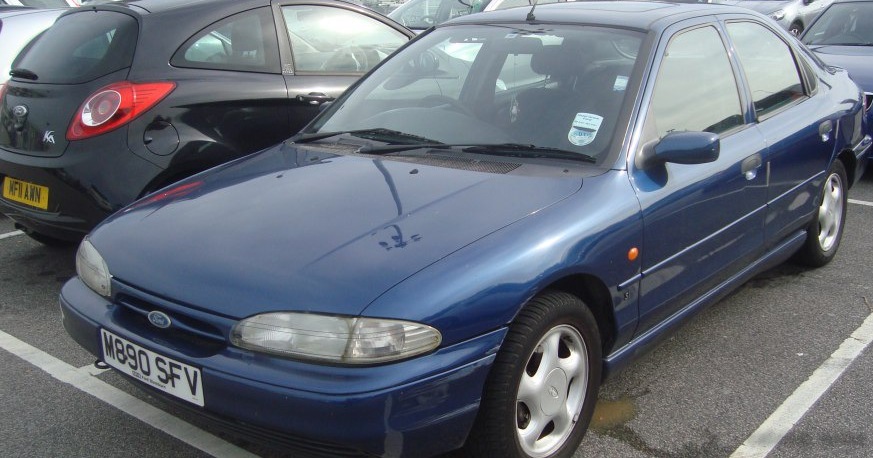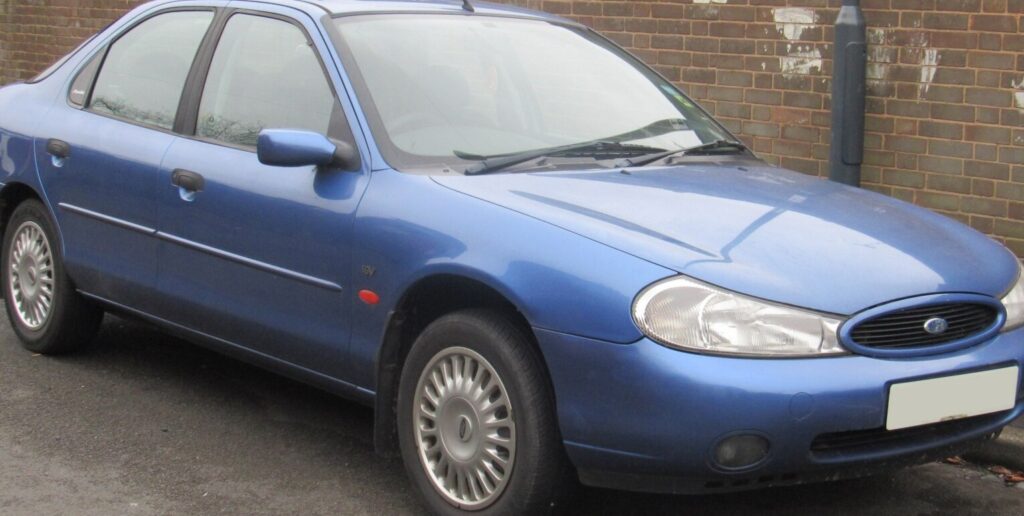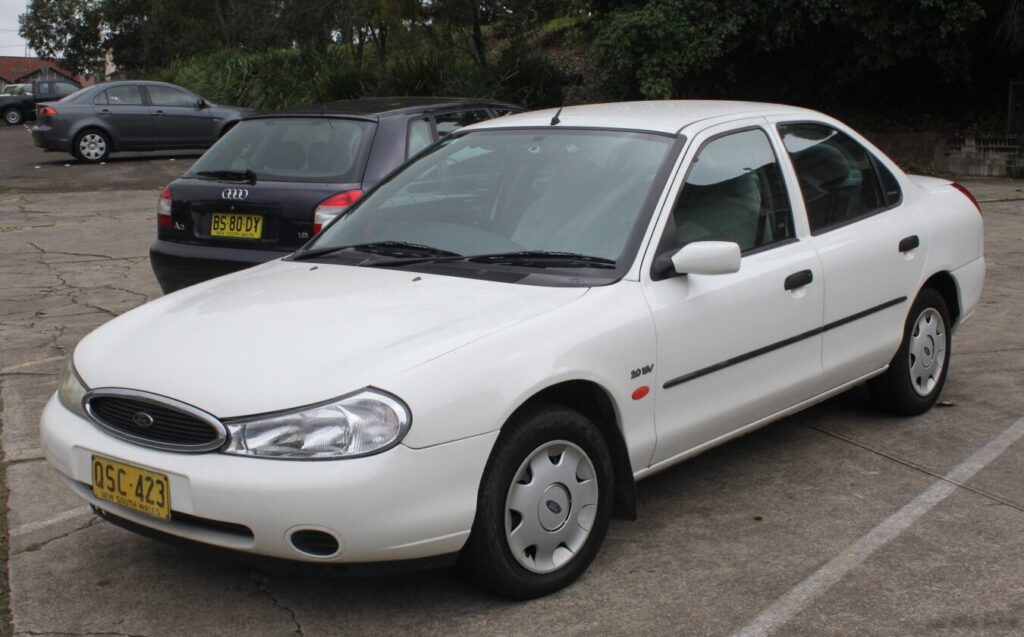
Technical Specifications
| Brand | Ford |
| Model | Mondeo |
| Generation | Mondeo I Sedan (facelift 1996) |
| Type (Engine) | 2.0i (130 Hp) |
| Start of production | 1996 |
| End of production | 2001 |
| Powertrain Architecture | Internal Combustion engine |
| Body type | Sedan |
| Seats | 5 |
| Doors | 4 |
| Fuel consumption (urban) | 11.6 l/100 km (20.3 US mpg) |
| Fuel consumption (extra urban) | 5.9 l/100 km (39.9 US mpg) |
| Fuel Type | Petrol (Gasoline) |
| Acceleration 0 – 100 km/h | 9.9 sec |
| Acceleration 0 – 62 mph | 9.9 sec |
| Acceleration 0 – 60 mph | 9.4 sec |
| Maximum speed | 206 km/h (128 mph) |
| Weight-to-power ratio | 9.6 kg/Hp |
| Weight-to-torque ratio | 7 kg/Nm |
| Power | 130 Hp @ 5600 rpm |
| Torque | 178 Nm @ 4000 rpm (131.29 lb.-ft. @ 4000 rpm) |
| Engine layout | Front, Transverse |
| Engine Model/Code | Zetec / NGA, NGB, NGC, NGD |
| Engine displacement | 1988 cm3 (121.32 cu. in.) |
| Number of cylinders | 4 |
| Engine configuration | Inline |
| Cylinder Bore | 84.8 mm (3.34 in.) |
| Piston Stroke | 88 mm (3.46 in.) |
| Compression ratio | 10:1 |
| Number of valves per cylinder | 4 |
| Fuel injection system | Multi-port manifold injection |
| Engine aspiration | Naturally aspirated engine |
| Valvetrain | OHC |
| Engine oil capacity | 4.25 l (4.49 US qt | 3.74 UK qt) |
| Coolant | 6.6 l (6.97 US qt | 5.81 UK qt) |
| Kerb Weight | 1245 kg (2744.76 lbs.) |
| Max. weight | 1815 kg (4001.39 lbs.) |
| Max load | 570 kg (1256.63 lbs.) |
| Trunk (boot) space – minimum | 460 l (16.24 cu. ft.) |
| Trunk (boot) space – maximum | 1290 l (45.56 cu. ft.) |
| Fuel tank capacity | 61 l (16.11 US gal | 13.42 UK gal) |
| Length | 4556 mm (179.37 in.) |
| Width | 1751 mm (68.94 in.) |
| Height | 1424 mm (56.06 in.) |
| Wheelbase | 2704 mm (106.46 in.) |
| Front track | 1503 mm (59.17 in.) |
| Rear (Back) track | 1487 mm (58.54 in.) |
| Drivetrain Architecture | The Internal combustion engine (ICE) drives the front wheels of the vehicle. |
| Drive wheel | Front wheel drive |
| Number of gears and type of gearbox | 5 gears, manual transmission |
| Front suspension | Wishbone |
| Rear suspension | Coil spring |
| Front brakes | Ventilated discs |
| Rear brakes | Disc |
| Assisting systems | ABS (Anti-lock braking system) |
| Steering type | Steering rack and pinion |
| Power steering | Hydraulic Steering |
| Tires size | 185/65 R14 |
The Ford Mondeo I Sedan, particularly the facelifted version introduced in 1996, represented a significant step forward for Ford’s mid-size offerings in Europe. Positioned as a direct competitor to the likes of the Volkswagen Passat and Opel Vectra, the Mondeo aimed to deliver a more modern and sophisticated driving experience. The 2.0i variant, producing 130 horsepower, was a mainstay of the lineup from 1996 through 2001, offering a balance between performance and affordability. It occupied a mid-range position within the Mondeo I family, slotting above the base 1.6L models and below the more powerful 2.5L V6.
Powertrain & Engine Architecture
The heart of the Mondeo 2.0i was the Zetec engine, specifically the NGA, NGB, NGC, or NGD code variants depending on the specific year and market. This 1.998-liter inline-four cylinder engine featured a cast iron block and an aluminum cylinder head. It utilized multi-port fuel injection, delivering fuel directly into the intake ports, and a single overhead camshaft (OHC) design. The Zetec engine was known for its relatively smooth operation and willingness to rev. The 130 horsepower output was achieved through careful tuning of the engine management system and optimized intake and exhaust designs. The engine was transversely mounted, driving the front wheels. The 2.0i was typically paired with a five-speed manual transmission, although a four-speed automatic transmission was also available, albeit less common. The automatic transmission, while offering convenience, did impact acceleration and fuel economy.
Driving Characteristics
The Mondeo 2.0i with the manual transmission offered a reasonably engaging driving experience. Acceleration to 60 mph took around 9.4 seconds, and top speed was approximately 128 mph. The engine provided adequate torque for everyday driving, with 178 Nm (131.29 lb.-ft.) available at 4000 rpm. The five-speed gearbox was well-matched to the engine’s characteristics, allowing drivers to keep the engine in its optimal power band. The automatic transmission, while smooth, noticeably dulled performance, extending the 0-60 mph time to around 9.9 seconds. Gear ratios were optimized for fuel efficiency, but this came at the expense of outright acceleration. The Mondeo’s suspension provided a comfortable ride, absorbing bumps and imperfections in the road well, while still offering decent handling characteristics.
Equipment & Trim Levels
The 2.0i Mondeo typically came equipped with features such as power steering, central locking, electric front windows, and an adjustable steering column. Higher trim levels, such as the Ghia, added features like alloy wheels, air conditioning, a sunroof, and upgraded interior trim. Interior upholstery was typically cloth, with options for leather in higher-spec models. The dashboard layout was functional and straightforward, with easy-to-read gauges and controls. Optional extras included a CD player, rear electric windows, and heated front seats.
Chassis & Braking
The Mondeo I Sedan utilized a front-wheel-drive layout with independent wishbone suspension at the front and a coil spring rear suspension. This setup provided a good balance of ride comfort and handling. The front brakes were ventilated discs, offering good stopping power, while the rear brakes were typically solid discs. Anti-lock Braking System (ABS) was standard on many models, enhancing safety. The steering was a rack and pinion system with hydraulic power assistance, providing precise and responsive steering feel. The standard tire size was 185/65 R14, offering a good compromise between comfort and grip.
Market Reception & Comparison
The Mondeo 2.0i was generally well-received by automotive critics. It was praised for its spacious interior, comfortable ride, and competitive pricing. Compared to the base 1.6L models, the 2.0i offered a noticeable performance improvement, making it a more enjoyable car to drive. However, it wasn’t as sporty as some of its rivals, such as the BMW 3 Series. The automatic transmission version was often criticized for its sluggish performance and reduced fuel economy compared to the manual. Fuel economy figures were respectable for the time, averaging around 20.3 US mpg in urban driving and 39.9 US mpg on the highway.
Legacy
The Ford Mondeo I Sedan 2.0i has proven to be a relatively reliable car, with many examples still on the road today. The Zetec engine is known for its durability, although regular maintenance is essential to prevent issues such as oil leaks and timing belt failure. The availability of spare parts is generally good, making it relatively easy and affordable to keep these cars running. In the used car market, the Mondeo 2.0i represents a good value proposition, offering a comfortable and practical family car at an affordable price. While not a collector’s item, it remains a popular choice for those seeking a dependable and reasonably economical vehicle.