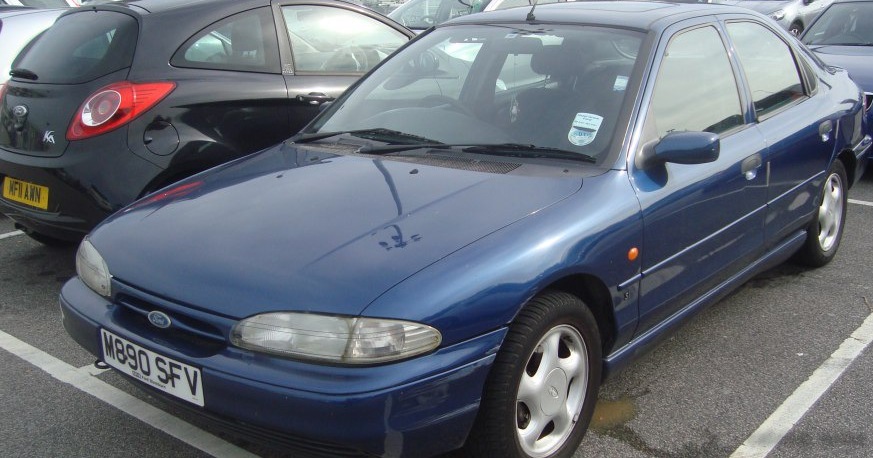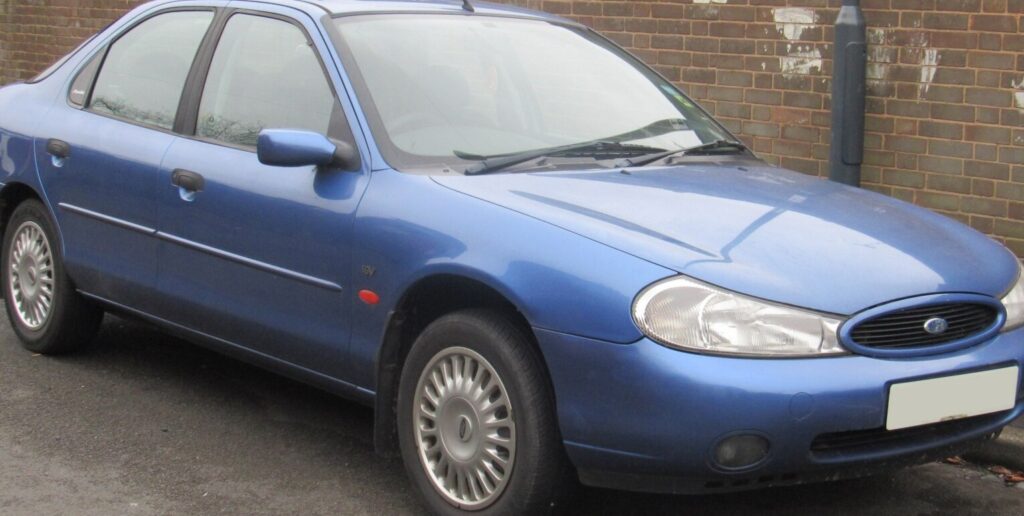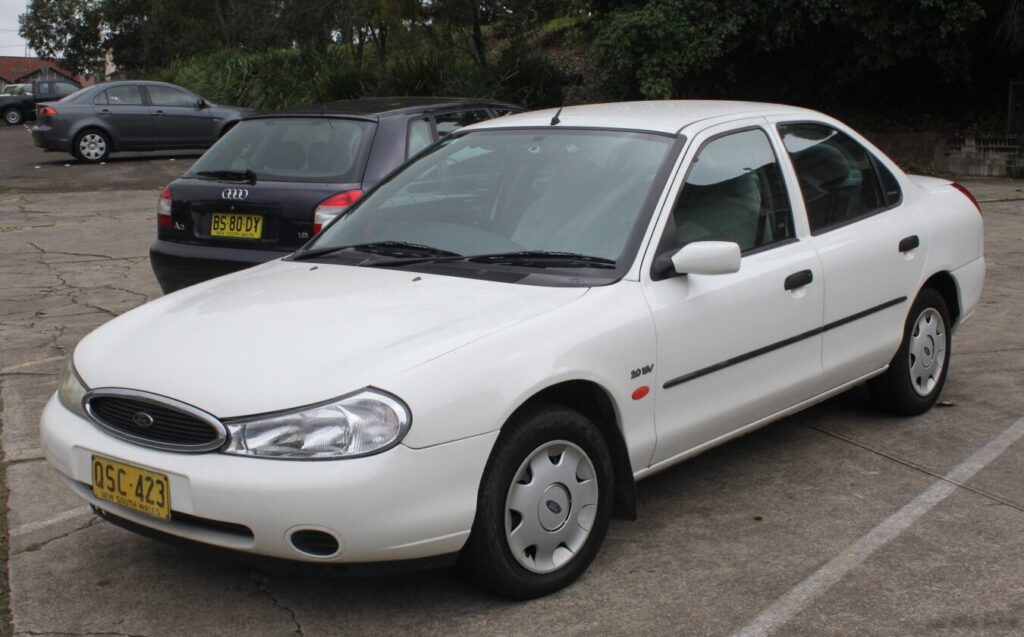
The Ford Mondeo I Sedan, particularly the 2.0i variant with an automatic transmission, represented a significant step forward for Ford’s mid-size offerings in Europe and, to a lesser extent, North America. Produced from 1996 to 2001 following a facelift of the original Mondeo introduced in 1993, this model aimed to provide a comfortable and well-equipped family sedan. The 2.0i Automatic trim occupied a middle ground in the Mondeo lineup, offering a balance between performance and affordability, positioned above the base 1.6L models and below the more powerful 2.5 V6. It was part of the first generation Mondeo (code-named B528), built on the CDW27 platform, which was shared with the Mazda 626 and the Ford Contour/Mystique in North America.
Technical Specifications
| Brand | Ford |
| Model | Mondeo |
| Generation | Mondeo I Sedan (facelift 1996) |
| Type (Engine) | 2.0i (130 Hp) Automatic |
| Start of production | 1996 |
| End of production | 2001 |
| Powertrain Architecture | Internal Combustion engine |
| Body type | Sedan |
| Seats | 5 |
| Doors | 4 |
| Fuel consumption (urban) | 12.7 l/100 km (18.5 US mpg, 22.2 UK mpg) |
| Fuel consumption (extra urban) | 6.4 l/100 km (36.8 US mpg, 44.1 UK mpg) |
| Fuel Type | Petrol (Gasoline) |
| Acceleration 0 – 100 km/h | 11.7 sec |
| Acceleration 0 – 62 mph | 11.7 sec |
| Acceleration 0 – 60 mph | 11.1 sec |
| Maximum speed | 190 km/h (118.06 mph) |
| Weight-to-power ratio | 9.6 kg/Hp |
| Weight-to-torque ratio | 7 kg/Nm |
| Power | 130 Hp @ 5600 rpm |
| Power per litre | 65.4 Hp/l |
| Torque | 178 Nm @ 4000 rpm (131.29 lb.-ft. @ 4000 rpm) |
| Engine layout | Front, Transverse |
| Engine Model/Code | Zetec / NGA, NGB, NGC, NGD |
| Engine displacement | 1988 cm3 (121.32 cu. in.) |
| Number of cylinders | 4 |
| Engine configuration | Inline |
| Cylinder Bore | 84.8 mm (3.34 in.) |
| Piston Stroke | 88 mm (3.46 in.) |
| Compression ratio | 10:1 |
| Number of valves per cylinder | 4 |
| Fuel injection system | Multi-port manifold injection |
| Engine aspiration | Naturally aspirated engine |
| Valvetrain | OHC |
| Engine oil capacity | 4.25 l (4.49 US qt | 3.74 UK qt) |
| Coolant capacity | 7.1 l (7.5 US qt | 6.25 UK qt) |
| Kerb Weight | 1245 kg (2744.76 lbs.) |
| Max. weight | 1815 kg (4001.39 lbs.) |
| Max load | 570 kg (1256.63 lbs.) |
| Trunk (boot) space – minimum | 460 l (16.24 cu. ft.) |
| Trunk (boot) space – maximum | 1290 l (45.56 cu. ft.) |
| Fuel tank capacity | 61 l (16.11 US gal | 13.42 UK gal) |
| Length | 4556 mm (179.37 in.) |
| Width | 1751 mm (68.94 in.) |
| Height | 1424 mm (56.06 in.) |
| Wheelbase | 2704 mm (106.46 in.) |
| Front track | 1503 mm (59.17 in.) |
| Rear track | 1487 mm (58.54 in.) |
| Drivetrain Architecture | Front wheel drive |
| Number of gears | 4 |
| Gearbox type | Automatic transmission |
| Front suspension | Wishbone |
| Rear suspension | Coil spring |
| Front brakes | Ventilated discs |
| Rear brakes | Disc |
| Assisting systems | ABS (Anti-lock braking system) |
| Steering type | Steering rack and pinion |
| Power steering | Hydraulic Steering |
| Tires size | 185/65 R14 |
| Wheel rims size | 14 |
Powertrain & Engine Architecture
The 2.0i Mondeo utilized Ford’s Zetec engine family, specifically the Zetec-E variant. Engine codes such as NGA, NGB, NGC, and NGD were common, denoting slight variations in calibration and emissions control equipment. This engine was a 16-valve, inline-four cylinder unit featuring a single overhead camshaft (SOHC) design. The multi-port fuel injection system delivered fuel directly to each cylinder, optimizing combustion efficiency. The 130 horsepower output was achieved through a combination of a relatively high compression ratio (10:1) and careful tuning of the engine management system. The four-speed automatic transmission was a crucial component of this variant, offering smooth gear changes but at the expense of some performance compared to the available five-speed manual. This automatic was designed for comfort and ease of use, prioritizing a relaxed driving experience over sporty responsiveness.
Driving Characteristics
The 2.0i Automatic Mondeo offered a comfortable and refined driving experience. Acceleration from 0-60 mph took around 11.1 seconds, which was adequate for everyday driving but noticeably slower than the manual transmission versions or the higher-output 2.5 V6. The automatic transmission’s gear ratios were geared towards fuel efficiency and smooth cruising, rather than aggressive acceleration. While the engine provided sufficient torque for overtaking maneuvers, it required a downshift from the automatic to access its full potential. The power delivery was linear, making it predictable and easy to control. Compared to the more engaging manual transmission, the automatic felt somewhat less connected to the driving experience, but it appealed to drivers prioritizing convenience.
Equipment & Trim Levels
The 2.0i Automatic trim typically included features such as power steering, central locking, electric front windows, and an AM/FM radio. Higher trim levels, often denoted by ‘GLX’ or ‘Ghia’ badges, added features like alloy wheels, air conditioning, a sunroof, and upgraded interior upholstery. Interior materials were generally of good quality for the price point, with a focus on durability and comfort. Optional extras included a CD player, rear electric windows, and upgraded sound systems. The dashboard layout was functional and ergonomically designed, providing easy access to essential controls.
Chassis & Braking
The Mondeo I Sedan featured an independent front suspension with MacPherson struts and a multi-link rear suspension, providing a comfortable ride and good handling characteristics. The 2.0i Automatic variant typically came equipped with ventilated disc brakes on the front wheels and solid disc brakes on the rear. Anti-lock Braking System (ABS) was standard, enhancing safety and stability during emergency braking. The suspension was tuned to prioritize ride comfort, but it still offered reasonable body control during cornering. Stabilizer bars were fitted to both the front and rear axles to reduce body roll.
Market Reception & Comparison
The 2.0i Automatic Mondeo was generally well-received by automotive critics as a practical and comfortable family sedan. It offered a good balance of features and affordability, making it a popular choice for buyers seeking a reliable and well-equipped vehicle. However, some critics noted that the automatic transmission detracted from the driving experience compared to the manual version. Fuel economy was respectable for its class, averaging around 25 mpg in mixed driving conditions. Compared to rivals like the Vauxhall/Opel Vectra and the Volkswagen Passat, the Mondeo offered a more modern design and a more engaging driving experience.
Legacy
The Ford Mondeo I Sedan, particularly the 2.0i Automatic variant, has proven to be a relatively reliable vehicle over the long term. The Zetec engine is known for its durability, and the automatic transmission, while not the sportiest, is generally dependable. Today, these vehicles are relatively affordable on the used car market, making them a popular choice for budget-conscious buyers. However, potential buyers should be aware of common issues such as corrosion, particularly on older examples, and potential wear and tear on suspension components. The Mondeo I established Ford as a serious contender in the mid-size sedan segment, paving the way for subsequent generations that continued to build on its success.