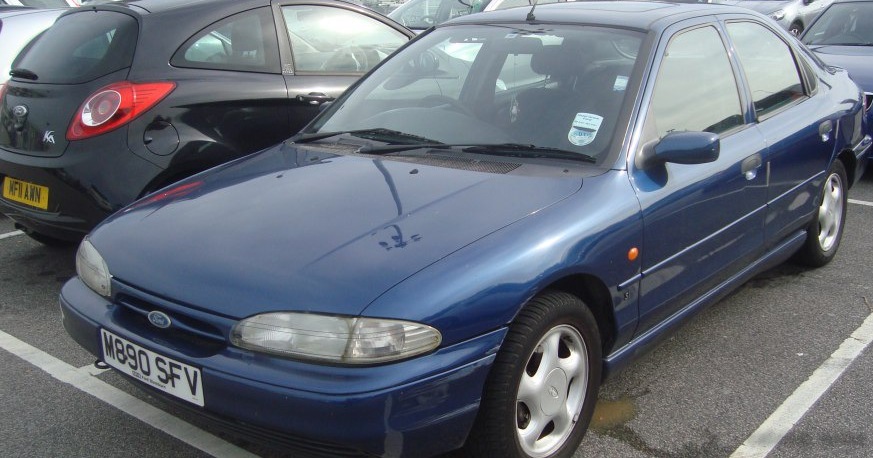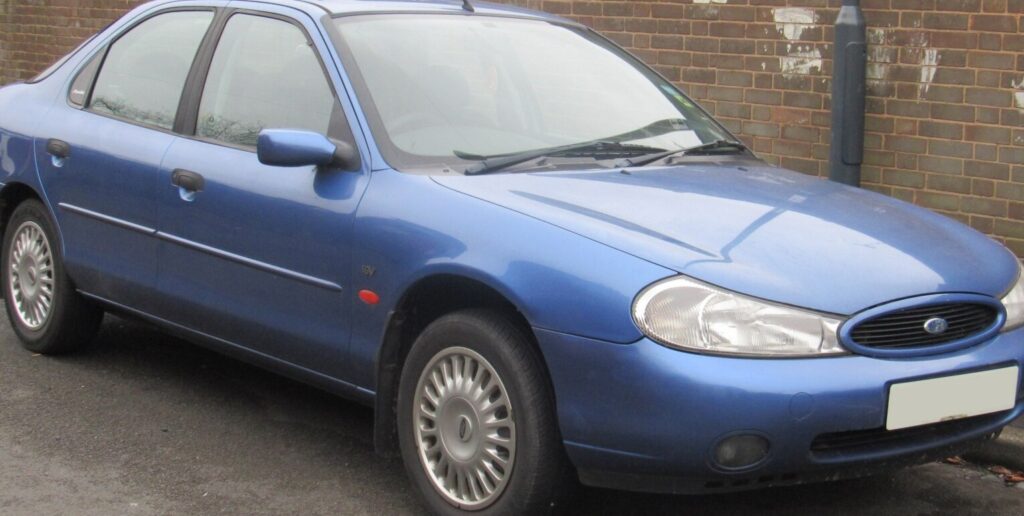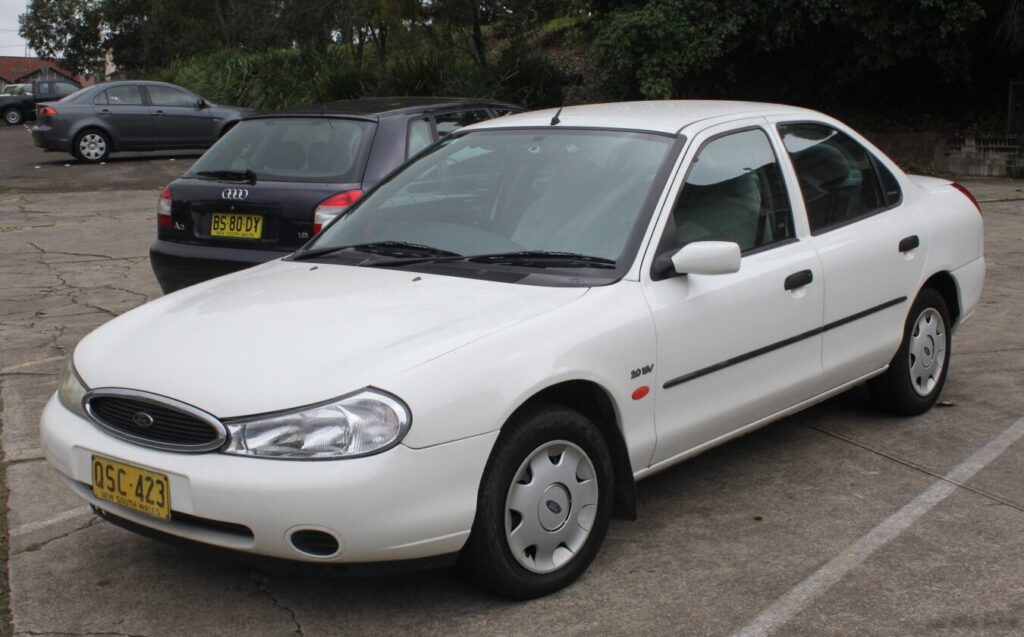
The Ford Mondeo I Sedan (facelift 1996) 2.5 ST 200, produced from 1999 to 2001, represented the performance pinnacle of the first-generation Mondeo sedan. Positioned as the flagship trim, it offered a significant step up in power and handling compared to the more common 1.8L and 2.0L variants. This model was primarily aimed at the European market, where the Mondeo competed with vehicles like the Volkswagen Passat and Opel Vectra, offering a blend of practicality, comfort, and sporting performance. The “ST” designation signified Ford’s Sport Technologies division’s involvement, indicating a focus on enhanced driving dynamics.
Technical Specifications
| Brand | Ford |
| Model | Mondeo |
| Generation | Mondeo I Sedan (facelift 1996) |
| Type (Engine) | 2.5 ST 200 (205 Hp) |
| Start of production | 1999 |
| End of production | 2001 |
| Powertrain Architecture | Internal Combustion engine |
| Body type | Sedan |
| Seats | 5 |
| Doors | 4 |
| Fuel consumption (urban) | 14.4 l/100 km (16.3 US mpg, 19.6 UK mpg) |
| Fuel consumption (extra urban) | 7.1 l/100 km (33.1 US mpg, 39.8 UK mpg) |
| Fuel Type | Petrol (Gasoline) |
| Acceleration 0 – 100 km/h | 7.7 sec |
| Acceleration 0 – 62 mph | 7.7 sec |
| Acceleration 0 – 60 mph | 7.3 sec |
| Maximum speed | 231 km/h (143.54 mph) |
| Weight-to-power ratio | 6.6 kg/Hp, 152.4 Hp/tonne |
| Weight-to-torque ratio | 5.7 kg/Nm, 174 Nm/tonne |
| Power | 205 Hp @ 6500 rpm |
| Power per litre | 82.2 Hp/l |
| Torque | 234 Nm @ 5500 rpm (172.59 lb.-ft. @ 5500 rpm) |
| Engine layout | Front, Transverse |
| Engine Model/Code | Duratec / SGA |
| Engine displacement | 2495 cm3 (152.25 cu. in.) |
| Number of cylinders | 6 |
| Engine configuration | V-engine |
| Cylinder Bore | 81.6 mm (3.21 in.) |
| Piston Stroke | 79.5 mm (3.13 in.) |
| Compression ratio | 10.3:1 |
| Number of valves per cylinder | 4 |
| Fuel injection system | Multi-port manifold injection |
| Engine aspiration | Naturally aspirated engine |
| Valvetrain | DOHC |
| Engine oil capacity | 5.5 l (5.81 US qt | 4.84 UK qt) |
| Coolant capacity | 9.5 l (10.04 US qt | 8.36 UK qt) |
| Kerb Weight | 1345 kg (2965.22 lbs.) |
| Max. weight | 1870 kg (4122.64 lbs.) |
| Max load | 525 kg (1157.43 lbs.) |
| Trunk (boot) space – minimum | 450 l (15.89 cu. ft.) |
| Trunk (boot) space – maximum | 1290 l (45.56 cu. ft.) |
| Fuel tank capacity | 61 l (16.11 US gal | 13.42 UK gal) |
| Length | 4556 mm (179.37 in.) |
| Width | 1751 mm (68.94 in.) |
| Height | 1424 mm (56.06 in.) |
| Wheelbase | 2704 mm (106.46 in.) |
| Front track | 1503 mm (59.17 in.) |
| Rear track | 1487 mm (58.54 in.) |
| Drivetrain Architecture | Front wheel drive |
| Number of gears | 5 |
| Gearbox type | Manual transmission |
| Front suspension | Wishbone |
| Rear suspension | Coil spring |
| Front brakes | Ventilated discs |
| Rear brakes | Disc |
| Assisting systems | ABS (Anti-lock braking system) |
| Steering type | Steering rack and pinion |
| Power steering | Hydraulic |
| Tires size | 215/45 R17 |
Powertrain & Engine Architecture
The heart of the Mondeo ST 200 was the Duratec 2.5-liter V6 engine, internally designated as the SGA code. This engine was a naturally aspirated, 60-degree V6, featuring a dual overhead camshaft (DOHC) valvetrain with four valves per cylinder. It utilized multi-port fuel injection to deliver fuel directly into the intake ports, optimizing combustion efficiency. The engine’s 10.3:1 compression ratio contributed to its respectable power output. The engine was transversely mounted, driving the front wheels. The five-speed manual transmission was specifically chosen to handle the increased torque and power, offering precise gear changes and a more engaging driving experience. This transmission featured relatively short gear ratios, designed to maximize acceleration.
Driving Characteristics
The 2.5 ST 200 offered a noticeably more spirited driving experience than its lower-powered siblings. Acceleration to 60 mph was achieved in approximately 7.3 seconds, and it boasted a top speed of 143.54 mph. The engine delivered a smooth and linear power delivery, with peak torque available at 5500 rpm. The short gear ratios of the manual transmission kept the engine within its power band, providing responsive acceleration in most driving situations. While not as nimble as some rear-wheel-drive competitors, the Mondeo ST 200 offered a good balance of handling and ride comfort. The front-wheel-drive configuration could exhibit some torque steer under hard acceleration, but this was generally manageable.
Equipment & Trim Levels
The ST 200 came generously equipped, reflecting its position as the range-topping model. Standard features included alloy wheels, sports suspension, air conditioning, power windows, and a CD stereo system. The interior featured sport seats with unique upholstery, often incorporating a combination of cloth and leather. Optional extras included a sunroof, leather upholstery, and upgraded audio systems. The dashboard featured a distinctive instrument cluster with unique graphics and additional gauges.
Chassis & Braking
The Mondeo ST 200 benefited from a revised suspension setup compared to the standard Mondeo. Stiffer springs and dampers, along with a thicker front stabilizer bar, reduced body roll and improved handling. The braking system featured ventilated discs on the front wheels and solid discs on the rear, providing adequate stopping power. Anti-lock Braking System (ABS) was standard, enhancing safety and control during emergency braking situations.
Market Reception & Comparison
The Mondeo ST 200 was generally well-received by automotive critics. It was praised for its powerful engine, engaging handling, and comfortable interior. However, some critics noted the front-wheel-drive configuration limited its ultimate handling potential compared to rear-wheel-drive rivals. Compared to the 1.8L and 2.0L Mondeo variants, the ST 200 offered significantly improved performance but at the cost of slightly lower fuel economy. The 1.8L models were favored by those prioritizing fuel efficiency and affordability, while the 2.0L offered a compromise between performance and economy. The ST 200 was aimed at drivers who wanted a genuinely sporty and capable sedan.
Legacy
The Ford Mondeo ST 200 has developed a cult following among enthusiasts. The Duratec V6 engine is known for its reliability and durability, provided it is properly maintained. While not immune to age-related issues, the powertrain is generally considered robust. Today, well-maintained examples of the ST 200 are sought after by collectors and enthusiasts, representing a unique and enjoyable driving experience from the late 1990s/early 2000s. Parts availability is generally good, although some specific ST 200 components may be becoming increasingly difficult to find.