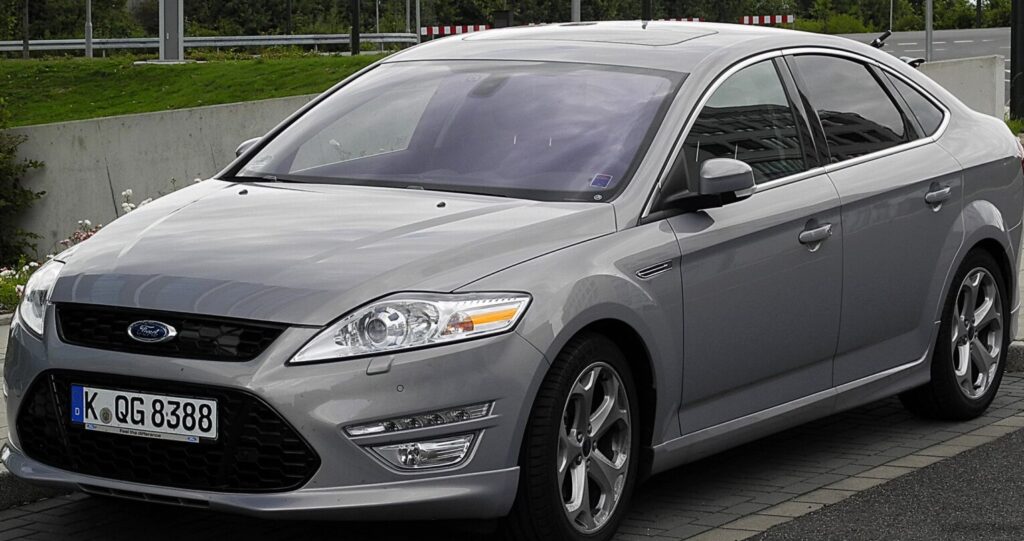
The Ford Mondeo III facelift, produced from 2010 to 2014, represented a significant refresh of the popular mid-size family car. Among the engine options available, the 2.0 EcoBoost variant paired with the PowerShift dual-clutch transmission (DCT) offered a compelling blend of performance and efficiency. This configuration, producing 203 horsepower, positioned itself as a mid-to-upper range offering within the Mondeo lineup, appealing to drivers seeking a more engaging experience than the base models but without the cost of the top-tier trims. The facelift brought updated styling, improved interior materials, and enhanced technology, solidifying the Mondeo’s position as a strong competitor in the European and, to a lesser extent, North American markets.
Technical Specifications
| Brand | Ford |
| Model | Mondeo |
| Generation | Mondeo III Hatchback (facelift 2010) |
| Type (Engine) | 2.0 EcoBoost (203 Hp) PowerShift |
| Start of production | 2010 |
| End of production | 2014 |
| Powertrain Architecture | Internal Combustion engine |
| Body type | Hatchback |
| Seats | 5 |
| Doors | 5 |
| Fuel consumption (urban) | 10.7 l/100 km (22 US mpg, 26.4 UK mpg, 9.3 km/l) |
| Fuel consumption (extra urban) | 6 l/100 km (39.2 US mpg, 47.1 UK mpg, 16.7 km/l) |
| Fuel consumption (combined) | 7.7 l/100 km (30.5 US mpg, 36.7 UK mpg, 13 km/l) |
| CO2 emissions | 179 g/km |
| Fuel Type | Petrol (Gasoline) |
| Acceleration 0 – 100 km/h | 7.9 sec |
| Acceleration 0 – 62 mph | 7.9 sec |
| Acceleration 0 – 60 mph | 7.5 sec |
| Maximum speed | 232 km/h (144.16 mph) |
| Emission standard | Euro 5 |
| Weight-to-power ratio | 7.7 kg/Hp, 129.4 Hp/tonne |
| Weight-to-torque ratio | 5.2 kg/Nm, 191.2 Nm/tonne |
| Power | 203 Hp @ 6000 rpm |
| Power per litre | 101.6 Hp/l |
| Torque | 300 Nm @ 1750-4500 rpm (221.27 lb.-ft. @ 1750-4500 rpm) |
| Engine layout | Front, Transverse |
| Engine Model/Code | TNBA |
| Engine displacement | 1999 cm3 (121.99 cu. in.) |
| Number of cylinders | 4 |
| Engine configuration | Inline |
| Cylinder Bore | 87.5 mm (3.44 in.) |
| Piston Stroke | 83.1 mm (3.27 in.) |
| Compression ratio | 10:1 |
| Number of valves per cylinder | 4 |
| Fuel injection system | Direct injection |
| Engine aspiration | Turbocharger, Intercooler |
| Valvetrain | DOHC |
| Engine oil capacity | 5.4 l (5.71 US qt | 4.75 UK qt) |
| Coolant | 6.2 l (6.55 US qt | 5.46 UK qt) |
| Kerb Weight | 1569 kg (3459.05 lbs.) |
| Max. weight | 2200 kg (4850.17 lbs.) |
| Max load | 631 kg (1391.12 lbs.) |
| Trunk (boot) space – minimum | 486 l (17.16 cu. ft.) |
| Trunk (boot) space – maximum | 1390 l (49.09 cu. ft.) |
| Length | 4784 mm (188.35 in.) |
| Width | 1886 mm (74.25 in.) |
| Height | 1500 mm (59.06 in.) |
| Wheelbase | 2850 mm (112.2 in.) |
| Front track | 1588 mm (62.52 in.) |
| Rear (Back) track | 1605 mm (63.19 in.) |
| Minimum turning circle | 11.6 m (38.06 ft.) |
| Drivetrain Architecture | The Internal combustion engine (ICE) drives the front wheels of the vehicle. |
| Drive wheel | Front wheel drive |
| Number of gears and type of gearbox | 6 gears, automatic transmission PowerShift |
| Front suspension | Independent, type McPherson with coil spring and anti-roll bar |
| Rear suspension | Independent multi-link spring suspension with stabilizer |
| Front brakes | Ventilated discs |
| Rear brakes | Disc |
| Assisting systems | ABS (Anti-lock braking system) |
| Steering type | Steering rack and pinion |
| Tires size | 205/55 R16 |
| Wheel rims size | 6.5J x 16 |
INTRODUCTION
The 2010-2014 Ford Mondeo III facelift, specifically the 2.0 EcoBoost 203 hp model equipped with the PowerShift transmission, was a key offering in Ford of Europe’s lineup. Built on the C390 platform (also known as the 1HX0 for the hatchback), this variant aimed to provide a more dynamic driving experience compared to the lower-powered engine options. The EcoBoost engine, a relatively new technology at the time, combined direct injection, turbocharging, and variable valve timing to deliver a balance of performance and fuel efficiency. The PowerShift transmission, a six-speed dual-clutch transmission (DCT), further enhanced the driving experience with quicker shifts and improved responsiveness. This combination targeted buyers who desired a modern, well-equipped family car with a sporty edge.
Powertrain & Engine Architecture
The heart of this Mondeo variant is the TNBA 2.0-liter inline-four cylinder EcoBoost engine. This engine utilizes direct fuel injection, spraying fuel directly into the combustion chamber for improved efficiency and power. A single turbocharger, coupled with an intercooler, provides forced induction, boosting power output. The engine also features Ford’s Twin Independent Variable Camshaft Timing (Ti-VCT), allowing for precise control of valve timing to optimize performance across the rev range. The PowerShift 6F35 transmission is a six-speed dual-clutch transmission. Unlike a traditional automatic, it uses two separate clutches – one for odd gears and one for even gears – allowing for seamless and rapid gear changes. This transmission is electronically controlled and offers a manual shift mode for greater driver involvement. The engine’s control unit (ECU) manages all aspects of engine operation, including fuel injection, ignition timing, and turbocharger boost pressure.
Driving Characteristics
The 203 hp EcoBoost engine, paired with the PowerShift transmission, provided a noticeable step up in performance compared to the lower-powered Mondeo variants. Acceleration from 0-60 mph was achieved in around 7.5 to 7.9 seconds, making it a relatively quick vehicle for its class. The PowerShift transmission contributed to this performance by providing quick and smooth gear changes, minimizing power interruption during shifts. While not as engaging as a traditional manual transmission, the PowerShift offered a good balance of convenience and performance. The gear ratios were tuned to provide strong acceleration in the lower gears, while higher gears were optimized for fuel efficiency during cruising. Compared to the 1.6 EcoBoost or the diesel variants, this 2.0L offered a more responsive and powerful driving experience, though it came at the cost of slightly higher fuel consumption.
Equipment & Trim Levels
The 2.0 EcoBoost PowerShift Mondeo typically came equipped with a generous level of standard features. These included air conditioning, power windows and mirrors, a CD/MP3 stereo system, and alloy wheels. Higher trim levels, such as Titanium, added features like leather upholstery, heated front seats, a sunroof, and a more advanced infotainment system with navigation. Optional extras included parking sensors, automatic headlights and wipers, and a premium sound system. Interior upholstery was typically cloth on lower trims and leather on higher trims. The dashboard layout was modern and functional, with a clear instrument cluster and intuitive controls.
Chassis & Braking
The Mondeo III facelift utilized an independent McPherson strut suspension setup at the front and an independent multi-link suspension at the rear. This suspension configuration provided a comfortable ride while maintaining good handling characteristics. Stabilizer bars were fitted to both the front and rear axles to reduce body roll during cornering. The braking system consisted of ventilated discs at the front and solid discs at the rear. Anti-lock Braking System (ABS) was standard, providing enhanced braking performance and stability. The steering was a rack and pinion system, offering precise and responsive steering feel.
Market Reception & Comparison
The 2.0 EcoBoost PowerShift Mondeo received generally positive reviews from automotive critics. It was praised for its strong performance, comfortable ride, and well-equipped interior. However, the PowerShift transmission did receive some criticism due to reports of occasional jerky shifts and reliability concerns, particularly in early production models. Compared to the 1.6 EcoBoost, the 2.0L offered a significant performance upgrade, while the diesel variants provided better fuel economy but less outright power. Fuel economy was respectable for a petrol engine of this size, averaging around 30.5 US mpg in combined driving.
Legacy
The 2.0 EcoBoost PowerShift Mondeo remains a popular choice in the used car market. While the PowerShift transmission’s reliability has been a concern for some owners, many examples have proven to be durable and reliable with proper maintenance. The EcoBoost engine is generally considered to be a robust and reliable unit. Today, these Mondeos offer a compelling value proposition for buyers seeking a spacious, well-equipped, and relatively sporty family car. The combination of performance, comfort, and technology continues to make it a desirable option in the mid-size segment.