Technical Specifications
| Brand | Ford |
| Model | Mondeo |
| Generation | Mondeo III Hatchback (facelift 2010) |
| Type (Engine) | 2.0 TDCI (115 Hp) Duratorq |
| Start of production | 2010 |
| End of production | 2014 |
| Powertrain Architecture | Internal Combustion engine |
| Body type | Hatchback |
| Seats | 5 |
| Doors | 5 |
| Fuel consumption (urban) | 6.4 l/100 km (36.8 US mpg, 44.1 UK mpg, 15.6 km/l) |
| Fuel consumption (extra urban) | 4.6 l/100 km (51.1 US mpg, 61.4 UK mpg, 21.7 km/l) |
| Fuel consumption (combined) | 5.3 l/100 km (44.4 US mpg, 53.3 UK mpg, 18.9 km/l) |
| CO2 emissions | 139 g/km |
| Fuel Type | Diesel |
| Acceleration 0 – 100 km/h | 11.2 sec |
| Acceleration 0 – 62 mph | 11.2 sec |
| Acceleration 0 – 60 mph | 10.6 sec |
| Maximum speed | 192 km/h (119.3 mph) |
| Emission standard | Euro 5 |
| Weight-to-power ratio | 13.5 kg/Hp, 73.9 Hp/tonne |
| Weight-to-torque ratio | 5.2 kg/Nm, 192.7 Nm/tonne |
| Power | 115 Hp @ 3750 rpm |
| Power per litre | 57.6 Hp/l |
| Torque | 300 Nm @ 1500-2250 rpm (221.27 lb.-ft. @ 1500-2250 rpm) |
| Engine layout | Front, Transverse |
| Engine Model/Code | TYBA |
| Engine displacement | 1997 cm3 (121.86 cu. in.) |
| Number of cylinders | 4 |
| Engine configuration | Inline |
| Cylinder Bore | 85 mm (3.35 in.) |
| Piston Stroke | 88 mm (3.46 in.) |
| Compression ratio | 17.9:1 |
| Number of valves per cylinder | 4 |
| Fuel injection system | Diesel Commonrail |
| Engine aspiration | Turbocharger, Intercooler |
| Engine oil capacity | 5.5 l (5.81 US qt | 4.84 UK qt) |
| Coolant | 8.1 l (8.56 US qt | 7.13 UK qt) |
| Kerb Weight | 1557 kg (3432.6 lbs.) |
| Max. weight | 2180 kg (4806.08 lbs.) |
| Max load | 623 kg (1373.48 lbs.) |
| Trunk (boot) space – minimum | 486 l (17.16 cu. ft.) |
| Trunk (boot) space – maximum | 1390 l (49.09 cu. ft.) |
| Length | 4784 mm (188.35 in.) |
| Width | 1886 mm (74.25 in.) |
| Height | 1500 mm (59.06 in.) |
| Wheelbase | 2850 mm (112.2 in.) |
| Front track | 1588 mm (62.52 in.) |
| Rear (Back) track | 1605 mm (63.19 in.) |
| Minimum turning circle | 11.6 m (38.06 ft.) |
| Drivetrain Architecture | The Internal combustion engine (ICE) drives the front wheels of the vehicle. |
| Drive wheel | Front wheel drive |
| Number of gears and type of gearbox | 6 gears, manual transmission |
| Front suspension | Independent, type McPherson with coil spring and anti-roll bar |
| Rear suspension | Independent multi-link spring suspension with stabilizer |
| Front brakes | Ventilated discs |
| Rear brakes | Disc |
| Assisting systems | ABS (Anti-lock braking system) |
| Steering type | Steering rack and pinion |
| Tires size | 205/55 R16 |
| Wheel rims size | 6.5J x 16 |
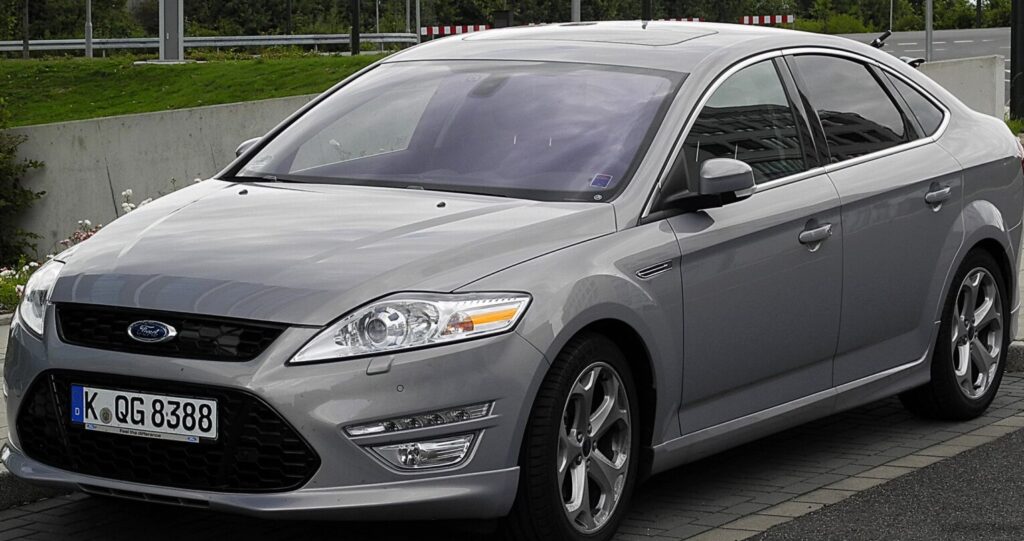
The Ford Mondeo III Hatchback, specifically the 2.0 TDCI variant produced from 2010 to 2014, represented a significant refinement of Ford’s mid-size offering in the European market. This facelifted version of the third-generation Mondeo (internally designated as the 2010 model year update) aimed to enhance fuel efficiency and reduce emissions while maintaining the practicality and comfort that had become hallmarks of the Mondeo nameplate. The 2.0 TDCI with 115 horsepower was positioned as a core engine option, appealing to buyers seeking a balance between running costs and everyday usability. It sat below the more powerful 2.2-liter TDCi models and above the lower-powered 1.6-liter petrol variants in the lineup.
Powertrain & Engine Architecture
The heart of this Mondeo variant is the 2.0-liter Duratorq TDCi engine, bearing the code TYBA. This engine is a four-cylinder, inline diesel utilizing a common-rail direct injection system. The common-rail system, supplied by Bosch, allowed for precise fuel delivery at very high pressures, contributing to improved combustion efficiency and reduced emissions. A turbocharger with an intercooler further enhances performance by forcing more air into the cylinders. The engine features four valves per cylinder, operated by a single overhead camshaft. The 115 horsepower output is achieved at 3750 rpm, while the peak torque of 300 Nm (221 lb-ft) is available from a low 1500 rpm, providing good responsiveness for everyday driving. The engine’s design prioritized fuel economy and low-end torque over outright power. The 6-speed manual transmission was the standard offering, chosen for its efficiency and driver engagement.
Driving Characteristics
The 2.0 TDCI 115 hp Mondeo offered a comfortable and refined driving experience, prioritizing fuel efficiency over sporty performance. Acceleration from 0-60 mph took around 10.6 seconds, which was adequate for most driving situations but noticeably slower than the higher-powered TDCi variants. The engine’s strong low-end torque made it easy to navigate city traffic and provided sufficient power for overtaking on the highway. The six-speed manual transmission was well-matched to the engine’s characteristics, allowing drivers to keep the engine in its optimal torque band. Compared to the 2.2-liter TDCi models, this variant felt less urgent in its acceleration, but it offered significantly better fuel economy. The suspension provided a good balance between comfort and handling, absorbing bumps effectively while maintaining reasonable body control.
Equipment & Trim Levels
The 2.0 TDCI 115 hp Mondeo typically came equipped with a respectable level of standard features. These generally included air conditioning, power windows, power mirrors, a CD/radio system, and alloy wheels. Higher trim levels, such as Titanium, added features like automatic climate control, rain-sensing wipers, rear parking sensors, and upgraded interior trim. Interior upholstery was typically cloth, with options for leather available on higher-spec models. Optional extras included a navigation system, a sunroof, and a premium sound system. The dashboard layout was functional and user-friendly, with clear instrumentation and logically placed controls.
Chassis & Braking
The Mondeo III utilized an independent front suspension with McPherson struts and a multi-link independent rear suspension. This setup provided a comfortable ride and good handling characteristics. The front brakes were ventilated discs, while the rear brakes were solid discs. Anti-lock Braking System (ABS) was standard, enhancing safety during emergency braking. The steering was a rack-and-pinion system, providing precise and responsive steering feel. The standard tire size was 205/55 R16, offering a good balance between grip and ride comfort.
Market Reception & Comparison
The 2.0 TDCI 115 hp Mondeo was well-received by critics as a practical and economical choice. It was praised for its fuel efficiency, comfortable ride, and spacious interior. However, some reviewers noted that the engine lacked the outright performance of the higher-powered TDCi variants. Compared to the 2.2-liter TDCi, the 2.0-liter offered better fuel economy but slower acceleration. Against competitors like the Volkswagen Passat and Opel/Vauxhall Insignia, the Mondeo offered a compelling combination of value, practicality, and driving dynamics. Its fuel economy was competitive within its class, and its reliability proved to be generally good.
Legacy
The 2.0 Duratorq TDCi engine, in various iterations, proved to be a robust and reliable powerplant. The TYBA code engine found in the Mondeo is generally known for its longevity, provided it receives regular maintenance, including oil changes and timing belt replacements. On the used car market, these Mondeos represent a good value proposition, offering a comfortable and economical driving experience. However, potential buyers should be aware of the potential for diesel particulate filter (DPF) issues, particularly on vehicles that have primarily been used for short journeys. Overall, the 2.0 TDCI 115 hp Mondeo remains a popular choice for those seeking a practical and reliable family car.