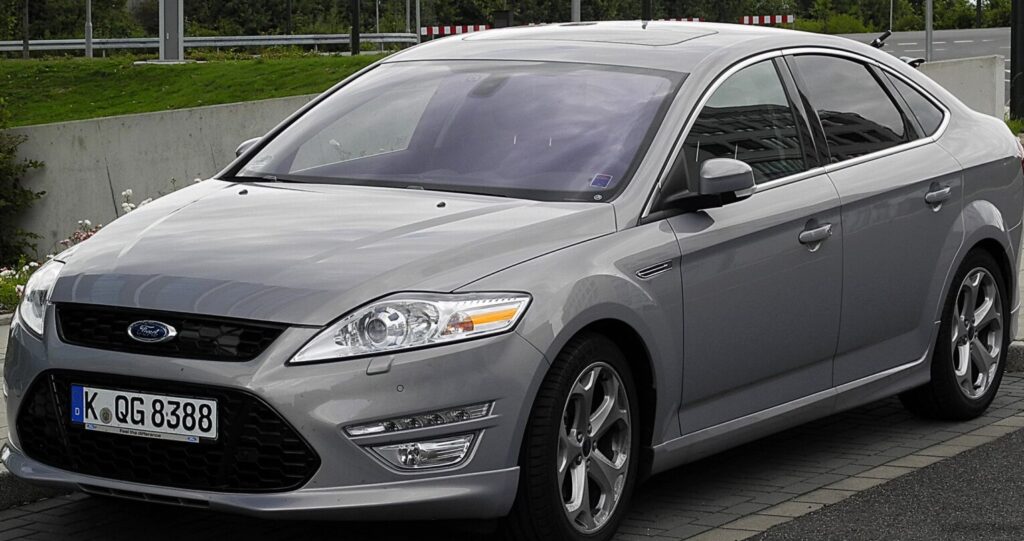
The Ford Mondeo III facelift, produced from 2010 to 2014, represented a significant refresh of Ford’s mid-size offering, aimed primarily at the European market. Within the Mondeo range, the 2.0 TDCI 140 horsepower variant equipped with the PowerShift dual-clutch transmission occupied a middle ground, balancing fuel efficiency with reasonable performance. This version aimed to appeal to drivers seeking a comfortable and economical family car with the convenience of an automatic gearbox. It was positioned above the lower-powered diesel options and below the more potent, and often more expensive, higher-output engines.
Technical Specifications
| Brand | Ford |
| Model | Mondeo |
| Generation | Mondeo III Hatchback (facelift 2010) |
| Type (Engine) | 2.0 TDCI (140 Hp) Duratorq PowerShift |
| Start of production | 2010 |
| End of production | 2014 |
| Powertrain Architecture | Internal Combustion engine |
| Body type | Hatchback |
| Seats | 5 |
| Doors | 5 |
| Fuel consumption (urban) | 7.2 l/100 km (32.7 US mpg, 39.2 UK mpg, 13.9 km/l) |
| Fuel consumption (extra urban) | 4.7 l/100 km (50 US mpg, 60.1 UK mpg, 21.3 km/l) |
| Fuel consumption (combined) | 5.6 l/100 km (42 US mpg, 50.4 UK mpg, 17.9 km/l) |
| CO2 emissions | 149 g/km |
| Fuel Type | Diesel |
| Acceleration 0 – 100 km/h | 10.2 sec |
| Acceleration 0 – 62 mph | 10.2 sec |
| Acceleration 0 – 60 mph | 9.7 sec |
| Maximum speed | 205 km/h (127.38 mph) |
| Emission standard | Euro 5 |
| Weight-to-power ratio | 11.2 kg/Hp, 89 Hp/tonne |
| Weight-to-torque ratio | 4.9 kg/Nm, 203.4 Nm/tonne |
| Power | 140 Hp @ 3750 rpm |
| Power per litre | 70.1 Hp/l |
| Torque | 320 Nm @ 1750-2750 rpm (236.02 lb.-ft. @ 1750-2750 rpm) |
| Engine layout | Front, Transverse |
| Engine Model/Code | UFBA |
| Engine displacement | 1997 cm3 (121.86 cu. in.) |
| Number of cylinders | 4 |
| Engine configuration | Inline |
| Cylinder Bore | 85 mm (3.35 in.) |
| Piston Stroke | 88 mm (3.46 in.) |
| Compression ratio | 17.9:1 |
| Number of valves per cylinder | 4 |
| Fuel injection system | Diesel Commonrail |
| Engine aspiration | Turbocharger, Intercooler |
| Engine oil capacity | 5.5 l (5.81 US qt | 4.84 UK qt) |
| Coolant | 8.1 l (8.56 US qt | 7.13 UK qt) |
| Kerb Weight | 1573 kg (3467.87 lbs.) |
| Max. weight | 2230 kg (4916.31 lbs.) |
| Max load | 657 kg (1448.44 lbs.) |
| Trunk (boot) space – minimum | 486 l (17.16 cu. ft.) |
| Trunk (boot) space – maximum | 1390 l (49.09 cu. ft.) |
| Length | 4784 mm (188.35 in.) |
| Width | 1886 mm (74.25 in.) |
| Height | 1500 mm (59.06 in.) |
| Wheelbase | 2850 mm (112.2 in.) |
| Front track | 1588 mm (62.52 in.) |
| Rear (Back) track | 1605 mm (63.19 in.) |
| Minimum turning circle | 11.6 m (38.06 ft.) |
| Drivetrain Architecture | Front wheel drive |
| Drive wheel | Front wheel drive |
| Number of gears | 6 gears, automatic transmission PowerShift |
| Front suspension | Independent, type McPherson with coil spring and anti-roll bar |
| Rear suspension | Independent multi-link spring suspension with stabilizer |
| Front brakes | Ventilated discs |
| Rear brakes | Disc |
| Assisting systems | ABS (Anti-lock braking system) |
| Steering type | Steering rack and pinion |
| Tires size | 205/55 R16 |
| Wheel rims size | 6.5J x 16 |
INTRODUCTION
The 2.0 TDCI 140 PS PowerShift variant of the Ford Mondeo III facelift, produced between 2010 and 2014, was a popular choice for European buyers. Built on the 1HX0/A3 platform, this Mondeo aimed to provide a blend of practicality, comfort, and efficiency. The facelift brought revised styling, improved interior materials, and updated technology, enhancing the Mondeo’s appeal in a competitive segment. The 2.0-liter Duratorq diesel engine, coupled with Ford’s six-speed PowerShift dual-clutch transmission, offered a compelling alternative to traditional automatic gearboxes, promising quicker shifts and improved fuel economy.
Powertrain & Engine Architecture
At the heart of this Mondeo variant lies the Ford 2.0-liter Duratorq TDCi engine, specifically the UFBA engine code. This engine is a four-cylinder, inline diesel utilizing a common-rail direct fuel injection system. The common-rail system, operating at very high pressures, ensures precise fuel delivery and contributes to efficient combustion. The engine also features a turbocharger with an intercooler, boosting power and torque output. The intercooler cools the compressed air from the turbocharger, increasing its density and further enhancing performance. The engine boasts 4 valves per cylinder, contributing to improved breathing and overall efficiency. The PowerShift transmission is a six-speed, dual-clutch transmission (DCT). Unlike a traditional automatic, PowerShift uses two separate clutches – one for odd gears and one for even gears – allowing for seamless and rapid gear changes. This results in a more engaging driving experience and improved fuel economy compared to conventional torque converter automatics.
Driving Characteristics
The 140 horsepower and 320 Nm (236 lb-ft) of torque provided by the 2.0 TDCI engine and PowerShift transmission delivered adequate performance for everyday driving. Acceleration from 0-60 mph took around 9.7 seconds, and a top speed of 127.38 mph was achievable. While not a sports car, the Mondeo 2.0 TDCI offered sufficient power for overtaking and cruising on motorways. The PowerShift transmission contributed to a smoother driving experience than older automatic gearboxes, with quick and decisive shifts. However, some drivers reported occasional low-speed jerkiness with the PowerShift, a common characteristic of early dual-clutch transmissions. The gear ratios were tuned for fuel efficiency, with a relatively tall sixth gear for relaxed highway cruising. Compared to the higher-output 163 hp version of the 2.0 TDCI, this variant felt slightly less responsive, but the difference was not dramatic.
Equipment & Trim Levels
The 2.0 TDCI 140 PS PowerShift Mondeo typically came equipped with a reasonable level of standard features. These included air conditioning, electric front and rear windows, power-adjustable mirrors, a CD/radio system, and alloy wheels. Higher trim levels, such as Titanium, added features like automatic climate control, heated front seats, a premium audio system, and parking sensors. Interior upholstery was typically cloth, with leather options available on higher trims. Optional extras included satellite navigation, a sunroof, and advanced safety features like adaptive cruise control. The dashboard layout was functional and well-designed, with clear instrumentation and intuitive controls.
Chassis & Braking
The Mondeo III facelift featured independent suspension on all four wheels. The front suspension utilized a McPherson strut setup with coil springs and an anti-roll bar, while the rear employed a multi-link system, also with coil springs and a stabilizer bar. This suspension configuration provided a comfortable ride and good handling characteristics. Braking duties were handled by ventilated discs on the front wheels and solid discs on the rear. Anti-lock Braking System (ABS) was standard, enhancing safety during emergency braking situations. The chassis was designed to provide a good balance between ride comfort and handling, making the Mondeo a pleasant car to drive on a variety of road surfaces.
Market Reception & Comparison
The Ford Mondeo III facelift, including the 2.0 TDCI 140 PS PowerShift variant, was generally well-received by automotive critics. It was praised for its spacious interior, comfortable ride, and competitive fuel economy. The PowerShift transmission was seen as a positive addition, offering a more engaging driving experience than traditional automatics. However, some reviewers noted the occasional jerkiness of the PowerShift at low speeds. Compared to other trims in the Mondeo lineup, the 2.0 TDCI 140 PS offered a good balance between performance and economy. The 1.6-liter diesel was more economical but lacked the power of the 2.0-liter, while the higher-output 2.0-liter and petrol engines offered more performance but at the expense of fuel efficiency. The Mondeo competed with rivals such as the Volkswagen Passat, Vauxhall/Opel Insignia, and Peugeot 508.
Legacy
The 2.0 TDCI Duratorq engine proved to be a reliable unit, although the PowerShift transmission has been known to experience issues in some cases, particularly with clutch wear and mechatronic unit failures. Regular maintenance, including timely transmission fluid changes, is crucial for ensuring the longevity of the PowerShift gearbox. Today, the Mondeo III facelift 2.0 TDCI 140 PS PowerShift can be found on the used car market at relatively affordable prices. It remains a practical and economical choice for buyers seeking a comfortable and spacious family car. Its blend of fuel efficiency, reasonable performance, and available features continues to make it a viable option in the mid-size segment.