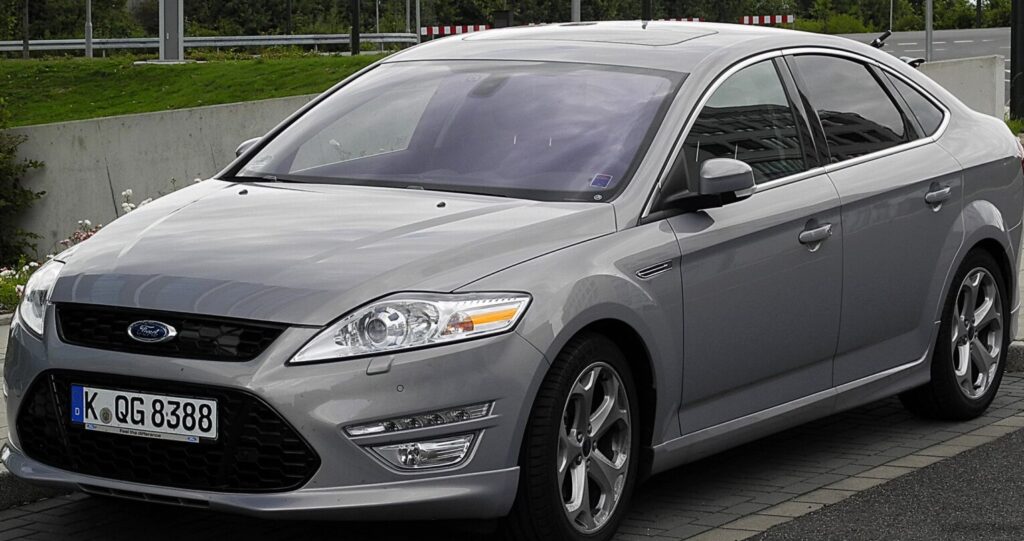
The Ford Mondeo III facelift, produced from 2010 to 2014, represented a significant refresh of Ford’s mid-size offering in the European market. This generation Mondeo, built on the Ford C/D platform (internally designated as 1HX0/A3), aimed to provide a comfortable and practical family vehicle with a focus on modern technology and fuel efficiency. The 2.0 TDCI variant, equipped with a 163 horsepower Duratorq engine and Ford’s PowerShift dual-clutch transmission, occupied a middle ground in the Mondeo lineup, offering a balance between performance, economy, and price. It was positioned above the lower-powered diesel options and below the more expensive, higher-output petrol engines.
Technical Specifications
| Brand | Ford |
| Model | Mondeo |
| Generation | Mondeo III Hatchback (facelift 2010) |
| Type (Engine) | 2.0 TDCI (163 Hp) Duratorq PowerShift |
| Start of production | 2010 |
| End of production | 2014 |
| Powertrain Architecture | Internal Combustion engine |
| Body type | Hatchback |
| Seats | 5 |
| Doors | 5 |
| Fuel consumption (urban) | 7.2 l/100 km (32.7 US mpg, 39.2 UK mpg, 13.9 km/l) |
| Fuel consumption (extra urban) | 4.7 l/100 km (50 US mpg, 60.1 UK mpg, 21.3 km/l) |
| Fuel consumption (combined) | 5.6 l/100 km (42 US mpg, 50.4 UK mpg, 17.9 km/l) |
| CO2 emissions | 149 g/km |
| Fuel Type | Diesel |
| Acceleration 0 – 100 km/h | 9.5 sec |
| Acceleration 0 – 62 mph | 9.5 sec |
| Acceleration 0 – 60 mph | 9 sec |
| Maximum speed | 215 km/h (133.59 mph) |
| Emission standard | Euro 5 |
| Weight-to-power ratio | 9.7 kg/Hp, 103.6 Hp/tonne |
| Weight-to-torque ratio | 4.6 kg/Nm, 216.1 Nm/tonne |
| Power | 163 Hp @ 3750 rpm |
| Power per litre | 81.6 Hp/l |
| Torque | 340 Nm @ 2000-3250 rpm (250.77 lb.-ft. @ 2000-3250 rpm) |
| Engine layout | Front, Transverse |
| Engine Model/Code | TXBA |
| Engine displacement | 1997 cm3 (121.86 cu. in.) |
| Number of cylinders | 4 |
| Engine configuration | Inline |
| Cylinder Bore | 85 mm (3.35 in.) |
| Piston Stroke | 88 mm (3.46 in.) |
| Compression ratio | 17.9:1 |
| Number of valves per cylinder | 4 |
| Fuel injection system | Diesel Commonrail |
| Engine aspiration | Turbocharger, Intercooler |
| Engine oil capacity | 5.5 l (5.81 US qt | 4.84 UK qt) |
| Coolant capacity | 8.1 l (8.56 US qt | 7.13 UK qt) |
| Kerb Weight | 1573 kg (3467.87 lbs.) |
| Max. weight | 2230 kg (4916.31 lbs.) |
| Max load | 657 kg (1448.44 lbs.) |
| Trunk (boot) space – minimum | 486 l (17.16 cu. ft.) |
| Trunk (boot) space – maximum | 1390 l (49.09 cu. ft.) |
| Length | 4784 mm (188.35 in.) |
| Width | 1886 mm (74.25 in.) |
| Height | 1500 mm (59.06 in.) |
| Wheelbase | 2850 mm (112.2 in.) |
| Front track | 1588 mm (62.52 in.) |
| Rear track | 1605 mm (63.19 in.) |
| Minimum turning circle | 11.6 m (38.06 ft.) |
| Drivetrain Architecture | Front wheel drive |
| Number of gears | 6 |
| Gearbox type | Automatic transmission PowerShift |
| Front suspension | Independent, type McPherson with coil spring and anti-roll bar |
| Rear suspension | Independent multi-link spring suspension with stabilizer |
| Front brakes | Ventilated discs |
| Rear brakes | Disc |
| Assisting systems | ABS (Anti-lock braking system) |
| Steering type | Steering rack and pinion |
| Tires size | 205/55 R16 |
| Wheel rims size | 6.5J x 16 |
Powertrain & Engine Architecture
The heart of this Mondeo variant is the 2.0-liter Duratorq TDCi engine, specifically the TXBA code. This engine is a four-cylinder, inline diesel utilizing common-rail direct injection and a turbocharger with an intercooler. The common-rail system, operating at very high pressures, allows for precise fuel metering and optimized combustion, contributing to both power and efficiency. The engine features four valves per cylinder, enhancing breathing and further improving performance. The Duratorq engine family was known for its robust construction and relatively simple design, making it generally reliable. Paired with this engine is Ford’s PowerShift six-speed dual-clutch transmission (DCT). This transmission, unlike a traditional automatic, offers quicker shifts and improved fuel economy by pre-selecting the next gear. It operates similarly to a manual transmission but without the need for driver intervention with a clutch pedal.
Driving Characteristics
The 163 horsepower and 340 Nm (250 lb-ft) of torque provided by the 2.0 TDCI engine and PowerShift transmission delivered a respectable, if not exhilarating, driving experience. Acceleration from 0 to 60 mph took around 9 seconds, making it suitable for everyday driving and highway cruising. The PowerShift transmission, while generally smooth, could exhibit some hesitation at low speeds or during parking maneuvers. Compared to the higher-output 2.0-liter petrol versions, the diesel offered significantly better fuel economy but lacked the same level of outright performance. Against other diesel variants, like the 1.6 TDCI, the 2.0 TDCI provided a noticeable increase in power and refinement, making it a more comfortable choice for longer journeys. The gear ratios in the PowerShift transmission were tuned for fuel efficiency, meaning the engine didn’t always feel as responsive as it could be.
Equipment & Trim Levels
The 2.0 TDCI PowerShift Mondeo typically came equipped with a reasonable level of standard features. These generally included air conditioning, alloy wheels, a CD/radio system with auxiliary input, electric front and rear windows, and remote central locking. Higher trim levels, such as Titanium, added features like automatic climate control, rain-sensing wipers, rear parking sensors, and upgraded interior trim. Interior upholstery was typically cloth, with leather options available as an upgrade. Dashboard configuration was generally consistent across the range, featuring a straightforward layout with easy-to-use controls.
Chassis & Braking
The Mondeo III utilized an independent suspension setup at all four corners. The front suspension employed McPherson struts with coil springs and an anti-roll bar, while the rear featured a multi-link system, also with a stabilizer bar. This setup provided a good balance between ride comfort and handling. Braking duties were handled by ventilated discs at the front and solid discs at the rear. Anti-lock Braking System (ABS) was standard, enhancing safety during emergency braking situations. The chassis was designed to provide a stable and predictable driving experience, even when fully loaded.
Market Reception & Comparison
The 2.0 TDCI PowerShift Mondeo was generally well-received by automotive critics. It was praised for its fuel efficiency, comfortable ride, and spacious interior. However, some reviewers noted the occasional hesitation of the PowerShift transmission and the lack of a truly sporty driving experience. Compared to the petrol-powered Mondeos, the diesel offered superior fuel economy, making it a popular choice for high-mileage drivers. Against competitors like the Volkswagen Passat and Opel/Vauxhall Insignia, the Mondeo offered a competitive package in terms of price, features, and practicality.
Legacy
The 2.0 Duratorq engine, in various iterations, proved to be a durable and reliable powerplant. The PowerShift transmission, however, has a more mixed reputation. While offering efficiency benefits, it has been known to experience issues with clutch wear and mechatronic unit failures, particularly in earlier versions. Today, used examples of the 2010-2014 Mondeo 2.0 TDCI PowerShift represent a relatively affordable option for those seeking a practical and fuel-efficient family car. However, potential buyers should be aware of the potential transmission issues and ensure a thorough inspection is carried out before purchase. Regular maintenance, including timely transmission fluid changes, is crucial for maximizing the longevity of the PowerShift unit.