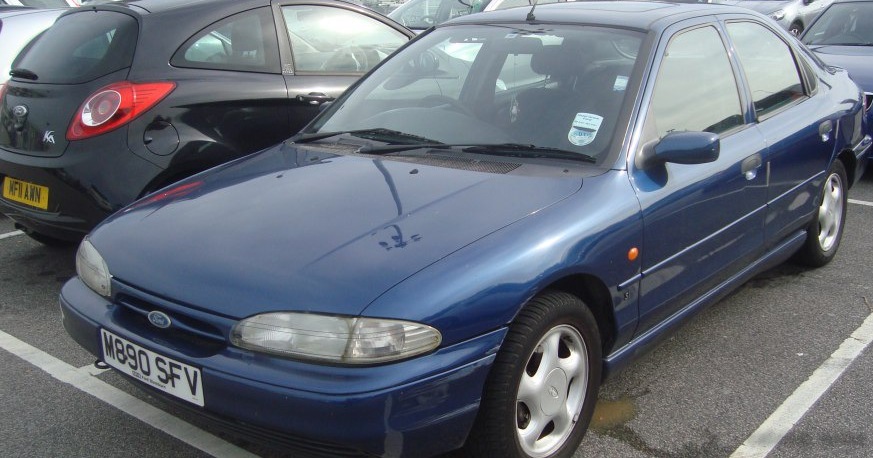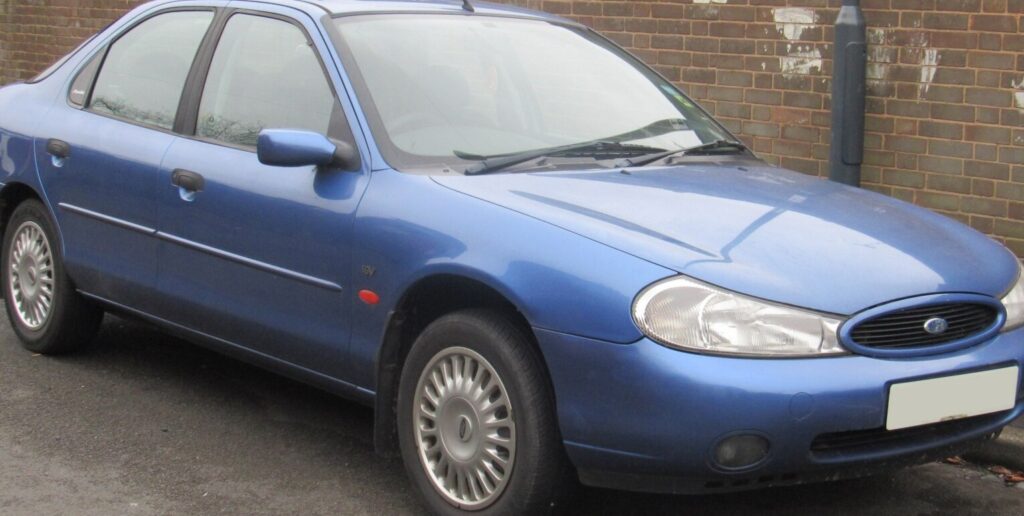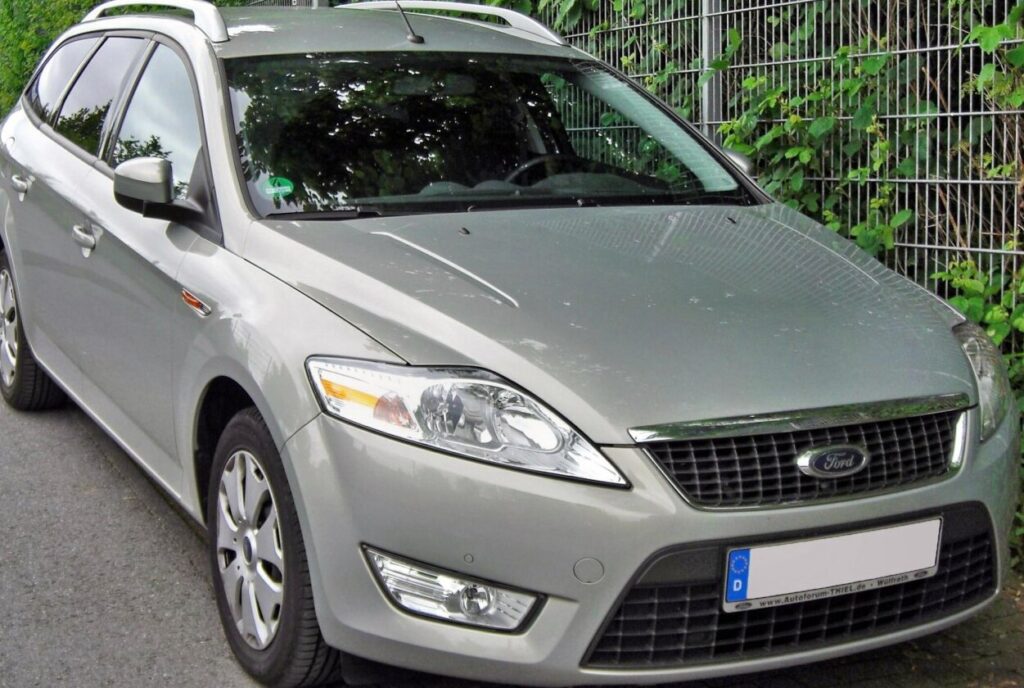
The Ford Mondeo III Wagon 1.6i 16V, produced between 2007 and 2010, represented an entry-level offering within the third-generation Mondeo (Mk3) lineup. Positioned as a practical and affordable family vehicle, this variant catered to buyers prioritizing fuel efficiency and everyday usability over outright performance. It was a key component of Ford of Europe’s strategy to offer a broad range of Mondeo models to suit diverse customer needs, leveraging the global 1HX0/A3 platform. The wagon body style, popular in Europe, provided increased cargo capacity, making it a versatile choice for families and those requiring ample space.
Technical Specifications
| Brand | Ford |
| Model | Mondeo |
| Generation | Mondeo III Wagon |
| Type (Engine) | 1.6 i 16V (125 Hp) |
| Start of production | 2007 |
| End of production | 2010 |
| Powertrain Architecture | Internal Combustion engine |
| Body type | Station wagon (estate) |
| Seats | 5 |
| Doors | 5 |
| Fuel consumption (urban) | 10.3 l/100 km (22.8 US mpg, 27.4 UK mpg, 9.7 km/l) |
| Fuel consumption (extra urban) | 5.7 l/100 km (41.3 US mpg, 49.6 UK mpg, 17.5 km/l) |
| Fuel consumption (combined) | 7.4 l/100 km (31.8 US mpg, 38.2 UK mpg, 13.5 km/l) |
| Fuel Type | Petrol (Gasoline) |
| Acceleration 0 – 100 km/h | 12.9 sec |
| Acceleration 0 – 62 mph | 12.9 sec |
| Acceleration 0 – 60 mph | 12.3 sec |
| Maximum speed | 190 km/h (118.06 mph) |
| Emission standard | Euro 4 |
| Weight-to-power ratio | 11.2 kg/Hp, 89.2 Hp/tonne |
| Weight-to-torque ratio | 8.8 kg/Nm, 114.1 Nm/tonne |
| Power | 125 Hp @ 6300 rpm |
| Power per litre | 78.3 Hp/l |
| Torque | 160 Nm @ 4100 rpm (118.01 lb.-ft. @ 4100 rpm) |
| Engine layout | Front, Transverse |
| Engine Model/Code | PNBA |
| Engine displacement | 1596 cm3 (97.39 cu. in.) |
| Number of cylinders | 4 |
| Engine configuration | Inline |
| Cylinder Bore | 79 mm (3.11 in.) |
| Piston Stroke | 81.4 mm (3.2 in.) |
| Compression ratio | 11:1 |
| Number of valves per cylinder | 4 |
| Fuel injection system | Multi-port manifold injection |
| Engine aspiration | Naturally aspirated engine |
| Valvetrain | DOHC |
| Engine oil capacity | 4.1 l (4.33 US qt | 3.61 UK qt) |
| Coolant capacity | 6 l (6.34 US qt | 5.28 UK qt) |
| Kerb Weight | 1402 kg (3090.88 lbs.) |
| Max. weight | 2090 kg (4607.66 lbs.) |
| Max load | 688 kg (1516.78 lbs.) |
| Trunk (boot) space – minimum | 550 l (19.42 cu. ft.) |
| Fuel tank capacity | 70 l (18.49 US gal | 15.4 UK gal) |
| Length | 4830 mm (190.16 in.) |
| Width | 1886 mm (74.25 in.) |
| Height | 1500 mm (59.06 in.) |
| Wheelbase | 2850 mm (112.2 in.) |
| Front track | 1522 mm (59.92 in.) |
| Rear track | 1537 mm (60.51 in.) |
| Minimum turning circle | 11.1 m (36.42 ft.) |
| Drivetrain Architecture | Front wheel drive |
| Number of gears | 5 |
| Gearbox type | Manual transmission |
| Front suspension | Coil spring |
| Rear suspension | Coil spring |
| Front brakes | Ventilated discs |
| Rear brakes | Disc |
| Assisting systems | ABS (Anti-lock braking system) |
| Steering type | Steering rack and pinion |
| Tires size | 205/55 R16 |
Powertrain & Engine Architecture
The Mondeo III Wagon 1.6i 16V utilized the Ford PNBA engine, a 1.6-liter inline-four cylinder gasoline engine. This engine was part of Ford’s Duratec family, known for its relatively simple design and focus on fuel efficiency. The PNBA featured a multi-port fuel injection system, delivering fuel directly into the intake ports, and a double overhead camshaft (DOHC) valvetrain, optimizing airflow for improved performance. The engine produced 125 horsepower at 6300 rpm and 160 Nm (118 lb-ft) of torque at 4100 rpm. It was paired with a five-speed manual transmission, which was the most common configuration for this variant. While a four-speed automatic transmission was available, it was less frequently chosen due to its impact on fuel economy and performance. The engine’s design prioritized smooth operation and reliability over outright power, making it suitable for everyday driving.
Driving Characteristics
The 1.6i 16V Mondeo Wagon offered a comfortable and predictable driving experience. Acceleration was adequate for most situations, with a 0-60 mph time of around 12.3 seconds, but it wasn’t particularly sporty. The five-speed manual transmission allowed drivers to keep the engine in its optimal power band, but the relatively low torque output meant frequent downshifts were necessary when overtaking or climbing hills. Compared to the higher-output 2.0-liter or 2.3-liter versions, the 1.6i felt noticeably less powerful. However, it offered a significant improvement in fuel economy. The suspension provided a good balance between comfort and handling, absorbing bumps effectively while maintaining reasonable body control. The steering was light and precise, making it easy to maneuver in urban environments.
Equipment & Trim Levels
The 1.6i 16V Mondeo Wagon typically came equipped with a reasonable level of standard features. These included power windows, power door locks, air conditioning, an audio system (usually a CD player with AM/FM radio), and ABS brakes. Interior upholstery was typically cloth, with a relatively simple dashboard layout. Optional extras included alloy wheels, a sunroof, upgraded audio systems, and parking sensors. Trim levels varied slightly depending on the market, but generally, the 1.6i represented the entry point to the Mondeo Wagon range. Higher trim levels, such as the Titanium, offered more luxurious features and styling enhancements.
Chassis & Braking
The Mondeo III Wagon featured a front-wheel-drive layout with independent suspension at all four corners. The front suspension utilized MacPherson struts, while the rear suspension employed a multi-link setup. This configuration provided a comfortable ride and good handling characteristics. Braking duties were handled by ventilated discs at the front and solid discs at the rear. ABS (Anti-lock Braking System) was standard, enhancing safety by preventing wheel lockup during hard braking. The chassis was designed to provide a stable and predictable platform, prioritizing comfort and practicality over sporty handling.
Market Reception & Comparison
The 1.6i 16V Mondeo Wagon was generally well-received by critics as a practical and affordable family car. It was praised for its fuel efficiency, comfortable ride, and spacious interior. However, it was often criticized for its lack of power, particularly when fully loaded or traveling uphill. Compared to the 2.0-liter and 2.3-liter variants, the 1.6i offered lower running costs but sacrificed performance. The diesel-powered Mondeos, such as the 1.8 TDCi and 2.0 TDCi, provided even better fuel economy and more torque, but at a higher initial cost. The 1.6i appealed to buyers who prioritized value for money and everyday usability over sporty performance.
Legacy
The PNBA 1.6-liter engine, while not known for its groundbreaking performance, proved to be a reliable and durable unit. Mondeo III Wagons equipped with this engine have generally aged well, and many are still on the road today. Common maintenance issues include wear and tear on suspension components and occasional problems with the fuel injection system. However, parts availability is generally good, and the engine is relatively easy to work on. In the used car market, the 1.6i Mondeo Wagon represents a budget-friendly option for those seeking a spacious and practical family vehicle. Its fuel efficiency and relatively low running costs continue to make it an attractive choice for buyers looking for a dependable and affordable estate car.