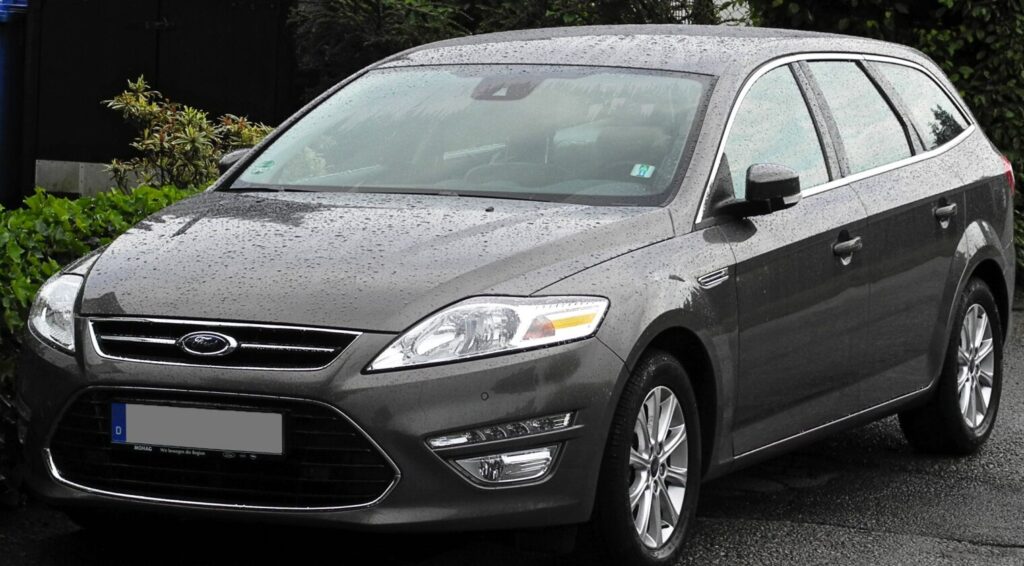
The Ford Mondeo III Wagon, specifically the facelifted version produced from 2010 to 2014, represented a significant evolution of Ford’s mid-size family car. The 2.0 EcoBoost (240 hp) PowerShift variant occupied the upper-mid-range position within the Mondeo wagon lineup, offering a blend of performance and practicality. This model was built on the Ford C/D platform (internally designated 1HX0 for the wagon), sharing its underpinnings with other Ford and Mazda vehicles of the era. It aimed to appeal to buyers seeking a spacious, well-equipped estate car with a more engaging driving experience than the lower-powered engine options.
The heart of the Mondeo 2.0 EcoBoost was the TPBA engine, a 1.999-liter inline-four cylinder gasoline engine. This engine utilized direct fuel injection and was turbocharged with an intercooler, allowing it to produce 240 horsepower at 6000 rpm and 340 Nm (250.77 lb-ft) of torque between 1900 and 3500 rpm. The engine featured a double overhead camshaft (DOHC) valvetrain with four valves per cylinder, contributing to its responsive nature. The “EcoBoost” designation signified Ford’s commitment to combining performance with improved fuel efficiency through technologies like turbocharging and direct injection. This engine was paired exclusively with Ford’s six-speed “PowerShift” dual-clutch transmission (DCT), an automated manual gearbox designed to offer the efficiency of a manual transmission with the convenience of an automatic.
In driving conditions, the 2.0 EcoBoost PowerShift Mondeo Wagon delivered noticeably quicker acceleration than its lower-powered siblings. The 0-100 km/h (0-62 mph) sprint took approximately 7.8 seconds, while 0-60 mph was achieved in around 7.4 seconds. The PowerShift transmission provided quick and smooth gear changes, enhancing the driving experience. While not as overtly sporty as some competitors, the Mondeo offered a comfortable and capable ride, with the turbocharger providing ample torque for overtaking maneuvers. The PowerShift transmission, while generally reliable, was known to require more diligent maintenance than a traditional automatic transmission, with regular fluid changes being crucial to prevent issues.
The 2.0 EcoBoost trim level typically included a generous level of standard equipment. Interior features often included comfortable cloth or partial leather upholstery, air conditioning, a CD/radio system with auxiliary input, and power windows and mirrors. Higher trim levels offered options such as full leather upholstery, a premium sound system, satellite navigation, and parking sensors. The dashboard layout was functional and well-designed, prioritizing ease of use. Available options also included features like heated front seats, rain-sensing wipers, and automatic headlights.
The Mondeo Wagon’s chassis featured independent suspension all around – McPherson struts at the front and a multi-link setup at the rear – providing a good balance between ride comfort and handling. Front brakes were ventilated discs, while rear brakes were solid discs. Anti-lock Braking System (ABS) was standard. The suspension was tuned to provide a comfortable ride for passengers and cargo, while still offering reasonable body control during cornering. Stabilizer bars were fitted to both the front and rear axles to reduce body roll.
Critics generally praised the Mondeo 2.0 EcoBoost for its strong performance, spacious interior, and comfortable ride. The PowerShift transmission received mixed reviews, with some praising its responsiveness and efficiency, while others noted occasional hesitation at low speeds. Fuel economy was respectable for a vehicle of its size and performance, averaging around 7.7 l/100 km (30.5 US mpg) in combined driving. Reliability was generally good, although the PowerShift transmission required careful maintenance to avoid potential issues. Compared to the 1.6 EcoBoost models, the 2.0 offered a significant performance upgrade, while the diesel variants (like the 2.0 TDCi) prioritized fuel economy over outright power.
| Brand | Ford |
| Model | Mondeo |
| Generation | Mondeo III Wagon (facelift 2010) |
| Type (Engine) | 2.0 EcoBoost (240 Hp) PowerShift |
| Start of production | 2010 |
| End of production | 2014 |
| Fuel consumption (urban) | 10.9 l/100 km (21.6 US mpg) |
| Fuel consumption (extra urban) | 6 l/100 km (39.2 US mpg) |
| Fuel consumption (combined) | 7.7 l/100 km (30.5 US mpg) |
| CO2 emissions | 179 g/km |
| Fuel Type | Petrol (Gasoline) |
| Acceleration 0 – 100 km/h | 7.8 sec |
| Acceleration 0 – 62 mph | 7.8 sec |
| Acceleration 0 – 60 mph | 7.4 sec |
| Maximum speed | 241 km/h (149.75 mph) |
| Emission standard | Euro 5 |
| Engine Power | 240 Hp @ 6000 rpm |
| Engine Torque | 340 Nm @ 1900-3500 rpm (250.77 lb.-ft.) |
| Engine Displacement | 1999 cm3 (121.99 cu. in.) |
| Number of cylinders | 4 |
| Engine Configuration | Inline |
| Compression ratio | 10:1 |
| Fuel injection system | Direct injection |
| Engine oil capacity | 5.4 l (5.71 US qt | 4.75 UK qt) |
| Kerb Weight | 1588 kg (3500.94 lbs) |
| Max. weight | 2300 kg (5070.63 lbs) |
| Trunk (boot) space – minimum | 489 l (17.27 cu. ft.) |
| Trunk (boot) space – maximum | 1680 l (59.33 cu. ft.) |
| Length | 4837 mm (190.43 in.) |
| Width | 1886 mm (74.25 in.) |
| Height | 1512 mm (59.53 in.) |
| Wheelbase | 2850 mm (112.2 in.) |
| Number of gears | 6 |
| Gearbox type | Automatic transmission PowerShift |
Today, the Ford Mondeo III Wagon 2.0 EcoBoost PowerShift remains a relatively affordable and practical used car option. While the PowerShift transmission requires careful inspection and maintenance, a well-maintained example can provide years of reliable service. The engine is generally robust, and parts availability is good. The Mondeo’s spacious interior and comfortable ride continue to make it a popular choice for families and those needing a versatile estate car.