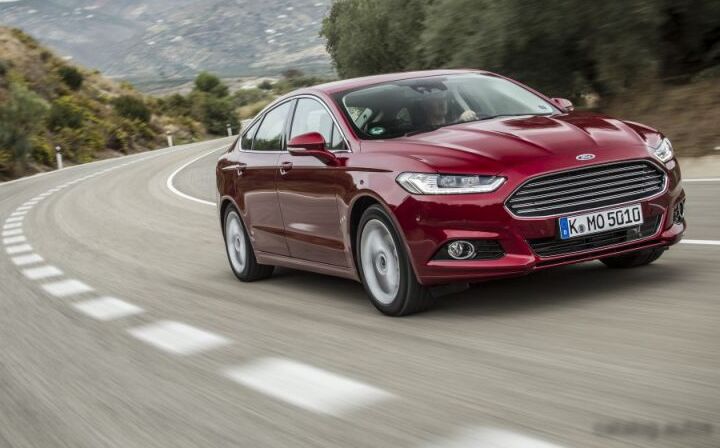
The Ford Mondeo IV Hatchback 2.0 TDCi (180 hp) PowerShift represents a significant iteration within the fourth generation of Ford’s globally successful Mondeo line. Produced from 2014 to 2018, this variant occupied a mid-to-upper position in the Mondeo IV range, offering a blend of performance, fuel efficiency, and technology aimed at buyers seeking a practical yet engaging family vehicle. It was built on the Ford C/D platform (internally designated as 1HX0 for the hatchback), sharing its basic architecture with other Ford and Mazda models of the era.
Powertrain & Engine Architecture
At the heart of the Mondeo IV 2.0 TDCi 180 hp PowerShift lies Ford’s 1997 cc (121.86 cu. in.) four-cylinder diesel engine, internally designated as the T8CC. This engine is a member of the Ford Duratorque family, known for its robust construction and relatively sophisticated technology. The engine utilizes a common rail direct fuel injection system, delivering fuel at extremely high pressure for optimized combustion. The turbocharger, coupled with an intercooler, provides increased air density to the cylinders, boosting power output. The engine features a double overhead camshaft (DOHC) valvetrain with four valves per cylinder, contributing to efficient gas exchange. A particulate filter was standard equipment to meet stringent Euro 6 emissions standards.
The “PowerShift” transmission is a crucial element of this variant. It’s a six-speed dual-clutch transmission (DCT), offering the efficiency of a manual gearbox with the convenience of an automatic. Unlike traditional torque-converter automatics, the PowerShift uses two separate clutches – one for odd-numbered gears and one for even-numbered gears – allowing for incredibly fast and smooth gear changes. This transmission was designed to improve fuel economy and provide a more engaging driving experience compared to conventional automatics.
Engine Specifications
The T8CC engine in this configuration produces 180 horsepower (hp) at 3500 rpm and 350 Nm (258.15 lb-ft) of torque between 2000-2500 rpm. The compression ratio is relatively high at 16.7:1, typical for modern diesel engines. Bore and stroke dimensions are 85 mm (3.35 in) and 88 mm (3.46 in) respectively. Engine oil capacity is 6.1 liters (6.45 US qt | 5.37 UK qt), and coolant capacity is 9 liters (9.51 US qt | 7.92 UK qt).
Driving Characteristics
The 180 hp 2.0 TDCi PowerShift Mondeo offers a noticeably more spirited driving experience than lower-powered versions of the Mondeo IV. The PowerShift transmission contributes significantly to this, providing quick and decisive gear changes, especially in Sport mode. Acceleration from 0-60 mph is approximately 8.2 seconds, and 0-100 km/h takes around 8.6 seconds. Maximum speed is rated at 223 km/h (138.57 mph). While not a sports car, the Mondeo 2.0 TDCi delivers ample power for overtaking and highway cruising. The torque curve is relatively flat, providing strong pull throughout the rev range. Compared to the 1.6 TDCi models, the 2.0 TDCi feels significantly more responsive, and while it doesn’t match the performance of the petrol-powered 2.0 EcoBoost variants, it offers a compelling balance of power and fuel economy. The PowerShift transmission, while generally smooth, could exhibit some low-speed jerkiness in certain conditions, a common characteristic of early dual-clutch transmissions.
Equipment & Trim Levels
The 2.0 TDCi 180 hp PowerShift Mondeo typically came equipped as a mid-to-high trim level, often designated as Titanium or similar. Standard features generally included air conditioning, power windows and mirrors, a multi-function steering wheel, an audio system with USB connectivity, and alloy wheels. Higher trim levels added features such as leather upholstery, heated front seats, a navigation system, a rear parking camera, and automatic headlights and wipers. Optional extras included a panoramic sunroof, upgraded audio systems (often Sony branded), and advanced driver-assistance systems like adaptive cruise control and lane-keeping assist. Interior upholstery was typically cloth on lower trims, upgrading to leather on higher-spec models. The dashboard layout was consistent across the Mondeo IV range, featuring a relatively clean and functional design.
Chassis & Braking
The Mondeo IV Hatchback 2.0 TDCi utilizes an independent McPherson strut front suspension with a coil spring and anti-roll bar. The rear suspension is an independent multi-link setup, also with a stabilizer bar. This suspension configuration provides a good balance between ride comfort and handling. Front brakes are ventilated discs, while rear brakes are discs. The braking system is equipped with ABS (Anti-lock Braking System). The weight of the 2.0 TDCi variant (approximately 1589 kg / 3503.15 lbs) is higher than the base models, necessitating slightly firmer suspension tuning to maintain control. Tire sizes varied depending on the trim level, ranging from 215/60 R16 to 235/40 R19.
Market Reception & Comparison
The Ford Mondeo IV 2.0 TDCi 180 hp PowerShift was generally well-received by automotive critics. It was praised for its strong engine performance, comfortable ride, spacious interior, and good fuel economy. Fuel consumption figures are rated at 5.3 l/100 km (44.4 US mpg / 53.3 UK mpg) in urban conditions, 4.4 l/100 km (53.5 US mpg / 64.2 UK mpg) extra-urban, and 4.8 l/100 km (49 US mpg / 58.9 UK mpg) combined, with CO2 emissions of 125 g/km. Compared to the lower-powered 1.6 TDCi models, the 2.0 TDCi offered a significant performance upgrade without a substantial penalty in fuel economy. However, the PowerShift transmission received some criticism for its occasional jerkiness at low speeds. Compared to petrol-powered Mondeos, the 2.0 TDCi offered superior fuel economy and torque, making it a popular choice for drivers covering long distances. Reliability of the PowerShift transmission was a known concern, with some owners reporting issues with clutch wear and mechatronic unit failures.
Technical Specifications
| Brand | Ford |
| Model | Mondeo |
| Generation | Mondeo IV Hatchback |
| Type (Engine) | 2.0 TDCi (180 Hp) PowerShift |
| Start of production | 2014 |
| End of production | 2018 |
| Engine Displacement | 1997 cm3 (121.86 cu. in.) |
| Number of Cylinders | 4 |
| Engine Configuration | Inline |
| Power | 180 Hp @ 3500 rpm |
| Torque | 350 Nm @ 2000-2500 rpm (258.15 lb.-ft.) |
| Fuel Type | Diesel |
| Transmission | 6-speed automatic PowerShift (DCT) |
| Acceleration 0-100 km/h | 8.6 sec |
| Acceleration 0-62 mph | 8.6 sec |
| Maximum Speed | 223 km/h (138.57 mph) |
| Kerb Weight | 1589 kg (3503.15 lbs) |
| Fuel Tank Capacity | 62.5 l (16.51 US gal | 13.75 UK gal) |
| Trunk Space (min/max) | 458 l / 1356 l (16.17 cu. ft. / 47.89 cu. ft.) |
Legacy
The Ford Mondeo IV 2.0 TDCi 180 hp PowerShift remains a relatively common sight on the used car market. While the PowerShift transmission’s reliability has been a concern, well-maintained examples can provide years of reliable service. The engine itself is generally considered robust, although regular servicing is essential. The Mondeo IV’s spacious interior, comfortable ride, and good fuel economy continue to appeal to buyers seeking a practical and affordable family car. However, potential buyers should be aware of the potential issues with the PowerShift transmission and factor in the cost of potential repairs when considering a purchase. The Mondeo IV, in all its variants, represents a high point in Ford’s mid-size car offerings, and the 2.0 TDCi 180 hp PowerShift variant offers a compelling blend of performance, efficiency, and practicality.