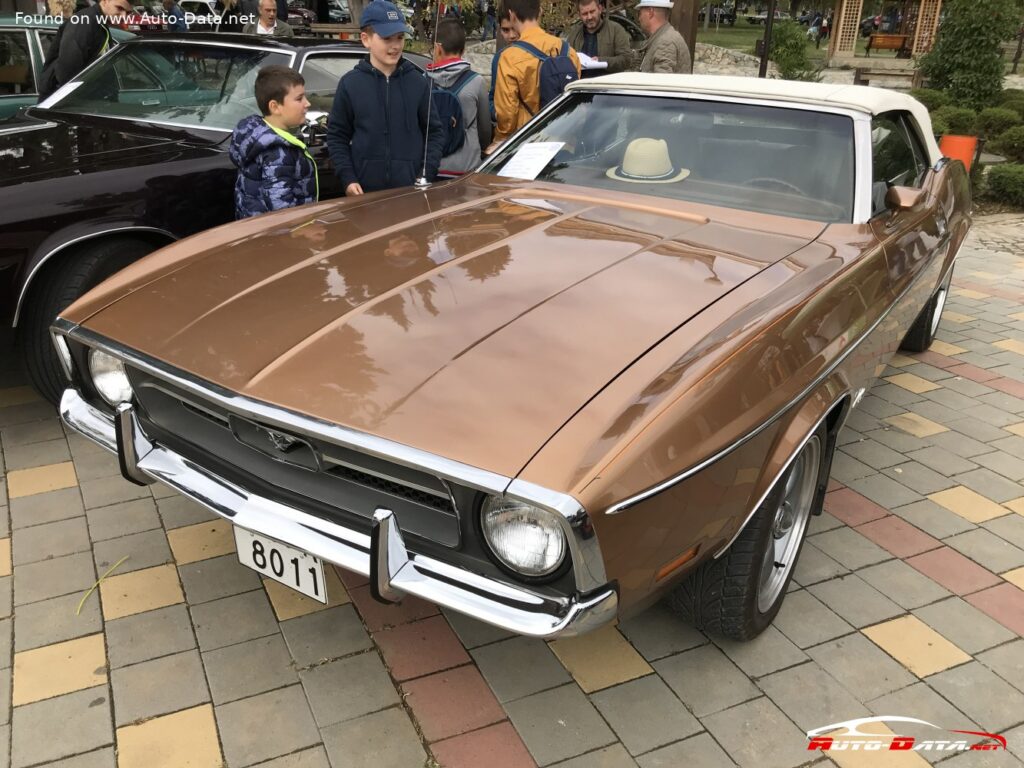
The Ford Mustang Convertible I (facelift 1970) with the 4.9-liter V8 engine producing 210 horsepower represents a significant iteration in the Mustang’s first generation. Introduced as part of a mid-cycle refresh for the 1970 model year, this variant aimed to balance performance with the open-air enjoyment of a convertible. Production continued through 1973, coinciding with a period of increasing emissions regulations and a shift in the American automotive landscape. This particular configuration occupied a middle ground in the Mustang lineup, offering more power than the inline-six options but remaining more accessible than the higher-performance models like the Boss 302 or Mach 1.
Powertrain & Engine Architecture
At the heart of the 1970-1973 Mustang Convertible I (facelift) 4.9 V8 was the 4.9-liter (302 cubic inch) small-block V8 engine, designated within Ford as the 302 Windsor. This engine, utilizing a 9:1 compression ratio, was a mainstay of Ford’s lineup during this era, known for its relative reliability and tunability. The engine employed an overhead valve (OHV) valvetrain with two valves per cylinder. Fuel delivery was managed by a two-barrel carburetor, a common setup for the time, though it would eventually be replaced by more sophisticated fuel injection systems in later years. The engine’s longitudinal front-engine layout was typical for rear-wheel-drive American cars of the period.
The 4.9L V8 produced 210 horsepower at 4600 rpm and 401 Nm (295.76 lb-ft) of torque at 2600 rpm. While not the most powerful Mustang available, this output provided adequate performance for comfortable cruising and spirited driving. The engine required 4.7 liters (4.97 US quarts) of engine oil and 14.2 liters (15 US quarts) of coolant for optimal operation. The engine’s design prioritized durability and ease of maintenance, making it a popular choice for both enthusiasts and everyday drivers.
Transmission
While the provided data indicates a 3-speed manual transmission was available, the 4.9L V8 was also frequently paired with a 3-speed automatic transmission (Ford C4). This automatic was a popular choice for convertible buyers seeking convenience and ease of use. The automatic transmission featured relatively simple hydraulic control, offering smooth, if not particularly sporty, shifts. Gear ratios were optimized for both acceleration and highway cruising, though the automatic did slightly diminish overall performance compared to the manual transmission option.
Driving Characteristics
The 1970-1973 Mustang Convertible I (facelift) 4.9 V8 offered a classic American driving experience. The 4.9L V8 provided ample low-end torque, making it responsive in everyday driving situations. Acceleration was respectable, though not blistering, with the 0-60 mph time estimated to be around 8-9 seconds. The automatic transmission, while convenient, resulted in some power loss compared to the manual version. The convertible body style added some flex to the chassis, noticeable on uneven road surfaces, but did not significantly detract from the overall driving experience. Steering was accomplished via a cone worm with recirculation balls, and hydraulic power steering was available as an option, making maneuvering easier, especially at low speeds.
Compared to the higher-performance Mustang variants, the 4.9L V8 offered a more relaxed and comfortable driving experience. The Boss 302, for example, prioritized track performance with a more aggressive camshaft and higher compression ratio, resulting in a significantly more demanding driving experience. The 4.9L V8, on the other hand, was better suited for cruising and everyday use.
Equipment & Trim Levels
The 1970-1973 Mustang Convertible I (facelift) 4.9 V8 came standard with a basic level of equipment, reflecting its position as a mid-range offering. Standard features typically included a vinyl interior, basic instrumentation (speedometer, fuel gauge, temperature gauge), and a standard AM radio. The convertible top was manually operated. Optional extras included power steering, power brakes, air conditioning, upgraded interior trim (cloth or leather), and a variety of engine appearance packages. Interior color options were varied, allowing buyers to personalize their vehicles. The dashboard configuration was relatively simple, with a focus on functionality rather than elaborate styling.
Chassis & Braking
The Mustang Convertible I (facelift) utilized a unibody construction. The front suspension consisted of wishbones with a transverse stabilizer bar, providing a reasonable level of handling. The rear suspension employed a rigid axle setup with leaf springs, a common design for American cars of the era. Braking duties were handled by disc brakes at the front and drum brakes at the rear. While adequate for normal driving conditions, the braking system lacked the stopping power of more modern systems. Tire size was typically 205/70 R14 for both front and rear wheels, mounted on 6J x 14 inch rims.
Market Reception & Comparison
The 1970-1973 Mustang Convertible I (facelift) 4.9 V8 was generally well-received by critics and consumers. It offered a good balance of performance, comfort, and affordability. Fuel economy, however, was not a strong point, averaging around 15-18 mpg in real-world driving conditions. Compared to the inline-six models, the 4.9L V8 offered a significant performance upgrade, justifying the higher price. Compared to the higher-performance Mustangs, it provided a more accessible and practical option for buyers who did not prioritize outright speed. Reliability was generally good, though carburetor maintenance was a common requirement.
Technical Specifications
| Brand | Ford |
| Model | Mustang |
| Generation | Mustang Convertible I (facelift 1970) |
| Type (Engine) | 4.9 V8 (210 Hp) |
| Start of production | 1970 year |
| End of production | 1973 year |
| Powertrain Architecture | Internal Combustion engine |
| Body type | Cabriolet |
| Seats | 4 |
| Doors | 2 |
| Fuel Type | Petrol (Gasoline) |
| Power | 210 Hp @ 4600 rpm |
| Torque | 401 Nm @ 2600 rpm / 295.76 lb.-ft. @ 2600 rpm |
| Engine layout | Front, Longitudinal |
| Engine displacement | 4949 cm3 / 302.01 cu. in. |
| Number of cylinders | 8 |
| Engine configuration | V-engine |
| Cylinder Bore | 101.6 mm / 4 in. |
| Piston Stroke | 76.2 mm / 3 in. |
| Compression ratio | 9:1 |
| Number of valves per cylinder | 2 |
| Fuel injection system | Carburettor |
| Engine aspiration | Naturally aspirated engine |
| Valvetrain | OHV |
| Engine oil capacity | 4.7 l / 4.97 US qt | 4.14 UK qt |
| Coolant | 14.2 l / 15 US qt | 12.49 UK qt |
| Trunk (boot) space – maximum | 229 l / 8.09 cu. ft. |
| Fuel tank capacity | 76 l / 20.08 US gal | 16.72 UK gal |
| Length | 4813 mm / 189.49 in. |
| Width | 1882 mm / 74.09 in. |
| Height | 1290 mm / 50.79 in. |
| Wheelbase | 2769 mm / 109.02 in. |
| Front track | 1562 mm / 61.5 in. |
| Rear (Back) track | 1549 mm / 60.98 in. |
| Minimum turning circle (turning diameter) | 12.1 m / 39.7 ft. |
| Drivetrain Architecture | Rear wheel drive. Internal Combustion engine. |
| Number of gears and type of gearbox | 3 gears, manual transmission |
| Front suspension | Wishbone, Transverse stabilizer |
| Rear suspension | Rigid axle suspension, Leaf spring |
| Front brakes | Disc |
| Rear brakes | Drum |
| Steering type | Cone worm with recirculation balls |
| Power steering | Hydraulic Steering |
| Tires size | Front wheel tires: 205/70 R14Rear wheel tires: 205/70 R14 |
| Wheel rims size | Front wheel rims: 6J x 14Rear wheel rims: 6J x 14 |
Legacy
The 1970-1973 Mustang Convertible I (facelift) 4.9 V8 remains a popular classic car today. The 302 Windsor engine is known for its durability and availability of parts, making it relatively easy to maintain and repair. While not the most collectible Mustang variant, it offers a good entry point into the classic Mustang market. Values have been steadily increasing in recent years, reflecting the growing demand for classic American cars. The combination of a V8 engine, convertible body style, and relatively affordable price makes it an appealing option for enthusiasts and collectors alike. The 4.9L V8, when properly maintained, can provide many years of reliable service, cementing its place as a significant engine in Ford’s history.