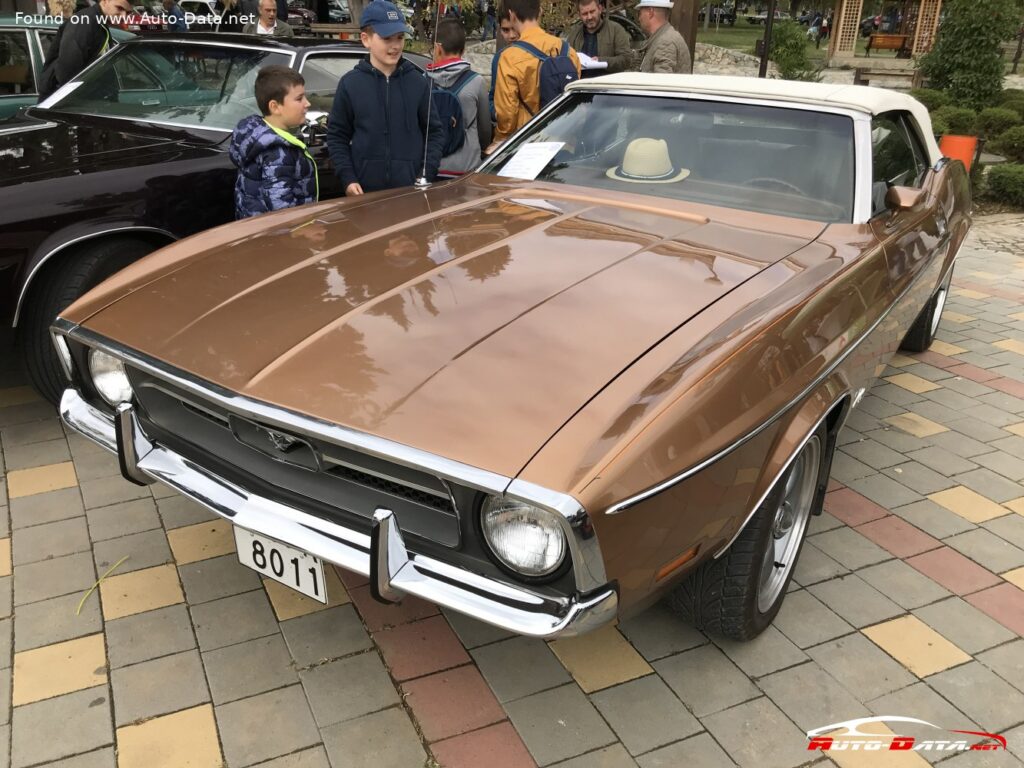
The Ford Mustang Convertible I (facelift 1970) with the 5.8-liter V8 engine producing 285 horsepower represents a significant iteration of the iconic American pony car. Introduced as part of a mid-cycle refresh for the first-generation Mustang, this variant was produced from 1970 through 1973. It occupied a premium position within the Mustang lineup, offering a blend of open-air driving enjoyment and substantial V8 performance. This model year saw a considerable increase in size compared to earlier Mustangs, reflecting evolving design trends and safety regulations of the era. It was built on the Ford Fox platform, though the first generation is often referred to as simply the “first generation” Mustang.
The 1970-1973 Mustang Convertible: A Performance Overview
The 1970 facelift brought substantial changes to the Mustang’s styling, making it larger and heavier than its predecessors. The 5.8L V8, often referred to as the 351 cubic inch engine, was a key component of the performance-oriented models. While not the most powerful engine option available (the Boss 351 and 429 offered higher outputs), the 285 hp version provided a strong balance of power and usability for the convertible. This engine was targeted towards drivers who desired a spirited driving experience without the extreme nature of the higher-performance, and often more expensive, Mustang variants.
Powertrain & Engine Architecture
The heart of this Mustang is the 5.8-liter (351 cubic inch) V8 engine, designated within Ford’s engine family as the 351 Windsor. This engine featured a 90-degree V configuration with a cast iron block and cast iron cylinder heads. The engine produced 285 horsepower at 5400 rpm and 502 Nm (370.26 lb-ft) of torque at 3400 rpm. It utilized a carburetor for fuel delivery, a common practice for the time, and an overhead valve (OHV) valvetrain with two valves per cylinder. The compression ratio was 11.7:1, contributing to the engine’s power output. The engine oil capacity was 4.8 liters (5.07 US quarts), and required a specific oil specification (details not publicly available without Ford service documentation). The engine was longitudinally mounted in the front of the vehicle.
While the provided information specifies a 4-speed manual transmission, it’s important to note that a 3-speed automatic transmission was also available, and quite popular, with this engine. The automatic transmission, a Ford C6, was a three-speed unit known for its durability. Gear ratios varied slightly depending on the specific rear axle ratio chosen by the buyer, but generally provided a balance between acceleration and cruising efficiency. The manual transmission offered a more direct connection to the engine, appealing to enthusiasts, while the automatic provided ease of use for everyday driving.
Driving Characteristics
The 1970-1973 Mustang Convertible with the 5.8L V8 and either transmission offered a distinctly American driving experience. The engine delivered strong low-end torque, making it responsive in everyday driving situations. The 285 hp output provided ample power for acceleration and highway cruising. The larger size and weight of the facelifted Mustang, however, meant that it wasn’t as nimble as earlier, smaller models. The convertible body style added further weight, slightly impacting handling. The rear-wheel-drive configuration and relatively soft suspension tuning provided a comfortable ride, but also allowed for some body roll during cornering. The manual transmission offered a more engaging driving experience, allowing the driver to fully control the engine’s power, while the automatic provided smooth and effortless shifting.
Equipment & Trim Levels
The Mustang Convertible I (facelift 1970) 5.8 V8 was positioned as a mid-to-upper trim level within the Mustang range. Standard features included a fully carpeted interior, color-keyed vinyl upholstery, and a basic instrument cluster. Power steering was often included, enhancing ease of maneuverability. Options were plentiful, allowing buyers to customize their Mustangs to their preferences. These included upgraded interior trim packages, a deluxe steering wheel, a console, and various exterior enhancements such as stripes and wheel covers. A power top was a popular option for the convertible, adding convenience. Air conditioning was also a frequently selected option, particularly in warmer climates.
Chassis & Braking
The chassis of the 1970-1973 Mustang Convertible featured independent front suspension with wishbones and a transverse stabilizer bar. The rear suspension utilized a rigid axle with leaf springs. This setup provided a comfortable ride but wasn’t particularly sophisticated in terms of handling. The braking system consisted of disc brakes on the front wheels and drum brakes on the rear. While adequate for the time, the braking performance wasn’t as powerful as modern systems. Steering was accomplished via a cone worm with recirculation balls, and power steering was often included as an option. The tires were typically 205/65 R15 on 6.5J x 15 inch rims.
Market Reception & Comparison
The 1970-1973 Mustang Convertible with the 5.8L V8 was generally well-received by automotive critics and the public. It was praised for its stylish design, comfortable ride, and strong V8 performance. Compared to the smaller 6-cylinder Mustangs, the 5.8L V8 offered a significant increase in power and responsiveness. Compared to the higher-performance Boss models, it provided a more affordable and practical option. Fuel economy, however, was a concern, as was typical for V8-powered vehicles of the era. Reliability was generally good, although carburetor maintenance was a regular requirement. The convertible body style added to the car’s appeal, making it a popular choice for those seeking an open-air driving experience.
Technical Specifications
| Brand | Ford |
| Model | Mustang |
| Generation | Mustang Convertible I (facelift 1970) |
| Type (Engine) | 5.8 V8 (285 Hp) |
| Start of production | 1970 year |
| End of production | 1973 year |
| Powertrain Architecture | Internal Combustion engine |
| Body type | Cabriolet |
| Seats | 4 |
| Doors | 2 |
| Fuel Type | Petrol (Gasoline) |
| Power | 285 Hp @ 5400 rpm |
| Torque | 502 Nm @ 3400 rpm / 370.26 lb.-ft. @ 3400 rpm |
| Engine layout | Front, Longitudinal |
| Engine displacement | 5752 cm3 / 351.01 cu. in. |
| Number of cylinders | 8 |
| Engine configuration | V-engine |
| Cylinder Bore | 101.6 mm / 4 in. |
| Piston Stroke | 88.9 mm / 3.5 in. |
| Compression ratio | 11.7:1 |
| Number of valves per cylinder | 2 |
| Fuel injection system | Carburettor |
| Engine aspiration | Naturally aspirated engine |
| Valvetrain | OHV |
| Engine oil capacity | 4.8 l / 5.07 US qt | 4.22 UK qt |
| Coolant | 13.7 l / 14.48 US qt | 12.05 UK qt |
| Trunk (boot) space – maximum | 229 l / 8.09 cu. ft. |
| Fuel tank capacity | 76 l / 20.08 US gal | 16.72 UK gal |
| Length | 4813 mm / 189.49 in. |
| Width | 1882 mm / 74.09 in. |
| Height | 1290 mm / 50.79 in. |
| Wheelbase | 2769 mm / 109.02 in. |
| Front track | 1562 mm / 61.5 in. |
| Rear (Back) track | 1549 mm / 60.98 in. |
| Minimum turning circle (turning diameter) | 12.1 m / 39.7 ft. |
| Drivetrain Architecture | Rear wheel drive. Internal Combustion engine. |
| Number of gears and type of gearbox | 4 gears, manual transmission |
| Front suspension | Wishbone, Transverse stabilizer |
| Rear suspension | Rigid axle suspension, Leaf spring |
| Front brakes | Disc |
| Rear brakes | Drum |
| Steering type | Cone worm with recirculation balls |
| Power steering | Hydraulic Steering |
| Tires size | Front wheel tires: 205/65 R15Rear wheel tires: 205/65 R15 |
| Wheel rims size | Front wheel rims: 6.5J x 15Rear wheel rims: 6.5J x 15 |
Legacy
The 1970-1973 Mustang Convertible with the 5.8L V8 remains a popular classic car today. The 351 Windsor engine is known for its durability and relative ease of maintenance, making it a desirable powertrain for restoration projects. While not as highly sought after as the Boss models, these Mustangs offer a good balance of performance, style, and affordability. The convertible body style adds to their appeal, particularly in regions with favorable weather. Parts availability is generally good, although some specific trim pieces can be difficult to find. Well-maintained examples command respectable prices in the used car market, reflecting their enduring popularity and iconic status.