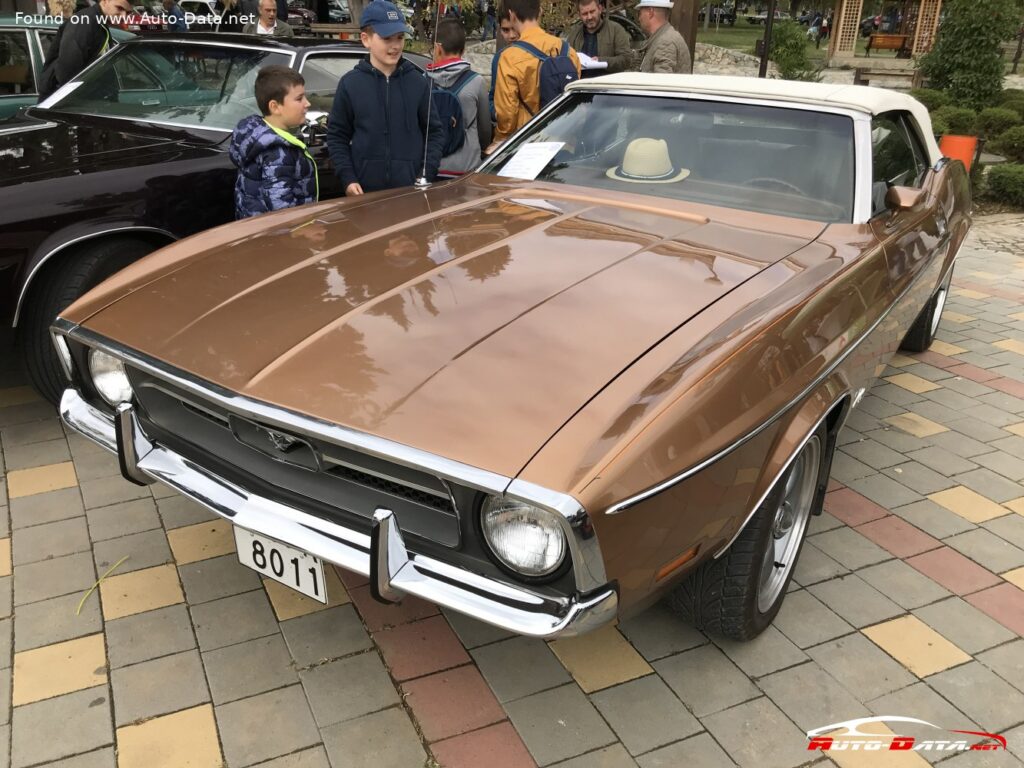
The Ford Mustang Convertible I, specifically the facelifted version produced from 1970 to 1971, represented a significant evolution in the iconic pony car’s lineage. While the first-generation Mustang (1964-1973) had grown considerably in size and weight over its initial years, the 1970 facelift aimed to modernize the styling and offer a broader range of performance options. Among these, the 7.0-liter (429 cubic inch) Cobra Jet V8 variant stood out as a high-performance offering, positioned as the top-tier engine choice for those seeking exhilarating acceleration and a commanding presence. This particular configuration, while not the most common, catered to enthusiasts desiring a powerful open-air driving experience.
The 1970-1971 Mustang Convertible Cobra Jet: A Performance Flagship
The 1970-1971 Mustang Convertible with the 7.0 Cobra Jet V8 engine was positioned as the premium performance variant within the Convertible I range. It sat above the base inline-six and smaller V8 options, appealing to buyers who prioritized raw power over fuel economy or affordability. While the standard Mustang offered a range of trims, the Cobra Jet was often associated with a more aggressive aesthetic and a focus on straight-line speed. It was a direct competitor to other muscle cars of the era, such as the Chevrolet Camaro and Pontiac Firebird, offering a similar blend of power and style.
Powertrain & Engine Architecture
The heart of this Mustang variant was the 7.0-liter (429 cubic inch) Cobra Jet V8 engine. Designated as the 370 horsepower version at 5200 rpm, it was a big-block V8 built for performance. The engine code varied, but commonly featured a cast iron block and heads. The Cobra Jet was specifically designed for drag racing and high-speed acceleration, featuring a high-rise intake manifold and a large four-barrel carburetor. While the carburetor was the fuel injection system of the time, it was a relatively simple setup compared to later fuel injection technologies. The engine utilized an overhead valve (OHV) valvetrain with two valves per cylinder.
The 429 Cobra Jet featured a compression ratio of 11.3:1, contributing to its substantial power output. Bore and stroke dimensions were 110.74 mm (4.36 inches) and 91.19 mm (3.59 inches) respectively. The engine required premium fuel to prevent detonation. The 1970-1971 models were exclusively paired with a 4-speed manual transmission, as the automatic transmissions of the era were not robust enough to handle the engine’s torque reliably. This transmission choice further emphasized the performance-oriented nature of the Cobra Jet.
Driving Characteristics
The 1970-1971 Mustang Convertible with the 7.0 Cobra Jet V8 delivered a thrilling driving experience. The engine produced a peak torque of 610 Nm (449.91 lb-ft) at 3400 rpm, providing strong acceleration across the rev range. The 4-speed manual transmission allowed drivers to fully exploit the engine’s power, offering precise control over gear selection. While the Mustang Convertible was not known for its nimble handling due to its size and weight, the Cobra Jet engine provided ample power to overcome these limitations. The rear-wheel-drive configuration and relatively short wheelbase contributed to a lively and engaging driving experience, particularly on open roads. The car was capable of impressive acceleration times for its era, making it a formidable performer at the drag strip.
Equipment & Trim Levels
The 1970-1971 Mustang Convertible Cobra Jet typically came with a relatively basic interior, focusing on functionality rather than luxury. Standard features included a vinyl interior, a three-spoke steering wheel, and basic instrumentation. However, buyers could opt for a range of optional extras, including power steering, power brakes, air conditioning, and upgraded audio systems. Interior color choices were limited but typically included black, white, and various shades of blue and red. The exterior styling was characterized by a long hood, a short deck, and a sporty convertible top. The Cobra Jet often featured unique badging and striping to distinguish it from other Mustang models. While not a luxury vehicle, the Mustang Convertible Cobra Jet offered a comfortable and stylish driving experience for those seeking a high-performance open-air car.
Chassis & Braking
The 1970-1971 Mustang Convertible utilized a traditional body-on-frame construction. The front suspension consisted of wishbones with a transverse stabilizer bar, while the rear suspension employed a rigid axle with leaf springs. This setup provided a comfortable ride but was not particularly sophisticated in terms of handling. The braking system featured disc brakes at the front and drum brakes at the rear. Power steering was available as an option, making the car easier to maneuver at low speeds. Tire size was typically 205/65 R15 for both front and rear wheels, mounted on 6.5J x 15 inch rims. The chassis and braking system were adequate for the car’s performance capabilities, but they were not as advanced as those found in some contemporary sports cars.
Market Reception & Comparison
The 1970-1971 Mustang Convertible Cobra Jet received generally positive reviews from automotive critics. It was praised for its powerful engine, exhilarating acceleration, and stylish design. However, some critics noted the car’s size and weight, as well as its relatively basic interior. Compared to other Mustang trims, the Cobra Jet offered a significant performance advantage but came at a higher price. It was also less fuel-efficient than the smaller-engined models. In terms of reliability, the Cobra Jet engine was generally considered to be robust, but it required regular maintenance to ensure optimal performance. The 4-speed manual transmission was also relatively reliable, but it required skilled operation to avoid damage. Overall, the Mustang Convertible Cobra Jet was a well-regarded muscle car that offered a compelling combination of power, style, and value.
Technical Specifications
| Brand | Ford |
| Model | Mustang |
| Generation | Mustang Convertible I (facelift 1970) |
| Type (Engine) | 7.0 Cobra Jet V8 (370 Hp) |
| Start of production | 1970 |
| End of production | 1971 |
| Powertrain Architecture | Internal Combustion engine |
| Body type | Cabriolet |
| Seats | 4 |
| Doors | 2 |
| Fuel Type | Petrol (Gasoline) |
| Power | 370 Hp @ 5200 rpm |
| Torque | 610 Nm @ 3400 rpm / 449.91 lb.-ft. @ 3400 rpm |
| Engine layout | Front, Longitudinal |
| Engine displacement | 7030 cm3 / 429 cu. in. |
| Number of cylinders | 8 |
| Engine configuration | V-engine |
| Cylinder Bore | 110.74 mm / 4.36 in. |
| Piston Stroke | 91.19 mm / 3.59 in. |
| Compression ratio | 11.3:1 |
| Number of valves per cylinder | 2 |
| Fuel injection system | Carburettor |
| Engine aspiration | Naturally aspirated engine |
| Valvetrain | OHV |
| Engine oil capacity | 6.6 l / 6.97 US qt | 5.81 UK qt |
| Coolant | 17.7 l / 18.7 US qt | 15.57 UK qt |
| Trunk (boot) space – maximum | 229 l / 8.09 cu. ft. |
| Fuel tank capacity | 76 l / 20.08 US gal | 16.72 UK gal |
| Length | 4813 mm / 189.49 in. |
| Width | 1882 mm / 74.09 in. |
| Height | 1290 mm / 50.79 in. |
| Wheelbase | 2769 mm / 109.02 in. |
| Front track | 1562 mm / 61.5 in. |
| Rear (Back) track | 1549 mm / 60.98 in. |
| Minimum turning circle (turning diameter) | 12.1 m / 39.7 ft. |
| Drivetrain Architecture | Rear wheel drive. Internal Combustion engine. |
| Number of gears and type of gearbox | 4 gears, manual transmission |
Legacy
The 1970-1971 Mustang Convertible Cobra Jet remains a highly sought-after classic muscle car today. Its combination of power, style, and rarity has made it a favorite among collectors and enthusiasts. While the engine itself is generally reliable, finding original parts can be challenging and expensive. The Cobra Jet’s legacy is one of raw power and American automotive excess, representing a high point in the muscle car era. Well-maintained examples command premium prices in the used car market, reflecting their historical significance and enduring appeal. The 7.0 Cobra Jet V8 engine is remembered as one of the most potent and iconic engines ever offered in the Ford Mustang.