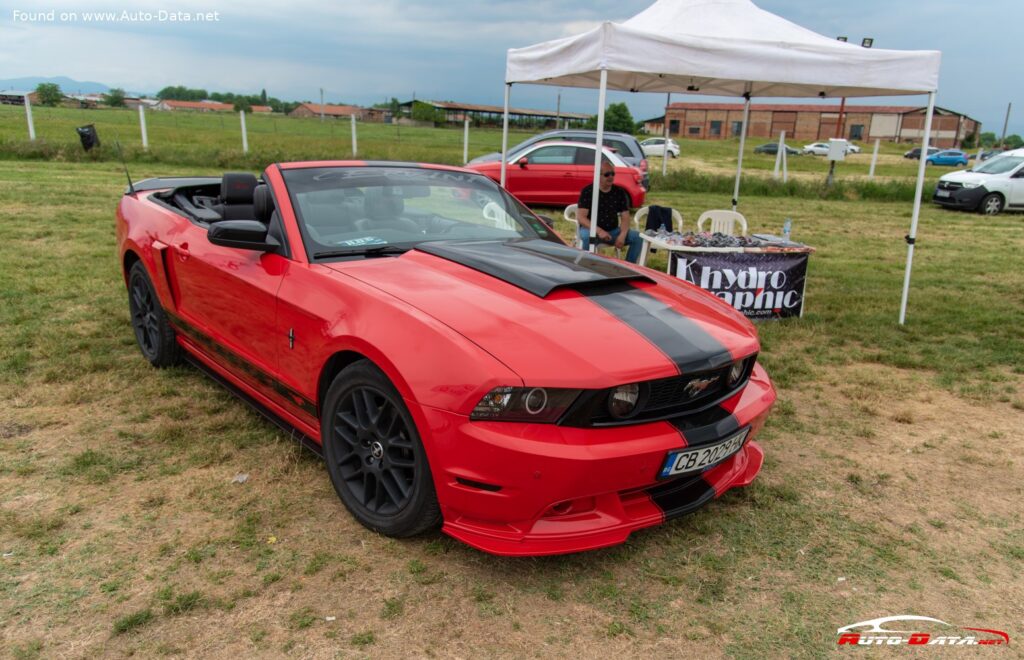
The Ford Mustang Convertible V (facelift 2009) GT 5.0 V8 (412 Hp) represents a significant chapter in the Mustang’s ongoing legacy. Produced from 2010 to 2012, this iteration of the fifth-generation (S197) Mustang marked the triumphant return of the iconic “5.0” V8 engine after a decade-long hiatus. Positioned as the top-tier GT convertible within the Mustang lineup, it combined classic Mustang styling with a thoroughly modern powertrain, appealing to enthusiasts seeking a high-performance, open-top experience. The facelift brought subtle but important updates to the S197 platform, enhancing both its aesthetics and performance capabilities.
Powertrain & Engine Architecture
The defining feature of the Ford Mustang Convertible V (facelift 2009) GT is its “Coyote” 5.0-liter V8 engine. This engine, internally designated as the 302, replaced the previous 4.6-liter modular V8, representing a substantial leap in technology and performance. The 4,951 cubic centimeter (302.13 cu. in.) engine utilizes a Double Overhead Camshaft (DOHC) design with Twin Independent Variable Cam Timing (Ti-VCT). This advanced valvetrain allows for precise control over valve timing, optimizing performance and efficiency across the entire rev range. The Coyote engine was a clean-sheet design, moving away from the modular architecture of its predecessor.
The engine produces 412 horsepower at 6,500 rpm and 390.17 lb-ft (529 Nm) of torque at 4,250 rpm. Its high 11:1 compression ratio and multi-port fuel injection system contribute to its responsiveness. The engine’s maximum engine speed is 7,000 rpm. Power is delivered exclusively to the rear wheels through a 6-speed manual transmission, providing a direct and engaging driving experience. While an automatic transmission was available on other Mustang trims, the 5.0L GT was exclusively offered with the manual.
Driving Characteristics
The 2010-2012 Mustang GT 5.0 Convertible delivers a distinctly American muscle car driving experience. The Coyote V8 provides strong, linear acceleration throughout the rev range. The 6-speed manual transmission allows for precise gear selection, maximizing the engine’s powerband. Compared to the earlier 4.6-liter V8, the Coyote engine offers significantly improved responsiveness and a higher redline, making it more enjoyable to drive aggressively. The weight-to-power ratio of 4.1 kg/Hp (244.2 Hp/tonne) contributes to its brisk performance.
While the manual transmission enhances driver engagement, it’s important to note that the Mustang GT Convertible is a relatively heavy vehicle. This weight, combined with the solid rear axle suspension, can result in some body roll during hard cornering. However, the car remains predictable and controllable, making it a rewarding vehicle to drive on both the street and the track. The exhaust note is a defining characteristic, providing a classic V8 rumble that is both exhilarating and iconic.
Equipment & Trim Levels
The Mustang GT Convertible V (facelift 2009) came standard with a comprehensive list of features. Interior appointments included sport seats upholstered in cloth or available leather, a leather-wrapped steering wheel with audio controls, and a premium sound system. The dashboard featured a revised instrument cluster with updated graphics and a more modern appearance. Standard exterior features included 18-inch alloy wheels, a rear spoiler, and a power-operated convertible top.
Optional extras included larger 19-inch wheels, a premium audio system (Shaker 500 or Shaker 1000), navigation system, automatic climate control, and heated seats. Appearance packages were also available, offering unique styling cues and exterior accents. The convertible top was available in several colors to complement the exterior paint options. The GT trim also included performance-oriented features such as upgraded brakes and a limited-slip differential.
Chassis & Braking
The chassis of the Mustang GT 5.0 Convertible utilizes an independent McPherson strut front suspension with a transverse stabilizer bar. The rear suspension employs a traditional solid axle design with coil springs and a transverse stabilizer bar. While the solid rear axle is a cost-effective and durable solution, it doesn’t offer the same level of sophistication as a fully independent rear suspension. The suspension tuning is geared towards providing a balance between ride comfort and handling performance.
Braking duties are handled by ventilated discs at all four corners, measuring 336×36 mm at the front and 300×19 mm at the rear. An Anti-lock Braking System (ABS) is standard. The electric power steering system provides variable assist, making the car easier to maneuver at low speeds and offering a firmer feel at higher speeds. The car’s curb weight of 3,719.2 lbs (1,687 kg) influences its braking performance and handling characteristics.
Market Reception & Comparison
The 2010-2012 Mustang GT Convertible with the 5.0-liter V8 was widely praised by automotive critics. The engine was lauded for its power, responsiveness, and sound. The car’s classic styling and engaging driving experience also received positive reviews. Compared to the Chevrolet Camaro Convertible and Dodge Challenger Convertible, the Mustang GT offered a more balanced package, with a lighter weight and more agile handling. The Camaro was often criticized for its interior quality and visibility, while the Challenger was seen as being larger and less nimble.
Fuel economy for the Mustang GT 5.0 Convertible is rated at 19.9 US mpg (11.8 l/100 km) combined, with 17 US mpg (13.8 l/100 km) in the city and 26.1 US mpg (9 l/100 km) on the highway. Reliability has generally been good, with the Coyote engine proving to be a durable and dependable powerplant. However, like all performance vehicles, regular maintenance is essential to ensure long-term reliability.
Technical Specifications
| Category | Specification |
| Brand | Ford |
| Model | Mustang |
| Generation | Mustang Convertible V (facelift 2009) |
| Type (Engine) | GT 5.0 V8 (412 Hp) |
| Start of Production | 2010 year |
| End of Production | 2012 year |
| Powertrain Architecture | Internal Combustion engine |
| Body type | Cabriolet |
| Seats | 4 |
| Doors | 2 |
| Fuel consumption (economy) – urban | 13.8 l/100 km (17 US mpg) |
| Fuel consumption (economy) – extra urban | 9 l/100 km (26.1 US mpg) |
| Fuel consumption (economy) – combined | 11.8 l/100 km (19.9 US mpg) |
| Fuel Type | Petrol (Gasoline) |
| Weight-to-power ratio | 4.1 kg/Hp (244.2 Hp/tonne) |
| Engine Specs | |
| Power | 412 Hp @ 6500 rpm |
| Power per liter | 83.2 Hp/l |
| Torque | 529 Nm @ 4250 rpm (390.17 lb.-ft. @ 4250 rpm) |
| Maximum engine speed | 7000 rpm |
| Engine layout | Front, Longitudinal |
| Engine Model/Code | Coyote |
| Engine displacement | 4951 cm3 (302.13 cu. in.) |
| Number of cylinders | 8 |
| Engine configuration | V-engine |
| Cylinder Bore | 92.2 mm (3.63 in.) |
| Piston Stroke | 92.7 mm (3.65 in.) |
| Compression ratio | 11:1 |
| Number of valves per cylinder | 4 |
| Fuel injection system | Multi-port manifold injection |
| Engine aspiration | Naturally aspirated engine |
| Valvetrain | DOHC, Ti-VCT |
| Kerb Weight | 1687 kg (3719.2 lbs) |
| Trunk (boot) space – minimum | 272 l (9.61 cu. ft.) |
| Fuel tank capacity | 61 l (16.11 US gal) |
| Minimum turning circle (turning diameter) | 11.2 m (36.75 ft.) |
Legacy
The Ford Mustang Convertible V (facelift 2009) GT 5.0 V8 has become a highly desirable classic among Mustang enthusiasts. The Coyote engine’s reputation for reliability and performance has ensured that these cars remain popular in the used car market. The combination of a powerful V8, a classic convertible design, and a relatively affordable price point has made it a favorite among collectors and drivers alike. The Coyote engine continues to be used in modern Mustangs, a testament to its enduring design and performance capabilities. Well-maintained examples of this generation Mustang are expected to hold their value and continue to appreciate in the years to come, solidifying its place as a modern classic.