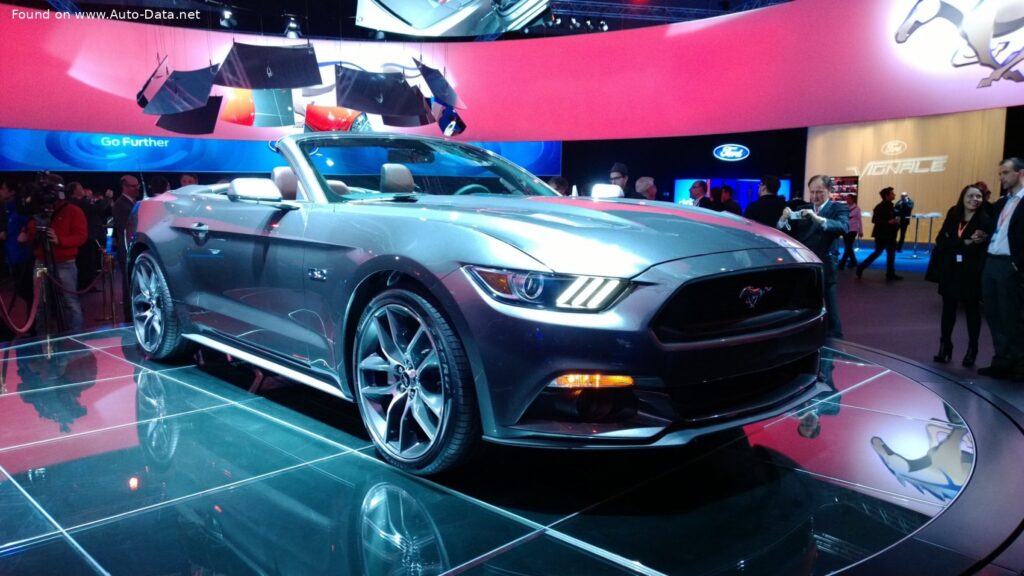
The Ford Mustang, an enduring icon of American automotive culture, entered its sixth generation (internal code S550) in 2015, marking a significant evolution for the storied pony car. This iteration was particularly notable as it was the first Mustang to be engineered as a truly global vehicle, designed to be sold and enjoyed in markets beyond North America, including Europe, Asia, and Australia. Among the diverse powertrain options offered, the Ford Mustang Convertible VI 2.3 EcoBoost (309 Hp) Automatic variant stood out, representing a modern approach to performance and efficiency within the classic Mustang lineage. Produced from 2015 to 2017, this model offered a compelling blend of open-air driving pleasure, contemporary technology, and a turbocharged four-cylinder engine that provided robust performance while addressing increasing global demands for fuel economy and lower emissions. It positioned the Mustang as a versatile sports convertible, appealing to a broader audience who desired the legendary styling and driving dynamics without necessarily opting for the traditional V8 powerplant.
Ford Mustang Convertible VI 2.3 EcoBoost Automatic: A Detailed Overview
The 2.3 EcoBoost Automatic trim occupied a mid-range position within the sixth-generation Mustang Convertible lineup. It served as the entry point into the convertible experience, offering a more accessible price point than the V6 and GT models. While the V6 provided a slightly lower cost of entry, the 2.3 EcoBoost offered a significant performance upgrade with its turbocharged engine, making it a popular choice for buyers seeking a balance of power, efficiency, and style. Compared to the GT, the 2.3 EcoBoost prioritized fuel economy and a more manageable power delivery, appealing to drivers who valued everyday usability alongside spirited driving.
Powertrain & Engine Architecture
At the heart of the Ford Mustang Convertible VI 2.3 EcoBoost (309 Hp) Automatic lies Ford’s acclaimed 2.3-liter EcoBoost engine. This powertrain architecture is an Internal Combustion Engine (ICE), a front, longitudinal-mounted inline-four cylinder unit, meticulously engineered for both power and efficiency. With an engine displacement of 2264 cm3 (138.16 cu. in.), this turbocharged and intercooled gasoline engine delivers an impressive 309 horsepower at 5500 rpm. Its power-per-liter ratio stands at a remarkable 136.5 Hp/l, showcasing its advanced design.
Torque output is equally compelling, with 407 Nm (300.19 lb.-ft.) available across a broad rev range, specifically from 2500 to 4500 rpm. This wide torque band ensures responsive acceleration and strong pulling power, making the convertible an engaging drive both in urban settings and on the open highway. The engine features a DOHC (Dual Overhead Camshaft) valvetrain with four valves per cylinder, contributing to its efficient breathing and high-revving capability. Fuel is delivered via a direct injection system, which precisely controls fuel atomization and combustion, further enhancing both power output and fuel economy.
The engine’s internal specifications include a cylinder bore of 87.55 mm (3.45 in.) and a piston stroke of 94 mm (3.7 in.), with a compression ratio of 9.5:1. This configuration, combined with the turbocharger, allows for significant power density from a relatively small displacement. Power is sent to the rear wheels via a smooth-shifting 6-speed automatic transmission, reinforcing the Mustang’s traditional rear-wheel-drive sports car ethos. This transmission, a Ford 6F35, is known for its relatively quick shifts and smooth operation. It features a torque converter for smooth launches and cruising, and offers a selectable Sport mode for more aggressive shifting. This combination ensures a dynamic driving experience, characteristic of the Mustang, while providing the convenience and refinement of an automatic gearbox.
Driving Characteristics
The 2.3 EcoBoost Automatic Mustang Convertible delivers a surprisingly engaging driving experience. While it doesn’t possess the raw, visceral power of the V8 GT, it offers ample acceleration and a responsive feel. The broad torque band of the engine means that strong pulling power is available throughout much of the rev range, making overtaking and merging onto highways effortless. The 6-speed automatic transmission is well-tuned, providing smooth and timely shifts. In comparison to a manual transmission equipped 2.3 EcoBoost, the automatic sacrifices some driver engagement but gains in convenience, particularly in stop-and-go traffic. The gear ratios are optimized for a balance of acceleration and fuel efficiency. First gear is relatively short for quick off-the-line acceleration, while higher gears are geared for comfortable highway cruising. The convertible’s chassis is well-balanced, providing a stable and predictable handling experience. However, the added weight of the convertible top and mechanism does result in slightly less sharp handling compared to the coupe version.
Equipment & Trim Levels
The 2.3 EcoBoost Automatic Mustang Convertible came standard with a respectable array of features. Standard interior appointments included cloth upholstery, air conditioning, a basic infotainment system with a touchscreen display, and power windows and locks. Optional extras were plentiful, allowing buyers to customize their Mustang to their preferences. Popular options included leather upholstery, upgraded sound systems (such as the Shaker system), navigation, heated and cooled front seats, and a premium appearance package. Safety features included standard ABS (Anti-lock Braking System), traction control, and a suite of airbags. The convertible top was power-operated and available in a variety of colors. Trim levels beyond the base 2.3 EcoBoost often included appearance packages that added unique styling elements, such as different wheel designs, body kits, and interior trim accents.
Chassis & Braking
The Mustang Convertible VI utilized an independent rear suspension (IRS) for the first time in the Mustang’s history, significantly improving ride quality and handling compared to previous generations. The front suspension consisted of MacPherson struts with a stabilizer bar, while the rear featured a multi-link setup. This IRS design was particularly beneficial for the convertible, as it helped to mitigate body flex and improve stability. The braking system consisted of ventilated disc brakes on all four wheels, providing ample stopping power. ABS (Anti-lock Braking System) was standard, enhancing safety and control during hard braking. The rear drums found on earlier Mustang models were absent in this generation, providing consistent braking performance. Stabilizer bars were fitted to both the front and rear axles to reduce body roll during cornering.
Market Reception & Comparison
Critics generally praised the Ford Mustang Convertible VI 2.3 EcoBoost Automatic for its blend of performance, style, and fuel efficiency. The turbocharged engine was lauded for its responsiveness and power, while the automatic transmission was appreciated for its smoothness and convenience. The convertible top mechanism was also well-received for its ease of use and reliability. Compared to the V8 GT, the 2.3 EcoBoost offered a more affordable and fuel-efficient alternative without sacrificing too much in terms of driving enjoyment. Fuel economy was a significant advantage, with the 2.3 EcoBoost achieving approximately 24 US mpg combined, compared to the GT’s lower figures. Reliability was generally good, although some owners reported minor issues with the infotainment system and occasional turbocharger concerns. Overall, the 2.3 EcoBoost Automatic Mustang Convertible was considered a well-rounded and appealing sports car that broadened the Mustang’s appeal to a wider audience.
Technical Specifications
| Category | Specification |
| General Information | |
| Brand | Ford |
| Model | Mustang |
| Generation | Mustang Convertible VI |
| Type (Engine) | 2.3 EcoBoost (309 Hp) Automatic |
| Start of Production | 2015 year |
| End of Production | 2017 year |
| Powertrain Architecture | Internal Combustion engine |
| Body type | Cabriolet |
| Seats | 4 |
| Doors | 2 |
| Performance Specs | |
| Fuel consumption (economy) – urban | 11.8 l/100 km (19.9 US mpg) |
| Fuel consumption (economy) – extra urban | 7.8 l/100 km (30.2 US mpg) |
| Fuel consumption (economy) – combined | 9.8 l/100 km (24 US mpg) |
| Fuel Type | Petrol (Gasoline) |
| Engine Specs | |
| Power | 309 Hp @ 5500 rpm |
| Power per liter | 136.5 Hp/l |
| Torque | 407 Nm @ 2500-4500 rpm (300.19 lb.-ft. @ 2500-4500 rpm) |
| Engine layout | Front, Longitudinal |
| Engine Model/Code | EcoBoost |
| Engine displacement | 2264 cm3 (138.16 cu. in.) |
| Number of cylinders | 4 |
| Engine configuration | Inline |
| Cylinder Bore | 87.55 mm (3.45 in.) |
| Piston Stroke | 94 mm (3.7 in.) |
| Compression ratio | 9.5:1 |
| Number of valves per cylinder | 4 |
| Fuel injection system | Direct injection |
| Engine aspiration | Turbocharger, Intercooler |
| Valvetrain | DOHC |
| Engine oil capacity | 5.4 l (5.71 US qt) |
| Coolant | 8.96 l (9.47 US qt) |
| Space, Volume and Weights | |
| Fuel tank capacity | 58 l (15.32 US gal) |
| Dimensions | |
| Length | 4783 mm (188.31 in.) |
| Width | 1915 mm (75.39 in.) |
| Width with mirrors folded | 2080 mm (81.89 in.) |
| Height | 1394 mm (54.88 in.) |
| Wheelbase | 2720 mm (107.09 in.) |
| Front track | 1582 mm (62.28 in.) |
| Rear (Back) track | 1648 mm (64.88 in.) |
| Drag coefficient (Cd) | 0.35 |
| Minimum turning circle (turning diameter) | 11.12 m (36.48 ft.) |
| Drivetrain, Brakes and Suspension Specs | |
| Drivetrain Architecture | The Internal combustion engine (ICE) drives the rear wheels of the vehicle. |
| Drive wheel | Rear wheel drive |
| Number of gears and type of gearbox | 6 gears, automatic transmission |
| Front brakes | Ventilated discs |
| Rear brakes | Ventilated discs |
| Assisting systems | ABS (Anti-lock braking system) |
| Steering type | Steering rack and pinion |
| Power steering | Electric Steering |
| Tires size | 235/55 R17 |
| Wheel rims size | 17 inches |
Legacy
The Ford Mustang Convertible VI 2.3 EcoBoost Automatic holds a significant place in the Mustang’s evolution. It demonstrated Ford’s commitment to adapting to changing market demands and embracing new technologies. The 2.3 EcoBoost engine proved to be a capable and reliable powerplant, and examples of this powertrain continue to be found on the used car market today. While not as highly sought after as the V8 GT models, the 2.3 EcoBoost Convertible offers a compelling value proposition for buyers seeking a stylish, fun-to-drive, and relatively fuel-efficient sports car. Its long-term reliability has been generally good, with routine maintenance being the key to keeping these engines running smoothly. The combination of its iconic styling, modern features, and accessible price point ensures that the 2.3 EcoBoost Automatic Mustang Convertible will remain a popular choice for enthusiasts for years to come.