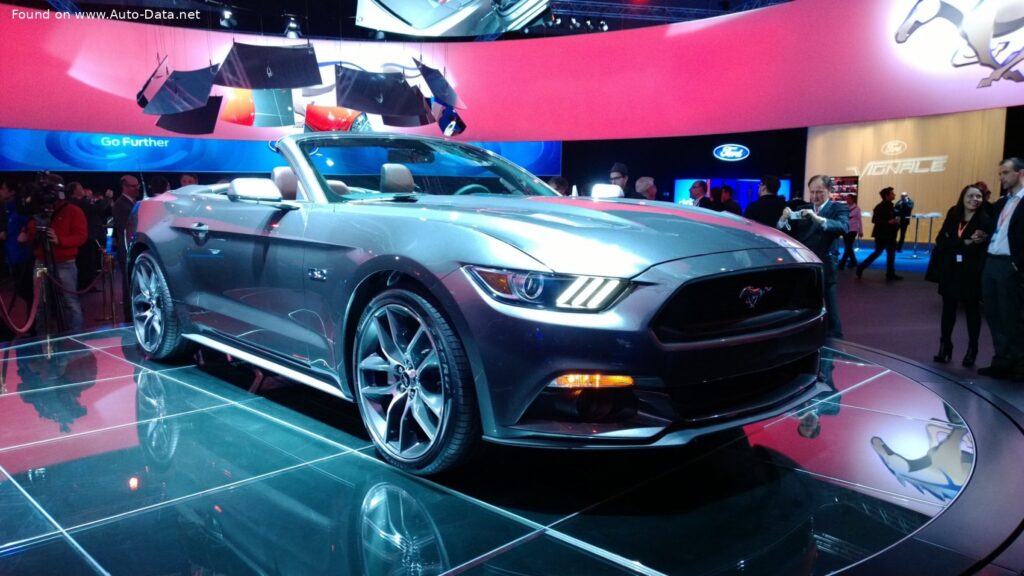
The Ford Mustang Convertible VI 2.3 EcoBoost (317 Hp) Automatic represents a significant chapter in the Mustang’s evolution, debuting in 2015 as part of the sixth generation (S550). This variant marked a departure from the traditional V8-centric Mustang formula, introducing a turbocharged four-cylinder engine to a broader audience. The S550 generation was the first Mustang designed and marketed as a global vehicle, embracing modern engineering while retaining the iconic American muscle car aesthetic. Produced from 2015 to 2017, the 2.3 EcoBoost Convertible offered a compelling blend of performance, efficiency, and contemporary technology, positioning the Mustang as a more accessible and versatile sports car.
The EcoBoost Revolution in the Ford Mustang Convertible VI
At the heart of the Ford Mustang Convertible VI 2.3 EcoBoost (317 Hp) Automatic lies a 2.3-liter (2264 cm3 or 138.16 cu. in.) inline-four engine, part of Ford’s EcoBoost family. This powerplant was engineered to deliver a balance of power and fuel efficiency, a relatively new concept for the Mustang. Utilizing direct fuel injection, a turbocharger, and an intercooler, the engine produces 317 horsepower at 5500 rpm and 318.63 lb.-ft. (432 Nm) of torque at 3000 rpm. This low-end torque contributes to a responsive driving experience.
Powertrain & Engine Architecture
The engine features a front, longitudinal layout with a DOHC (Dual Overhead Camshaft) valvetrain and four valves per cylinder, optimizing airflow and combustion. A compression ratio of 9.5:1 is designed for efficiency without sacrificing performance. Power is channeled through a smooth 6-speed automatic transmission to the rear wheels, maintaining the Mustang’s rear-wheel-drive dynamics. This drivetrain, combined with a curb weight of 3787.54 lbs. (1718 kg), results in a weight-to-power ratio of 5.4 kg/Hp (184.5 Hp/tonne), allowing for spirited acceleration. The automatic transmission utilized is a 6F35, a six-speed unit known for its smooth shifts and reliability. It features a torque converter lock-up clutch to improve fuel efficiency at cruising speeds. The transmission control module (TCM) is integrated with the engine control module (ECM) for optimized performance.
Driving Characteristics
The 2.3 EcoBoost Automatic offers a distinct driving experience compared to its V8 siblings and manual transmission counterparts. While lacking the raw power and visceral sound of the 5.0L V8, the EcoBoost provides ample power for everyday driving and spirited backroad excursions. The 6-speed automatic transmission is tuned for a balance of comfort and performance, with gear ratios optimized for both acceleration and fuel economy. First gear is relatively short for quick off-the-line acceleration, while higher gears are geared for efficient highway cruising. Compared to the manual transmission version, the automatic offers smoother shifts and reduced driver fatigue, but at the expense of some driver engagement. The EcoBoost engine’s turbocharger provides a noticeable boost in power, delivering a responsive and engaging driving experience. However, some turbo lag is present, particularly at lower engine speeds.
Equipment & Trim Levels
The Ford Mustang Convertible VI 2.3 EcoBoost Automatic typically served as a mid-range offering within the S550 lineup, positioned above the base model but below the GT and Performance Pack equipped Mustangs. Standard features included air conditioning, power windows and locks, a basic infotainment system with a touchscreen display, and cloth upholstery. The convertible top was power-operated and featured a multi-layer construction for improved insulation and noise reduction. Optional extras included leather upholstery, upgraded sound systems, navigation, blind-spot monitoring, and adaptive cruise control. Appearance packages were also available, offering unique styling cues such as different wheel designs, body kits, and interior trim options. The interior dashboard configuration was a modern design, incorporating analog gauges with a digital display screen providing vehicle information.
Chassis & Braking
A significant engineering improvement in the S550 generation was the adoption of an independent multi-link rear suspension, replacing the traditional live axle. This drastically improved ride quality, handling precision, and overall refinement. The front suspension retained an independent McPherson strut design. The 2.3 EcoBoost models typically featured ventilated disc brakes on all four wheels, providing ample stopping power. An Anti-lock Braking System (ABS) was standard, enhancing safety and control. Steering was managed by a responsive rack and pinion system. Stabilizer bars were fitted to both the front and rear suspension to reduce body roll during cornering. The rear stabilizer bar was typically smaller in diameter than those found on the V8 models, reflecting the lower weight and power of the 2.3 EcoBoost engine.
Market Reception & Comparison
Critics generally viewed the 2.3 EcoBoost Mustang favorably, praising its blend of performance, efficiency, and modern features. It was often lauded as a more accessible and practical alternative to the V8 models, appealing to a wider range of buyers. Fuel economy was a significant advantage, with the 2.3 EcoBoost achieving approximately 24 US mpg (9.8 l/100 km) combined, a substantial improvement over the V8’s fuel consumption. Reliability was generally good, with the EcoBoost engine proving to be durable and dependable. Compared to the V8 models, the 2.3 EcoBoost offered a more refined and comfortable ride, but lacked the raw power and exhaust note that many Mustang enthusiasts craved. The 2.3 EcoBoost also offered a competitive alternative to other sports coupes and convertibles in its price range, such as the Chevrolet Camaro and Dodge Challenger.
Technical Specifications
| Brand | Ford |
| Model | Mustang |
| Generation | Mustang Convertible VI |
| Type (Engine) | 2.3 EcoBoost (317 Hp) Automatic |
| Start of Production | 2015 year |
| End of Production | 2017 year |
| Powertrain Architecture | Internal Combustion engine |
| Body type | Cabriolet |
| Seats | 4 |
| Doors | 2 |
| Fuel consumption (combined) | 9.8 l/100 km (24 US mpg) |
| CO2 emissions | 225 g/km |
| Fuel Type | Petrol (Gasoline) |
| Weight-to-power ratio | 5.4 kg/Hp (184.5 Hp/tonne) |
| Weight-to-torque ratio | 4 kg/Nm (251.5 Nm/tonne) |
| Power | 317 Hp @ 5500 rpm |
| Power per liter | 140 Hp/l |
| Torque | 432 Nm (318.63 lb.-ft.) @ 3000 rpm |
| Engine layout | Front, Longitudinal |
| Engine Model/Code | EcoBoost |
| Engine displacement | 2264 cm3 (2.3 l / 138.16 cu. in.) |
| Number of cylinders | 4 |
| Engine configuration | Inline |
| Cylinder Bore | 87.55 mm (3.45 in.) |
| Piston Stroke | 94 mm (3.7 in.) |
| Compression ratio | 9.5:1 |
| Number of valves per cylinder | 4 |
| Fuel injection system | Direct injection |
| Engine aspiration | Turbocharger, Intercooler |
| Valvetrain | DOHC |
| Engine oil capacity | 5.4 l (5.71 US qt) |
| Coolant | 8.96 l (9.47 US qt) |
| Kerb Weight | 1718 kg (3787.54 lbs.) |
| Trunk (boot) space – minimum | 332 l (11.72 cu. ft.) |
| Fuel tank capacity | 59 l (15.59 US gal) |
| Length | 4784 mm (188.35 in.) |
| Width | 1916 mm (75.43 in.) |
| Width with mirrors folded | 1956 mm (77.01 in.) |
| Width including mirrors | 2080 mm (81.89 in.) |
| Height | 1394 mm (54.88 in.) |
| Wheelbase | 2720 mm (107.09 in.) |
| Front track | 1582 mm (62.28 in.) |
| Rear (Back) track | 1655 mm (65.16 in.) |
| Minimum turning circle | 12.2 m (40.03 ft.) |
| Drivetrain Architecture | The Internal combustion engine (ICE) drives the rear wheels of the vehicle. |
| Drive wheel | Rear wheel drive |
| Number of gears and type of gearbox | 6 gears, automatic transmission |
| Front suspension | Independent type McPherson |
| Rear suspension | Independent multi-link spring suspension with stabilizer |
| Front brakes | Ventilated discs |
| Rear brakes | Ventilated discs |
| Assisting systems | ABS (Anti-lock braking system) |
| Steering type | Steering rack and pinion |
| Tires size | 255/40 R19 |
| Wheel rims size | 19 |
Legacy
The Ford Mustang Convertible VI 2.3 EcoBoost Automatic has proven to be a reliable and popular choice in the used car market. The EcoBoost engine has demonstrated good long-term durability, and the 6-speed automatic transmission is known for its smooth operation. These models continue to offer a compelling combination of style, performance, and fuel efficiency, making them an attractive option for buyers seeking a modern sports car experience. The introduction of the EcoBoost engine broadened the Mustang’s appeal and helped to solidify its position as a global icon, demonstrating Ford’s ability to adapt to changing market demands while remaining true to its heritage.