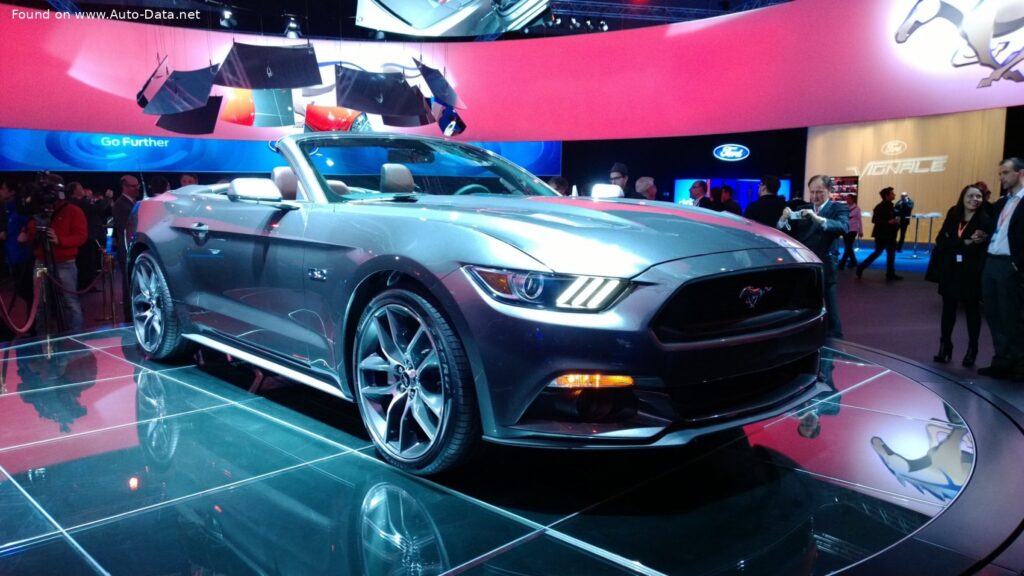
The Ford Mustang, an icon of American automotive culture, entered its sixth generation (internal code S550) for the 2015 model year, marking a significant evolution for the storied pony car. This generation was particularly notable as it was the first Mustang designed from the ground up to be a global vehicle, intended for sale in markets beyond North America. Among its initial powertrain offerings, the Ford Mustang Convertible VI 3.7 V6 (304 Hp) served as a compelling entry point into the Mustang lineup, providing a blend of performance, style, and accessibility. Produced from 2015 to 2017, this particular variant showcased the new platform’s capabilities in a classic two-door, four-seat cabriolet configuration, embracing both its heritage and a fresh, modern appeal.
The S550 Mustang and the 3.7L V6 Position
The S550 generation of the Mustang represented a pivotal moment, introducing an independent rear suspension across all models, a long-awaited upgrade that vastly improved handling and ride comfort compared to previous generations’ live axle setup. The 3.7-liter V6 engine, while eventually phased out, played a crucial role during its tenure, offering a robust power output that positioned it well against competitors and provided a spirited driving experience for those not opting for the more powerful EcoBoost four-cylinder or the range-topping V8 GT models. This variant occupied the entry-level position in the convertible lineup, appealing to buyers prioritizing style and open-air enjoyment over outright performance. It was priced significantly lower than the EcoBoost and GT convertibles, making it accessible to a wider range of customers.
Powertrain & Engine Architecture
At the heart of the Ford Mustang Convertible VI 3.7 V6 lies Ford’s Duratec 37 engine, a naturally aspirated, 3.7-liter (3726 cm3 or 227.37 cu. in.) V6 powerplant. This engine was a familiar and proven unit within Ford’s portfolio, known for its reliability and smooth power delivery. It produced a respectable 304 horsepower at 6500 rpm, translating to an impressive 81.6 horsepower per liter. Peak torque reached 269.95 lb.-ft. (366 Nm) at 4000 rpm, providing ample thrust for daily driving and spirited acceleration.
The engine’s configuration is a 60-degree V-engine with six cylinders, featuring a DOHC (Dual Overhead Camshaft) valvetrain with four valves per cylinder, optimizing airflow for both power and efficiency. Fuel delivery was handled by a multi-port fuel injection system, a robust and well-understood technology. With a compression ratio of 10.5:1, the engine was designed to run on regular unleaded gasoline, making it a more economical choice compared to premium-fuel-dependent performance engines. The front, longitudinal engine layout contributed to the Mustang’s classic rear-wheel-drive architecture, ensuring a traditional sports car feel. The Duratec 37 utilized a timing chain rather than a belt, contributing to its long-term reliability and reduced maintenance requirements.
The standard transmission was a six-speed manual, but a six-speed automatic transmission with SelectShift functionality was also available. The automatic featured steering wheel-mounted paddle shifters, allowing drivers to manually select gears for a more engaging driving experience. The automatic transmission was geared for a balance of acceleration and fuel economy, with ratios optimized for both city and highway driving.
Driving Characteristics
The 3.7L V6 with the automatic transmission provided a smooth and refined driving experience. While not as aggressively powerful as the V8 GT, it offered ample acceleration for everyday driving and enjoyable cruising. The automatic transmission shifted smoothly and responsively, and the paddle shifters allowed for a degree of driver control. Compared to the manual transmission version, the automatic offered greater convenience in stop-and-go traffic. However, the manual transmission provided a more direct connection to the engine and a more engaging driving experience for enthusiasts.
The independent rear suspension significantly improved handling compared to previous Mustangs. The car felt more planted and stable in corners, and the ride quality was noticeably improved. The steering was precise and well-weighted, providing good feedback to the driver. The 3.7L V6’s power delivery was linear and predictable, making it easy to control the car in various driving conditions. While the 0-60 mph time was in the mid-5-second range, the focus was more on providing a comfortable and enjoyable driving experience rather than outright performance.
Equipment & Trim Levels
The Ford Mustang Convertible VI 3.7 V6 came standard with a respectable array of features. Standard interior appointments included cloth upholstery, air conditioning, a basic audio system, and power windows and locks. The standard infotainment system was Ford’s SYNC, offering Bluetooth connectivity and voice control. Optional extras included leather upholstery, upgraded audio systems, a navigation system, and a power-operated convertible top. Available packages added features like heated and cooled front seats, automatic climate control, and advanced safety technologies.
Exterior features included standard alloy wheels, automatic headlights, and a rear spoiler. Optional exterior upgrades included different wheel designs, body-colored side mirrors, and a premium paint finish. The convertible top was available in several colors to complement the exterior paint.
Chassis & Braking
The S550 Mustang featured a robust chassis with improved rigidity compared to previous generations. The independent rear suspension consisted of a multi-link setup, providing excellent handling and ride comfort. The front suspension utilized MacPherson struts. Stabilizer bars were fitted to both the front and rear axles to reduce body roll during cornering. The braking system consisted of ventilated disc brakes on all four wheels, providing strong and consistent stopping power. An Anti-lock Braking System (ABS) was standard, enhancing safety and control. The standard tire size was 235/55 R17 on 17-inch alloy wheels.
Market Reception & Comparison
Critics generally praised the S550 Mustang for its improved handling, ride quality, and interior design. The 3.7L V6 engine was considered a capable and reliable powerplant, offering a good balance of performance and fuel economy. However, some critics noted that it lacked the character and excitement of the V8 GT engine. Compared to the EcoBoost four-cylinder, the 3.7L V6 offered a more traditional engine sound and feel. Fuel economy was rated at an estimated 17 US mpg in the city, 28 US mpg on the highway, and a combined 21 US mpg, which was competitive for a V6-powered convertible of its era. The Camaro V6 offered similar performance and fuel economy, while the Challenger V6 was less fuel-efficient but offered a more spacious interior.
Technical Specifications: Ford Mustang Convertible VI 3.7 V6 (304 Hp)
| Brand | Ford |
| Model | Mustang |
| Generation | Mustang Convertible VI |
| Type (Engine) | 3.7 V6 (304 Hp) |
| Start of Production | 2015 year |
| End of Production | 2017 year |
| Powertrain Architecture | Internal Combustion engine |
| Body type | Cabriolet |
| Seats | 4 |
| Doors | 2 |
| Fuel consumption (economy) – urban | 13.8 l/100 km (17 US mpg) |
| Fuel consumption (economy) – extra urban | 8.4 l/100 km (28 US mpg) |
| Fuel consumption (economy) – combined | 11.2 l/100 km (21 US mpg) |
| Fuel Type | Petrol (Gasoline) |
| Power | 304 Hp @ 6500 rpm |
| Power per liter | 81.6 Hp/l |
| Torque | 366 Nm (269.95 lb.-ft.) @ 4000 rpm |
| Engine layout | Front, Longitudinal |
| Engine Model/Code | Duratec 37 |
| Engine displacement | 3726 cm3 (227.37 cu. in.) |
| Number of cylinders | 6 |
| Engine configuration | V-engine |
| Cylinder Bore | 95.5 mm (3.76 in.) |
| Piston Stroke | 86.7 mm (3.41 in.) |
| Compression ratio | 10.5:1 |
| Number of valves per cylinder | 4 |
| Fuel injection system | Multi-port manifold injection |
| Engine aspiration | Naturally aspirated engine |
| Valvetrain | DOHC |
| Engine oil capacity | 5.7 l (6.02 US qt) |
| Coolant | 11.7 l (12.36 US qt) |
| Fuel tank capacity | 60 l (15.85 US gal) |
| Length | 4783 mm (188.31 in.) |
| Width | 1915 mm (75.39 in.) |
| Height | 1394 mm (54.88 in.) |
| Wheelbase | 2720 mm (107.09 in.) |
| Drag coefficient (Cd) | 0.35 |
| Minimum turning circle (turning diameter) | 11.12 m (36.48 ft.) |
| Drivetrain Architecture | The Internal combustion engine (ICE) drives the rear wheels of the vehicle. |
| Drive wheel | Rear wheel drive |
| Number of gears and type of gearbox | 6 gears, manual transmission |
| Front brakes | Ventilated discs |
| Rear brakes | Ventilated discs |
| Assisting systems | ABS (Anti-lock braking system) |
| Steering type | Steering rack and pinion |
| Power steering | Electric Steering |
| Tires size | 235/55 R17 |
| Wheel rims size | 17 |
Legacy
The Ford Mustang Convertible VI 3.7 V6, while a relatively short-lived variant, remains a desirable entry point into the S550 Mustang generation. Its combination of classic styling, modern features, and a reliable V6 engine has made it a popular choice among used car buyers. The Duratec 37 engine is known for its durability and relatively low maintenance costs. While it may not offer the same level of performance as the EcoBoost or GT models, it provides a comfortable and enjoyable driving experience at a more affordable price point. As the S550 Mustang continues to age, the 3.7L V6 models are likely to become increasingly collectible, particularly those in well-maintained condition and with low mileage, representing a sweet spot for enthusiasts seeking a classic American convertible with modern reliability.