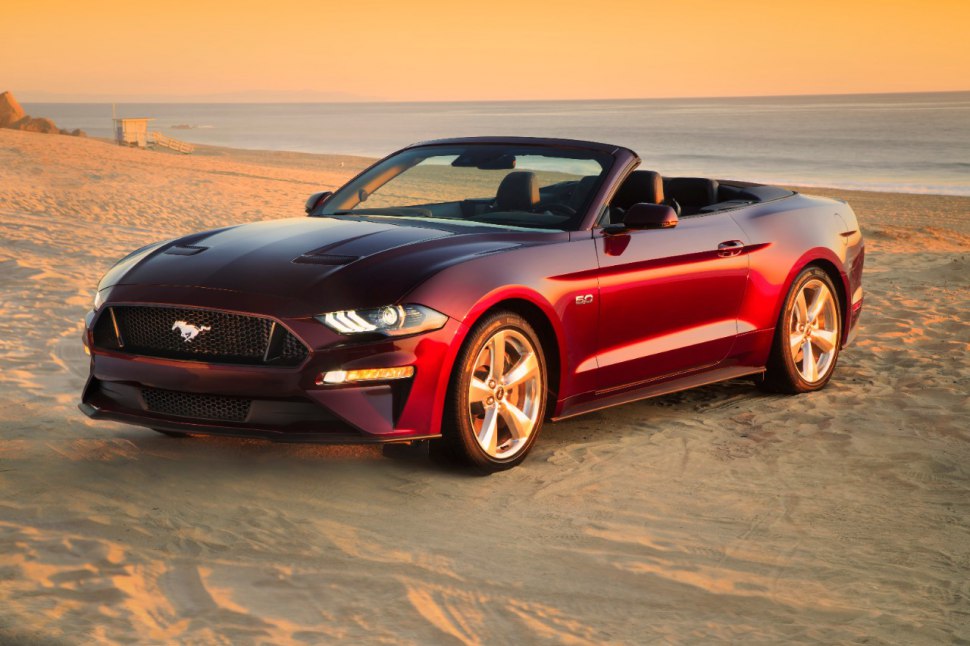
The Ford Mustang Convertible VI (facelift 2017) GT 5.0 Ti-VCT V8 (460 Hp) represents a significant evolution of an American icon. Produced from 2017 to 2021, this variant of the sixth-generation Mustang (S550 chassis) combined the classic appeal of a convertible with the potent performance of Ford’s 5.0-liter Coyote V8 engine. This facelifted model built upon the foundation laid by the 2015 introduction of the independent rear suspension, offering a more refined and globally competitive package. Positioned as the premium performance trim within the Mustang Convertible lineup, the GT model catered to buyers seeking an exhilarating open-air driving experience without compromising on power or style.
Evolution of the Sixth-Generation Mustang
The sixth-generation Mustang, launched for the 2015 model year, marked a turning point for the nameplate. For the first time, the Mustang adopted an independent rear suspension across all trims, moving away from the solid rear axle that had been a hallmark of previous generations. This change dramatically improved handling, ride quality, and overall refinement, allowing the Mustang to compete more effectively with global sports car offerings. The 2017 facelift further enhanced the S550 platform with revised styling, updated technology, and a more powerful version of the 5.0-liter Coyote V8. The convertible body style, in particular, amplified the driving experience, allowing occupants to fully enjoy the sound and sensation of the V8 engine while experiencing the freedom of open-air motoring.
Powertrain & Engine Architecture: The 5.0 Ti-VCT V8
The heart of the Ford Mustang Convertible VI (facelift 2017) GT 5.0 Ti-VCT V8 (460 Hp) is its naturally aspirated 5.0-liter “Coyote” V8 engine. This engine, designated as the Gen 3 Coyote, received significant upgrades for the 2017 model year. It produced 460 horsepower at 5500 rpm and 419.67 lb-ft of torque at 4600 rpm. These figures represented a notable increase over the pre-facelift Coyote V8. The power gains were achieved through a combination of revised cylinder heads, upgraded valve springs, a larger throttle body, and optimized intake and exhaust manifolds. While some sources mention a dual-fuel injection system, the engine primarily utilizes multi-port fuel injection.
The “Ti-VCT” designation stands for Twin Independent Variable Cam Timing, a crucial technology that optimizes valve timing for improved performance and efficiency. This system allows for independent control of intake and exhaust valve timing, maximizing cylinder filling and scavenging across the engine’s operating range. The engine features a 11:1 compression ratio and a displacement of 4949 cc (302.01 cubic inches). The engine is longitudinally mounted and drives the rear wheels exclusively. The standard transmission was a precise and robust 6-speed manual, though a 6-speed automatic transmission with paddle shifters was also available. The automatic transmission featured a torque converter optimized for both performance and fuel efficiency.
Driving Characteristics
The 2017 Mustang GT Convertible, equipped with the 5.0-liter V8 and either the manual or automatic transmission, delivered a distinctly American driving experience. The engine’s linear power delivery and broad torque curve provided strong acceleration in any gear. The manual transmission offered a direct and engaging connection to the powertrain, while the automatic provided smooth and responsive shifts. Compared to the EcoBoost 2.3L turbocharged four-cylinder Mustang, the GT offered significantly more power and a more visceral driving experience, albeit with a trade-off in fuel economy. Compared to the higher-performance Shelby GT350, the GT was more focused on everyday usability and grand touring comfort, sacrificing some track-focused precision for a more accessible driving experience. The convertible top added some weight, slightly impacting handling compared to the coupe, but the independent rear suspension minimized body flex and maintained a reasonably composed ride.
Equipment & Trim Levels
The Mustang GT Convertible came standard with a comprehensive list of features. Interior appointments typically included leather-trimmed sport seats, a leather-wrapped steering wheel, and aluminum pedal covers. The standard infotainment system featured an 8-inch touchscreen display with Ford’s SYNC 3 software, offering navigation, smartphone integration (Apple CarPlay and Android Auto), and a premium sound system. Available options included heated and cooled front seats, a power-adjustable steering column, and a premium audio system from Bang & Olufsen. Exterior features included 18-inch alloy wheels, LED headlights, and a rear spoiler. The convertible top was electrically operated and available in a variety of colors. Performance packages added features like Brembo brakes, a limited-slip differential, and adjustable suspension.
Chassis & Braking
The sixth-generation Mustang benefited greatly from its switch to an independent rear suspension. The front suspension utilized a McPherson strut design with coil springs and an anti-roll bar, while the rear featured a multi-link setup with a stabilizer bar. This configuration provided a significant improvement in handling and ride comfort compared to previous generations. The GT models featured larger brakes than the EcoBoost models, with ventilated discs at all four corners. Anti-lock Braking System (ABS) and Electronic Stability Control (ESC) were standard safety features. The steering system employed an electric power-assisted rack-and-pinion setup, providing precise and responsive steering feel. Standard wheel size was 18 inches, with tire sizes typically 245/45R18 front and 275/40R18 rear.
Market Reception & Comparison
The 2017 Mustang GT Convertible was generally well-received by automotive critics. It was praised for its powerful engine, improved handling, and stylish design. The convertible top was noted for its ease of use and relatively quiet operation. Fuel economy was considered respectable for a high-performance V8 convertible, with EPA estimates of 15 mpg city, 25 mpg highway, and 18 mpg combined. Compared to the Chevrolet Camaro Convertible, the Mustang GT was often seen as offering a more refined and comfortable driving experience, while the Camaro was praised for its sharper handling. The Dodge Challenger, lacking a convertible option in this generation, appealed to buyers seeking a more retro-inspired muscle car with a focus on straight-line performance. Reliability reports generally indicated good overall reliability, with the Coyote V8 proving to be a durable and dependable engine.
Technical Specifications
| Category | Specification |
| Brand | Ford |
| Model | Mustang |
| Generation | Mustang Convertible VI (facelift 2017) |
| Type (Engine) | GT 5.0 Ti-VCT V8 (460 Hp) |
| Start of Production | 2017 |
| End of Production | 2021 |
| Powertrain Architecture | Internal Combustion engine |
| Body type | Cabriolet |
| Seats | 4 |
| Doors | 2 |
| Fuel Type | Petrol (Gasoline) |
| Fuel Consumption (Urban) | 15.1 US mpg (15.6 l/100 km) |
| Fuel Consumption (Extra Urban) | 25 US mpg (9.4 l/100 km) |
| Fuel Consumption (Combined) | 18.1 US mpg (13 l/100 km) |
| Power | 460 Hp @ 5500 rpm |
| Power per liter | 92.9 Hp/l |
| Torque | 419.67 lb.-ft. @ 4600 rpm (569 Nm) |
| Engine Layout | Front, Longitudinal |
| Engine Model/Code | Coyote |
| Engine Displacement | 302.01 cu. in. (4949 cm³) |
| Number of Cylinders | 8 |
| Engine Configuration | V-engine |
| Cylinder Bore | 3.63 in. (92.2 mm) |
| Piston Stroke | 3.65 in. (92.7 mm) |
| Compression Ratio | 11:1 |
| Fuel Injection System | Multi-port manifold injection |
| Engine Aspiration | Naturally aspirated engine |
| Valvetrain | Ti-VCT |
| Engine Oil Capacity | 10.04 US qt (9.5 l) |
| Coolant Capacity | 13.61 US qt (12.88 l) |
| Kerb Weight | 3891.16 lbs. (1765 kg) |
| Weight-to-Power Ratio | 3.8 kg/Hp |
| Weight-to-Torque Ratio | 3.1 kg/Nm |
| Trunk (boot) Space – Minimum | 11.41 cu. ft. (323 l) |
| Fuel Tank Capacity | 16.11 US gal (61 l) |
| Length | 188.5 in. (4788 mm) |
| Width | 75.39 in. (1915 mm) |
| Width with mirrors folded | 76.1 in. (1933 mm) |
| Width including mirrors | 81.89 in. (2080 mm) |
| Height | 54.88 in. (1394 mm) |
| Wheelbase | 107.09 in. (2720 mm) |
| Front Track | 62.4 in. (1585 mm) |
| Rear (Back) Track | 65.12 in. (1654 mm) |
| Drivetrain Architecture | The Internal combustion engine (ICE) drives the rear wheels of the vehicle. |
| Drive Wheel | Rear wheel drive |
| Number of Gears and Type of Gearbox | 6 gears, manual transmission |
| Front Suspension | Independent, type McPherson with coil spring and anti-roll bar |
| Rear Suspension | Independent multi-link spring suspension with stabilizer |
| Front Brakes | Ventilated discs |
| Rear Brakes | Ventilated discs |
| Assisting Systems | ABS (Anti-lock braking system) |
| Steering Type | Steering rack and pinion |
| Wheel Rims Size | 8J x 18 |
Legacy
The Ford Mustang Convertible VI (facelift 2017) GT 5.0 Ti-VCT V8 (460 Hp) continues to be a desirable vehicle in the used car market. The Coyote V8 engine is known for its reliability and durability, provided it receives regular maintenance. The sixth-generation Mustang’s improved build quality and independent rear suspension have also contributed to its long-term appeal. The combination of performance, style, and open-air driving enjoyment ensures that this Mustang variant will remain a popular choice for enthusiasts for years to come, representing a high point in the modern Mustang lineage.