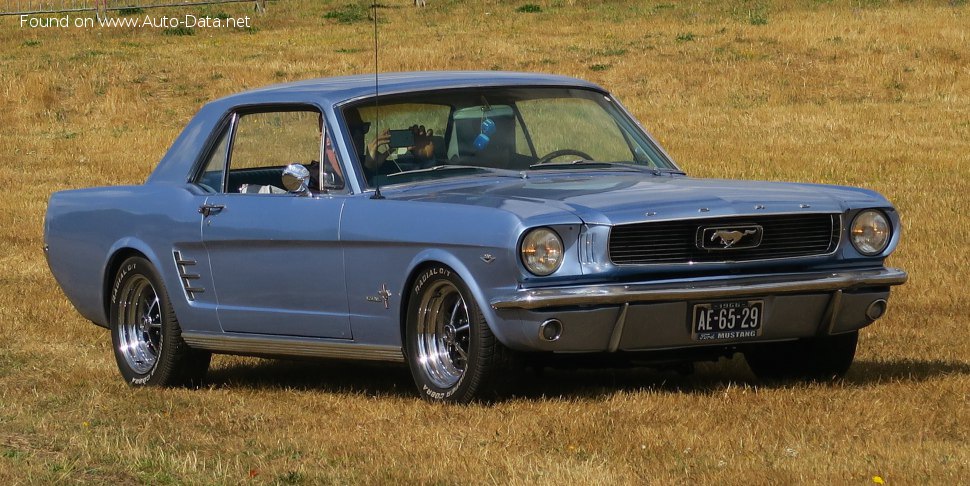
The Ford Mustang I 2.8 V6 (101 Hp) represents a crucial, albeit lesser-known, variant of one of the most significant automobiles in American history. Launched in 1964 as a 1964½ model, the original Ford Mustang didn’t just introduce a new car; it created an entirely new market segment: the “pony car.” This segment was characterized by sporty, affordable, and compact vehicles with long hood, short deck styling, appealing primarily to younger buyers. While the legendary V8 engines often grab the headlines, the 2.8-liter V6, available during the Mustang’s inaugural year, offered an accessible entry point into the Mustang ownership experience, blending style with a more economical and practical powertrain option. This particular configuration, produced only for a brief period in 1964, showcases Ford’s strategy to offer a broad appeal from the outset, ensuring the Mustang could cater to a diverse range of budgets and performance expectations.
The Mustang I: A Market Revolution
The first generation Mustang, often referred to as the Mustang I, was an immediate and runaway success. Its introduction at the New York World’s Fair on April 17, 1964, generated unprecedented excitement, leading to an astonishing 22,000 sales on the first day alone. While the more potent V8s garnered attention for their performance, the six-cylinder models, including this 2.8 V6, were instrumental in achieving the massive sales volumes that solidified the Mustang’s place in automotive lore. They provided the distinctive Mustang look and feel at a lower price point, making the dream of owning a sporty, stylish coupe attainable for a wider demographic. This specific 2.8 V6 variant, with its 101 horsepower output, contributed to the Mustang’s initial market dominance by offering a balanced blend of efficiency and sufficient power for everyday driving.
Powertrain & Engine Architecture
Under the hood of the Ford Mustang I 2.8 V6 (101 Hp) lay a naturally aspirated, front-longitudinal inline-six engine, a departure from the V8s typically associated with the Mustang’s performance image, yet a vital part of its initial appeal. This particular engine, with a displacement of 2,786 cubic centimeters (approximately 2.8 liters or 170.01 cubic inches), was designed for reliability and economy rather than outright speed. It delivered a modest but competent 101 horsepower at 4400 rpm, providing adequate thrust for the lightweight coupe. Torque figures stood at 212 Nm, or 156.36 lb.-ft., peaking at a relatively low 2400 rpm, which ensured good low-end responsiveness for city driving and highway cruising.
The engine featured an Overhead Valve (OHV) valvetrain with two valves per cylinder, a common and robust design for the era. Fuel delivery was managed by a carburetion system, standard technology before the widespread adoption of electronic fuel injection. Its 8.7:1 compression ratio was typical for the time, allowing it to run efficiently on standard gasoline. This powertrain architecture, driving the rear wheels through a 3-speed manual transmission, offered a straightforward and engaging driving experience. While not a drag-strip contender, the 2.8 V6 Mustang provided a spirited ride, benefiting from its relatively low curb weight of 2,561.77 pounds (1162 kg). The power-to-weight ratio of 86.9 horsepower per tonne (or 11.5 kg/Hp) underscored its efficient design, making it a capable and enjoyable vehicle for its segment. The engine oil capacity was 4.3 liters (4.54 US quarts), and the cooling system held 9 liters (9.51 US quarts) of coolant, indicating standard maintenance requirements for a vehicle of its vintage.
Driving Characteristics
The 2.8L V6 Mustang offered a distinctly different driving experience compared to its V8 siblings. While the V8s prioritized acceleration and raw power, the 2.8L focused on smooth, predictable performance. The 3-speed manual transmission, while not offering the versatility of later 4-speed or automatic options, provided a direct connection to the engine. The lower horsepower and torque figures meant that spirited driving required more frequent downshifting, particularly when overtaking or climbing hills. However, the engine’s peak torque at 2400 rpm provided adequate pulling power for everyday driving situations. Compared to the later 3.3L inline-six, the 2.8L felt less strained at higher speeds, though it lacked the overall punch of the larger engine. The relatively light weight of the Mustang I helped to mitigate the power deficit, making it feel nimble and responsive in city driving.
Equipment & Trim Levels
The 1964 Mustang I 2.8 V6 (101 Hp) was positioned as the entry-level model in the Mustang lineup. As such, it came standard with a relatively basic set of features. The interior typically featured vinyl upholstery, a simple dashboard layout with basic instrumentation, and a floor-mounted shifter. Standard exterior features included the iconic Mustang grille with the galloping horse emblem, chrome bumpers, and basic hubcaps. Optional extras included a radio, heater, whitewall tires, and upgraded interior trim. The base price of the 2.8 V6 Mustang was significantly lower than the V8 models, making it an attractive option for budget-conscious buyers. The focus was on providing a stylish and sporty car at an accessible price point, rather than offering a luxurious or feature-rich experience.
Chassis & Braking
The Mustang employed a double wishbone setup at the front and a rigid axle with leaf springs at the rear. This tried-and-true configuration, borrowed in part from the Ford Falcon, provided a comfortable ride characteristic of American cars of the period, albeit with some body roll during aggressive cornering. Braking was handled by drum brakes on all four wheels, with a diameter of 228.6 mm (9 inches) both front and rear. While adequate for the car’s performance, these systems required more stopping distance than modern disc brakes. The car rode on 13-inch wheels (6.5J x 13) fitted with 165/80 R13 tires, providing a balanced contact patch for its weight and power output. The suspension was tuned for a balance of ride comfort and handling, prioritizing a smooth and predictable driving experience over sporty performance.
Market Reception & Comparison
Critics generally viewed the 2.8L V6 Mustang as a sensible and practical option for buyers who prioritized fuel economy and affordability over outright performance. While it didn’t offer the same thrills as the V8 models, it provided the iconic Mustang styling and a comfortable driving experience at a lower price point. Fuel economy was a key selling point, particularly in an era of rising gasoline prices. Compared to the V8 models, the 2.8L V6 offered significantly better gas mileage, making it a more economical choice for daily commuting. Reliability was also a strength, as the inline-six engine was known for its durability and ease of maintenance. The 2.8L V6 Mustang appealed to a different demographic than the V8 models, attracting buyers who were looking for a stylish and sporty car that was also practical and affordable.
Technical Specifications: Ford Mustang I 2.8 V6 (101 Hp)
| Brand | Ford |
| Model | Mustang |
| Generation | Mustang I |
| Type (Engine) | 2.8 V6 (101 Hp) |
| Start of production | 1964 year |
| End of production | 1964 year |
| Powertrain Architecture | Internal Combustion engine |
| Body type | Coupe |
| Seats | 4 |
| Doors | 2 |
| Fuel Type | Petrol (Gasoline) |
| Weight-to-power ratio | 11.5 kg/Hp, 86.9 Hp/tonne |
| Weight-to-torque ratio | 5.5 kg/Nm, 182.4 Nm/tonne |
| Power | 101 Hp @ 4400 rpm. |
| Power per liter | 36.3 Hp/l |
| Torque | 212 Nm @ 2400 rpm. (156.36 lb.-ft. @ 2400 rpm.) |
| Engine layout | Front, Longitudinal |
| Engine displacement | 2786 cm3 (2.8 l, 170.01 cu. in.) |
| Number of cylinders | 6 |
| Engine configuration | Inline |
| Cylinder Bore | 88.9 mm (3.5 in.) |
| Piston Stroke | 74.68 mm (2.94 in.) |
| Compression ratio | 8.7:1 |
| Number of valves per cylinder | 2 |
| Fuel injection system | Carburettor |
| Engine aspiration | Naturally aspirated engine |
| Valvetrain | OHV |
| Engine oil capacity | 4.3 l (4.54 US qt) |
| Coolant | 9 l (9.51 US qt) |
| Kerb Weight | 1162 kg (2561.77 lbs.) |
| Trunk (boot) space – minimum | 241 l (8.51 cu. ft.) |
| Fuel tank capacity | 61 l (16.11 US gal) |
| Length | 4613 mm (181.61 in.) |
| Width | 1732 mm (68.19 in.) |
| Height | 1298 mm (51.1 in.) |
| Wheelbase | 2743 mm (107.99 in.) |
| Front track | 1407 mm (55.39 in.) |
| Rear (Back) track | 1422 mm (55.98 in.) |
| Minimum turning circle (turning diameter) | 11.6 m (38.06 ft.) |
| Drivetrain Architecture | The Internal combustion engine (ICE) drives the rear wheels of the vehicle. |
| Drive wheel | Rear wheel drive |
| Number of gears and type of gearbox | 3 gears, manual transmission |
| Front suspension | Double wishbone |
| Rear suspension | Rigid axle suspension, Leaf spring |
| Front brakes | Drum, 228.6 mm |
| Rear brakes | Drum, 228.6 mm |
| Steering type | Cone worm with recirculation balls |
| Power steering | Hydraulic Steering |
| Front wheel tires | 165/80 R13 |
| Rear wheel tires | 165/80 R13 |
| Front wheel rims | 6.5J x 13 |
| Rear wheel rims | 6.5J x 13 |
Legacy
The Ford Mustang’s launch in 1964 was nothing short of a cultural phenomenon, and even the entry-level 2.8 V6 (101 Hp) played a critical role in its unprecedented success. By offering a stylish, sporty car at an affordable base price, Ford democratized the concept of a performance-oriented vehicle, making it accessible to a much broader audience, particularly the burgeoning youth market. This strategic positioning allowed the Mustang to sell over a million units in its first two years, a feat unmatched by any car before it. While the V8 models captured the headlines for their raw power, the six-cylinder variants, including this 2.8 V6, were the workhorses that kept sales figures soaring, proving that the Mustang’s appeal extended far beyond just brute force. The 2.8 V6 Mustang, though short-lived in this specific configuration, exemplified the Mustang’s core philosophy: a customizable, personal car that could be anything from an economical cruiser to a high-performance machine. It allowed buyers to get the iconic Mustang styling and experience without the higher cost and fuel consumption of the larger V8s, broadening its demographic appeal.
Today, the 1964 Mustang, regardless of its engine, is a highly sought-after classic. The early six-cylinder models are particularly valued for their historical significance as part of the original launch lineup and for their relative rarity compared to the more common later six-cylinder engines and the ubiquitous V8s. They represent the genesis of a legend, a car that perfectly captured the spirit of the mid-1960s American optimism and desire for personal expression. The Ford Mustang I 2.8 V6 (101 Hp) is a testament to Ford’s brilliant marketing and product planning, demonstrating that sometimes, the most enduring legacies are built not just on raw power, but on widespread accessibility and undeniable style. Its impact continues to resonate in the automotive world, solidifying its status as an enduring American icon.