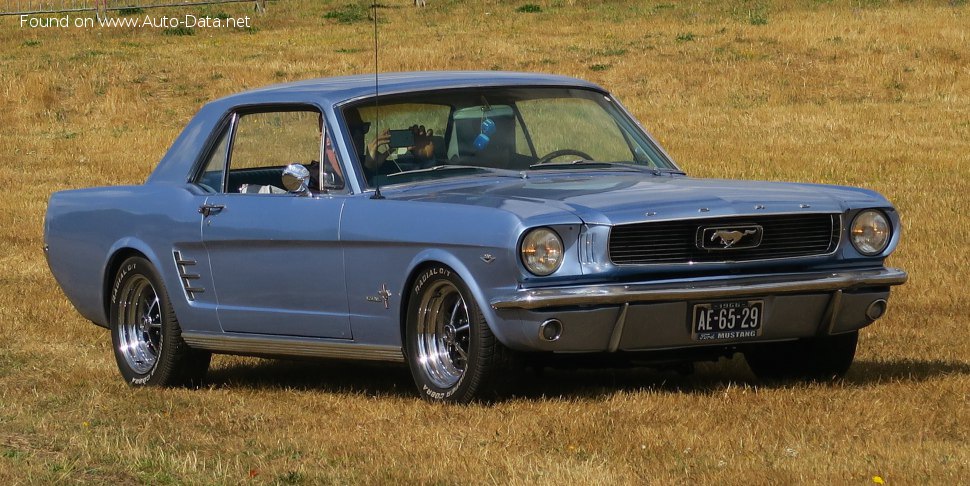
The Ford Mustang, introduced to the public at the New York World’s Fair on April 17, 1964, quickly became a cultural icon, embodying the spirit of American youth and the growing demand for sporty, personal transportation. The original Mustang, often referred to by enthusiasts as the “1964½” model due to its mid-year launch, effectively created the “pony car” segment. Among the initial engine options, the 4.7-liter (289 cubic inch) V8 producing 210 horsepower represented a substantial upgrade from the standard inline-six engine, offering a compelling combination of performance and the classic American V8 sound. This variant occupied a key position in the early Mustang lineup, bridging the gap between the economical base models and the higher-performance, more expensive options like the GT.
The 289 Cubic Inch V8: A Foundation of Mustang Performance
The 4.7-liter V8, internally designated as the 289 cubic inch engine, was a member of Ford’s small-block V8 family. It was based on the earlier 221 cubic inch engine, with a larger bore contributing to the increased displacement. This engine was a significant departure from the six-cylinder offerings, providing a noticeable increase in acceleration and overall driving enjoyment. The 210 horsepower version utilized a two-barrel carburetor, a relatively simple but effective fuel delivery system for the time. This configuration was designed to provide a balance between performance and fuel economy, making it an attractive option for buyers who wanted V8 power without the higher running costs associated with more sophisticated setups.
Engine Architecture and Key Components
The 289 V8 featured a cast iron block and cylinder heads, with a cast aluminum intake manifold. The engine utilized a hydraulic lifter camshaft, contributing to quieter operation and reduced maintenance compared to solid lifter designs. The two-barrel carburetor, typically a Ford Motorcraft unit, provided adequate fuel mixture for the engine’s output. The engine’s firing order (1-5-4-8-6-3-7-2) was carefully designed to minimize vibration and maximize smoothness. The 210 hp version typically featured a compression ratio of 9.5:1. The engine was relatively lightweight, contributing to the Mustang’s favorable weight distribution. Cooling was achieved through a conventional water-cooled system with a radiator and fan. The exhaust system consisted of cast iron exhaust manifolds and a dual exhaust system, enhancing the V8’s characteristic sound.
Powertrain and Transmission Options
The 210 hp 4.7L V8 was primarily offered with Ford’s three-speed Cruise-O-Matic automatic transmission. A four-speed manual transmission was also available, but less common with this specific engine configuration. The Cruise-O-Matic was a fully automatic transmission utilizing a torque converter for smooth launches and gear changes. The automatic transmission was favored by many Mustang buyers for its ease of use, particularly in city driving. The rear axle was typically a Ford 8-inch unit with varying gear ratios depending on the specific vehicle configuration. Common ratios included 3.00:1 and 3.25:1, influencing acceleration and fuel economy. The combination of the 289 V8 and the Cruise-O-Matic provided a comfortable and capable driving experience, suitable for both cruising and spirited driving.
Driving Characteristics and Performance
The 210 hp Mustang delivered brisk acceleration for its time. Independent tests of the era indicated a 0-60 mph time of around 8-9 seconds, which was competitive with other pony cars and significantly faster than the six-cylinder models. The engine’s torque output, approximately 260 lb-ft, provided ample power for passing maneuvers and climbing hills. The automatic transmission offered smooth, albeit not particularly quick, gear changes. The overall driving experience was characterized by a comfortable ride and responsive handling. Compared to the higher-performance Mustang GT models with their four-barrel carburetors and dual exhaust systems, the 210 hp version offered a more relaxed and refined driving experience. The manual transmission option, while less common, provided more driver control and slightly improved acceleration.
Equipment and Trim Levels
The 210 hp 4.7L V8 was available on a variety of Mustang trim levels, including the base coupe and convertible models. Standard equipment typically included a basic interior with vinyl upholstery, a simple dashboard layout, and a three-spoke steering wheel. Optional extras included upgraded interior trim, a center console, a radio, and whitewall tires. The Mustang’s interior was designed to be functional and stylish, appealing to a broad range of buyers. Exterior options included a variety of paint colors and trim packages. The 210 hp version did not typically come with the GT’s distinctive styling cues, such as fog lights and rocker panel stripes. However, buyers could often add some of these features as individual options.
Chassis and Braking System
The original Mustang utilized a unibody construction, providing a good balance of strength and weight. The front suspension consisted of independent coil springs and ball joints, while the rear suspension featured a solid axle with leaf springs. This suspension setup provided a comfortable ride and predictable handling. Brakes were initially drum brakes on all four wheels, although front disc brakes became available as an option later in the 1964½ model year. The drum brakes provided adequate stopping power for the Mustang’s weight and performance. Steering was accomplished through a recirculating ball steering system. The Mustang’s chassis and braking system were designed to provide a safe and reliable driving experience.
Market Reception and Comparison
The 210 hp 4.7L V8 Mustang was well-received by the public and automotive critics alike. It offered a compelling combination of performance, style, and affordability. Compared to the base six-cylinder models, the V8 provided a significant upgrade in driving enjoyment. Compared to the higher-performance GT models, the 210 hp version offered a more economical and practical option. Fuel economy was reasonable for the time, averaging around 16-18 mpg. Reliability was generally good, although the early Mustang models were prone to some minor mechanical issues. The 210 hp V8 Mustang represented a sweet spot in the early Mustang lineup, appealing to buyers who wanted V8 power without the higher cost and complexity of the GT models.
Technical Specifications
| Engine Type | Ford 289 cubic inch (4.7L) V8 |
| Displacement | 289 cubic inches (4,739 cc) |
| Horsepower | 210 hp @ 4,600 rpm |
| Torque | 260 lb-ft @ 3,200 rpm |
| Compression Ratio | 9.5:1 |
| Fuel System | Ford Motorcraft two-barrel carburetor |
| Valve Configuration | Overhead valve (OHV), hydraulic lifters |
| Transmission | Three-speed Cruise-O-Matic automatic (primary), Four-speed manual (optional) |
| Rear Axle Ratio | 3.00:1, 3.25:1 (common) |
| Brakes | Drum brakes (all four wheels, disc optional) |
| Weight (approx.) | 2,700 – 3,000 lbs (depending on configuration) |
| 0-60 mph (approx.) | 8-9 seconds |
Legacy and Current Status
The 289 cubic inch V8, including the 210 hp version, played a pivotal role in establishing the Mustang as a performance icon. These engines are known for their durability and relative simplicity, making them popular choices for restoration projects and restomod builds. Today, well-maintained 1964½-1967 Mustangs with the 289 V8 command strong prices in the collector car market. The 210 hp version, while not as highly sought after as the GT models, remains a desirable and affordable entry point into classic Mustang ownership. Parts availability is generally good, thanks to the large number of Mustangs produced and the continued support from aftermarket suppliers. The 289 V8 continues to be a popular choice for engine swaps in other vehicles, testament to its enduring appeal and performance capabilities. The engine’s legacy is firmly cemented in automotive history as a cornerstone of the pony car revolution.