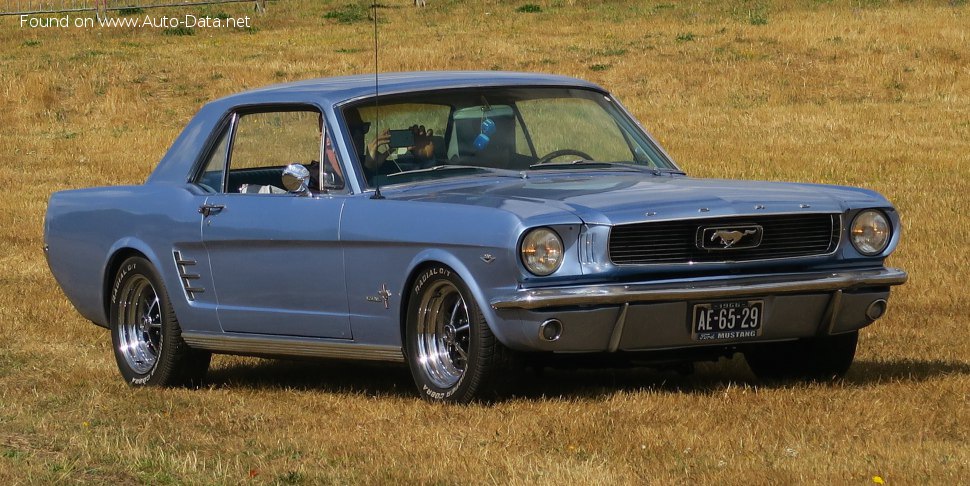
The Ford Mustang I, launched in the spring of 1964, is arguably one of the most important and influential automobiles in automotive history. It essentially invented the “pony car” segment, offering a compelling combination of sporty styling, accessible performance, and extensive customization options at a relatively affordable price point. Among the various engine and transmission combinations available, the Ford Mustang I 4.7 V8 (271 Hp) variant – commonly known as the “K-Code” 289 High-Performance model – represented a significant step up in factory-available power for the early years of the first generation. Produced from 1964 through 1967, this particular configuration solidified the Mustang’s reputation as a capable performer, appealing to both everyday drivers and enthusiasts seeking a more exhilarating driving experience.
The 289 High-Performance: Positioning in the Mustang Lineup
The 4.7L V8 (271 hp) Mustang occupied a mid-range performance position within the first-generation Mustang lineup. The base Mustang typically came equipped with a 170 cubic inch (2.8L) inline-six cylinder engine, offering economy and basic transportation. A 260 cubic inch (4.3L) V8 was also available as a step-up option. The K-Code 289 High-Performance engine, however, was positioned above these, offering a substantial increase in power and performance. It was the most powerful engine available from the factory until the introduction of the 390 cubic inch (6.4L) FE-series V8 in 1967. The K-Code was aimed at buyers who wanted a sporty car that could deliver genuine thrills, but didn’t necessarily require the larger, heavier, and more expensive big-block V8s. It bridged the gap between the entry-level six-cylinder models and the ultimate performance offerings.
Powertrain & Engine Architecture
The heart of the Ford Mustang I 4.7 V8 (271 Hp) was Ford’s 289 cubic inch (4.7-liter) Windsor V8 engine. This engine, designated with the engine code “K” for the High-Performance version, produced 271 horsepower at 6,000 rpm and 311.99 lb-ft of torque at 3,400 rpm. Several key internal upgrades distinguished the Hi-Po 289 from the standard 289. These included a solid-lifter camshaft, larger intake and exhaust valves, a higher 10.5:1 compression ratio, and a four-barrel carburetor – typically a Ford Autolite 4100 – to efficiently deliver fuel to the engine. The engine featured a classic front, longitudinal V-engine layout, powering the rear wheels.
The 289’s architecture was a 90-degree V8 with a bore of 4.0 inches and a stroke of 2.87 inches. The overhead valve (OHV) valvetrain was a robust and reliable design. While a three-speed manual transmission was standard, the K-Code 289 was most commonly paired with a four-speed manual transmission (Toploader), providing drivers with greater control over the engine’s power. A Cruise-O-Matic three-speed automatic transmission was also available, though it was less common with the Hi-Po engine due to its impact on performance. The automatic transmission was a fully automatic hydraulic system, offering smooth shifts but at the expense of some power transfer efficiency.
Driving Characteristics
The 1964-1967 Mustang with the 289 Hi-Po engine and four-speed manual transmission delivered a genuinely engaging driving experience. The engine’s strong low-end torque and willingness to rev made it feel significantly faster than the base six-cylinder or standard 289 models. The four-speed manual allowed drivers to keep the engine in its sweet spot, maximizing acceleration. The gear ratios were relatively close, providing good acceleration in each gear. The automatic transmission, while offering convenience, noticeably dulled the car’s responsiveness. The automatic’s torque converter robbed some power, resulting in slower acceleration times compared to the manual version. The Mustang’s relatively lightweight construction – around 2,460 lbs – further enhanced the performance, allowing the 271 hp engine to deliver brisk acceleration and respectable top speed.
Equipment & Trim Levels
The K-Code 289 High-Performance Mustang was typically offered as part of a package that included additional performance-oriented equipment. This often included a heavy-duty suspension with stiffer springs and shocks, a quicker steering ratio, and upgraded brakes. Interior appointments were generally consistent with other Mustang trims, but the K-Code models often featured upgraded instrumentation, such as a tachometer, to monitor engine speed. Standard interior features included vinyl upholstery, a basic dashboard layout, and a three-spoke steering wheel. Optional extras included deluxe interior trim, bucket seats, a center console, and a variety of exterior trim options, such as stripes and wheel covers. The Mustang was heavily marketed towards personalization, allowing buyers to create a car that reflected their individual style.
Chassis & Braking
The first-generation Mustang utilized a relatively conventional chassis design for the era. It featured a unibody construction, providing a good balance of strength and weight. The front suspension consisted of independent double wishbones with coil springs, offering a comfortable ride and reasonable handling. The rear suspension employed a solid axle with leaf springs, a common setup for American cars of the time. Braking was initially handled by drum brakes on all four wheels. Later models (primarily 1965 and onward) offered front disc brakes as an option, significantly improving stopping power. The K-Code models often received heavier-duty brake components to cope with the increased performance. Power steering was available as an option, making the Mustang easier to maneuver, particularly at low speeds. Stabilizer bars were often included as part of the High-Performance package, further enhancing handling stability.
Market Reception & Comparison
The K-Code 289 Mustang was generally well-received by automotive critics and enthusiasts. It was praised for its strong performance, sporty handling, and attractive styling. Compared to the base six-cylinder models, the K-Code offered a dramatic improvement in acceleration and overall driving enjoyment. Compared to the larger-displacement V8s, the 289 Hi-Po provided a good balance of power and fuel economy. Fuel economy, while not a primary concern for many buyers, was generally better with the 289 than with the 390 cubic inch V8. Reliability was generally good, although the solid-lifter camshaft in the Hi-Po engine required periodic valve adjustments. The K-Code Mustang’s main competitors included the Plymouth Barracuda, Chevrolet Camaro, and Pontiac Firebird, all of which offered similar performance and features. However, the Mustang’s early lead in the market and its iconic status gave it a significant advantage.
Technical Specifications
| Brand | Ford |
| Model | Mustang |
| Generation | Mustang I |
| Type (Engine) | 4.7 V8 (271 Hp) |
| Start of Production | 1964 |
| End of Production | 1967 |
| Powertrain Architecture | Internal Combustion engine |
| Body type | Coupe |
| Seats | 4 |
| Doors | 2 |
| Performance Specs | |
| Fuel Type | Petrol (Gasoline) |
| Weight-to-power ratio | 4.1 kg/Hp, 242.8 Hp/tonne |
| Weight-to-torque ratio | 2.6 kg/Nm, 379 Nm/tonne |
| Engine Specs | |
| Power | 271 Hp @ 6000 rpm |
| Power per liter | 57.2 Hp/l |
| Torque | 423 Nm @ 3400 rpm (311.99 lb.-ft. @ 3400 rpm) |
| Engine layout | Front, Longitudinal |
| Engine displacement | 4736 cm3 (289.01 cu. in.) |
| Number of cylinders | 8 |
| Engine configuration | V-engine |
| Cylinder Bore | 101.6 mm (4 in.) |
| Piston Stroke | 72.9 mm (2.87 in.) |
| Compression ratio | 10.5:1 |
| Number of valves per cylinder | 2 |
| Fuel injection system | Carburetor |
| Engine aspiration | Naturally aspirated engine |
| Valvetrain | OHV |
| Engine oil capacity | 4.7 l (4.97 US qt) |
| Coolant capacity | 14.2 l (15 US qt) |
| Space, Volume and Weights | |
| Kerb Weight | 1116 kg (2460.36 lbs.) |
| Trunk (boot) space – minimum | 241 l (8.51 cu. ft.) |
| Trunk (boot) space – maximum | 524 l (18.5 cu. ft.) |
| Dimensions | |
| Length | 4613 mm (181.61 in.) |
| Width | 1732 mm (68.19 in.) |
| Height | 1298 mm (51.1 in.) |
| Wheelbase | 2743 mm (107.99 in.) |
| Front track | 1422 mm (55.98 in.) |
| Rear (Back) track | 1422 mm (55.98 in.) |
| Minimum turning circle | 11.6 m (38.06 ft.) |
| Drivetrain, Brakes and Suspension Specs | |
| Drivetrain Architecture | The Internal combustion engine (ICE) drives the rear wheels of the vehicle. |
| Drive wheel | Rear wheel drive |
| Number of gears and type of gearbox | 4 gears, manual transmission |
| Front suspension | Double wishbone |
| Rear suspension | Rigid axle suspension, Leaf spring |
| Front brakes | Drum, 228.6 mm |
| Rear brakes | Drum, 228.6 mm |
| Steering type | Cone worm with recirculation balls |
| Power steering | Hydraulic Steering |
| Tires size | Front wheel tires: 205/70 R14, Rear wheel tires: 205/70 R14 |
| Wheel rims size | Front wheel rims: 6J x 14, Rear wheel rims: 6J x 14 |
Legacy
The Ford Mustang I 4.7 V8 (271 Hp) remains a highly desirable classic car today. Well-maintained examples command significant prices in the collector car market. The 289 Hi-Po engine is known for its durability and relative ease of maintenance, although regular valve adjustments are necessary due to the solid-lifter camshaft. The availability of aftermarket parts and support ensures that these cars can be kept running and enjoyed for years to come. The K-Code Mustang’s enduring popularity is a testament to its iconic design, strong performance, and lasting impact on automotive culture. It represents a pivotal moment in automotive history, marking the birth of the pony car and solidifying the Mustang’s place as a true American legend.