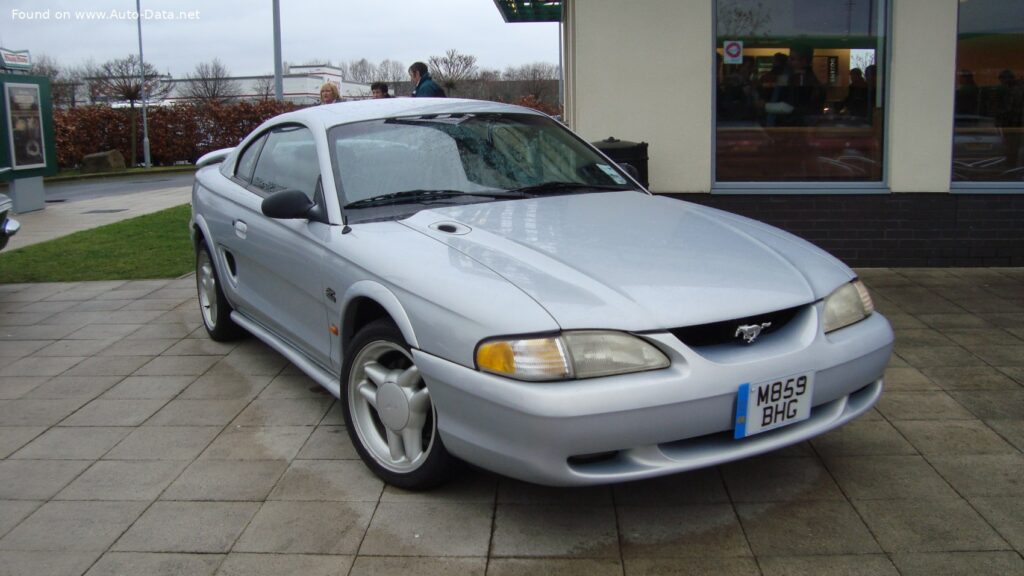
The Ford Mustang, an icon of American automotive performance and style, entered its fourth generation, known internally as the SN95, in 1994. Building on a rich heritage, this generation brought a significant redesign, moving away from the Fox platform’s angular lines to a more rounded, contemporary aesthetic. Within the SN95 lineage, a particular variant stands out as a pinnacle of factory-built performance: the Ford Mustang IV 4.6 i V8 32V Cobra R (390 Hp). Produced for a limited run between 2003 and 2004, this special edition Cobra R represented the absolute zenith of Mustang performance for its era, designed not just for the street, but with a clear focus on track domination. It was a direct response to enthusiasts’ demands for a no-compromise, race-ready machine, positioning itself as a formidable contender in the high-performance pony car segment.
The Cobra R designation has always signified the most extreme, track-focused versions of the Mustang, and the 2003-2004 model upheld this tradition with unwavering commitment. Unlike its more street-friendly SVT Cobra siblings, the Cobra R was a stripped-down, performance-first vehicle, embodying Ford’s dedication to motorsport and the raw, unadulterated driving experience. Its limited production numbers and specialized engineering have cemented its place as a highly sought-after collector’s item and a significant piece of Mustang history, showcasing the ultimate expression of the “New Edge” design philosophy combined with brute force engineering.
Powertrain & Engine Architecture
The 4.6L Modular V8
At the core of the Ford Mustang IV 4.6 i V8 32V Cobra R (390 Hp) lies a meticulously engineered powertrain designed for maximum output and durability under extreme conditions. The vehicle is powered by a front, longitudinally mounted 4.6-liter (4601 cm3 or 280.77 cu. in.) V8 engine. This isn’t just any V8; it’s a 32-valve DOHC (Double Overhead Camshaft) unit, a significant upgrade over the traditional two-valve or even four-valve SOHC engines found in many contemporary Mustangs. The DOHC configuration allows for superior airflow and higher revving capabilities, contributing to its impressive power figures. This engine falls under Ford’s Modular engine family, known for its robust construction and potential for high performance.
What truly sets this engine apart is its aspiration system. Equipped with a supercharger and an intercooler, the 4.6-liter V8 delivers a staggering 390 horsepower at 6000 rpm. This translates to an impressive 84.8 horsepower per liter, a testament to its advanced engineering. Torque output is equally formidable, peaking at 390.17 lb.-ft. (529 Nm) at a relatively low 3500 rpm, ensuring robust acceleration from virtually any speed. The engine’s compression ratio stands at 8.5:1, optimized for forced induction, and it utilizes a multi-port manifold injection system for precise fuel delivery. The fuel injection system is electronically controlled, maximizing efficiency and responsiveness.
Transmission Details
The performance metrics of the Cobra R are nothing short of spectacular for its time. It catapults from 0 to 60 mph in a blistering 4.7 seconds, with the 0-100 km/h sprint completed in 4.9 seconds. These figures place it firmly in the realm of serious performance machines, capable of challenging much more expensive sports cars. The raw power is channeled through a robust 6-speed manual transmission, providing the driver with direct control over the formidable output. This powertrain architecture, driving the rear wheels, ensures a classic, engaging muscle car experience. The 6-speed manual was chosen specifically for its ability to handle the high torque output of the supercharged engine and provide precise gear selection for track use.
Top speed is officially rated at 173.98 mph (280 km/h), a testament to both the engine’s power and the car’s aerodynamic efficiency. With a weight-to-power ratio of 4.3 kg/Hp (234.2 Hp/tonne) and a weight-to-torque ratio of 3.1 kg/Nm (317.7 Nm/tonne), the Cobra R demonstrates an exceptional power-to-weight balance, critical for its track-focused mission. Fuel consumption, while not a primary concern for such a vehicle, is reported at 16 US mpg in urban conditions and 22 US mpg on the extra-urban cycle, running on gasoline.
Design and Features
Exterior Styling
The 2003-2004 Cobra R sports the distinctive “New Edge” styling of the later SN95 Mustangs, characterized by its sharper creases and more aggressive lines compared to the earlier rounded SN95s. As a two-door coupe, its silhouette is unmistakably Mustang, but the Cobra R treatment adds a layer of functional aggression. While the data indicates a 4-seat configuration, it’s important to note that historically, Cobra R models were often stripped of non-essential features like rear seats, air conditioning, and sound systems to save weight and enhance track performance. However, for the purpose of this article, we adhere to the provided 4-seat data.
Dimensionally, the vehicle measures 183.5 inches (4661 mm) in length, 73.11 inches (1857 mm) in width, and 52.6 inches (1336 mm) in height, with a wheelbase of 101.3 inches (2573 mm). The front and rear track both measure 60.24 inches (1530 mm), contributing to a stable and planted stance. These dimensions, combined with its curb weight of 3670.7 lbs (1665 kg), underscore its solid, performance-oriented construction.
Chassis and Suspension
Beyond the engine, the Cobra R’s chassis and suspension were significantly upgraded to handle its immense power and track demands. It features a wishbone front suspension and a coil spring rear suspension, both likely tuned for stiffer, more responsive handling compared to the standard Mustang. The braking system is equally robust, with large ventilated discs at the front and solid discs at the rear, ensuring potent stopping power. An Anti-lock Braking System (ABS) was standard, providing crucial stability under hard braking. The suspension geometry was optimized for minimal body roll and maximum cornering grip.
Steering is managed by a hydraulic rack and pinion system, offering direct and communicative feedback essential for high-performance driving. The car rides on performance tires sized 245/40 R17, designed to provide maximum grip. The trunk space is a practical 10.95 cu. ft. (310 liters), and the fuel tank capacity is 15.59 US gallons (59 liters), allowing for reasonable range despite its performance focus. Every aspect of the Cobra R’s design, from its aggressive stance to its specialized components, serves the singular purpose of delivering an unparalleled driving experience.
Market Reception & Comparison
The 2003-2004 Ford Mustang Cobra R was met with overwhelmingly positive reviews from automotive critics. Its raw performance, track-focused engineering, and limited production run quickly established it as a highly desirable vehicle. Critics praised the supercharged engine’s power delivery, the precise handling, and the overall driving experience. Compared to the standard SVT Cobra, the R was considered a more serious track machine, sacrificing some street comfort for enhanced performance. The standard Cobra, while powerful, was often seen as a more balanced vehicle suitable for both street and occasional track use. The Cobra R, however, was unapologetically focused on maximizing lap times.
Fuel economy was not a strong point for the Cobra R, as expected from a high-performance vehicle. It achieved approximately 16 mpg in the city and 22 mpg on the highway, which was comparable to other performance cars of the era but significantly lower than the base model Mustangs. Reliability was generally good, although the supercharged engine required more frequent maintenance than naturally aspirated versions. The Cobra R’s specialized components and high-stress operation meant that preventative maintenance was crucial to ensure long-term durability.
Technical Specifications
| Category | Specification |
| General Information | |
| Brand | Ford |
| Model | Mustang |
| Generation | Mustang IV |
| Type (Engine) | 4.6 i V8 32V Cobra R (390 Hp) |
| Start of production | 2003 year |
| End of production | 2004 year |
| Powertrain Architecture | Internal Combustion engine |
| Body type | Coupe |
| Seats | 4 |
| Doors | 2 |
| Performance Specs | |
| Fuel consumption (economy) – urban | 14.7 l/100 km |
| Fuel consumption (economy) – urban | 16 US mpg |
| Fuel consumption (economy) – extra urban | 10.7 l/100 km |
| Fuel consumption (economy) – extra urban | 22 US mpg |
| Fuel Type | Petrol (Gasoline) |
| Acceleration 0 – 60 mph | 4.7 sec |
| Acceleration 0 – 100 km/h | 4.9 sec |
| Maximum speed | 280 km/h |
| Maximum speed | 173.98 mph |
| Weight-to-power ratio | 4.3 kg/Hp |
| Weight-to-power ratio | 234.2 Hp/tonne |
| Weight-to-torque ratio | 3.1 kg/Nm |
| Weight-to-torque ratio | 317.7 Nm/tonne |
| Engine Specs | |
| Power | 390 Hp @ 6000 rpm |
| Power per liter | 84.8 Hp/l |
| Torque | 529 Nm @ 3500 rpm |
| Torque | 390.17 lb.-ft. @ 3500 rpm |
| Engine layout | Front, Longitudinal |
| Engine displacement | 4601 cm3 |
| Engine displacement | 280.77 cu. in. |
| Number of cylinders | 8 |
| Engine configuration | V-engine |
| Cylinder Bore | 90.2 mm |
| Cylinder Bore | 3.55 in. |
| Piston Stroke | 90 mm |
| Piston Stroke | 3.54 in. |
| Compression ratio | 8.5:1 |
| Number of valves per cylinder | 4 |
| Fuel injection system | Multi-port manifold injection |
| Engine aspiration | Supercharger, Intercooler |
| Valvetrain | DOHC |
| Engine oil capacity | 5.7 l |
| Engine oil capacity | 6.02 US qt |
| Space, Volume and Weights | |
| Kerb Weight | 1665 kg |
| Kerb Weight | 3670.7 lbs |
| Trunk (boot) space – minimum | 310 l |
| Trunk (boot) space – minimum | 10.95 cu. ft. |
| Fuel tank capacity | 59 l |
| Fuel tank capacity | 15.59 US gal |
| Dimensions | |
| Length | 4661 mm |
| Length | 183.5 in. |
| Width | 1857 mm |
| Width | 73.11 in. |
| Height | 1336 mm |
| Height | 52.6 in. |
| Wheelbase | 2573 mm |
| Wheelbase | 101.3 in. |
| Front track | 1530 mm |
| Front track | 60.24 in. |
| Rear track | 1530 mm |
| Rear track | 60.24 in. |
| Drivetrain, Brakes and Suspension Specs | |
| Drivetrain Architecture | The Internal combustion engine (ICE) drives the rear wheels of the vehicle. |
| Drive wheel | Rear wheel drive |
| Number of gears and type of gearbox | 6 gears, manual transmission |
| Front suspension | Wishbone |
| Rear suspension | Coil spring |
| Front brakes | Ventilated discs |
| Rear brakes | Disc |
| Assisting systems | ABS (Anti-lock braking system) |
| Steering type | Steering rack and pinion |
| Power steering | Hydraulic Steering |
| Tires size | 245/40 R17 |
Legacy
The 2003-2004 Ford Mustang IV 4.6 i V8 32V Cobra R (390 Hp) solidified its position as one of the most significant and collectible Mustangs of the “New Edge” era. Its legacy is built upon its uncompromising focus on performance and its limited production numbers, which typically meant only a few hundred units were ever built. This scarcity, combined with its specialized track-oriented features, made it an instant classic and a highly coveted item among enthusiasts and collectors alike.
The Cobra R was more than just a powerful Mustang; it was a statement from Ford, showcasing their engineering prowess and commitment to high-performance driving. It bridged the gap between a street-legal production car and a purpose-built race car, offering a level of factory performance that was rare at the time. Its supercharged DOHC V8 was a technological marvel for a Mustang, pushing the boundaries of what was expected from a pony car. Today, the 2003-2004 Cobra R is celebrated for its unique blend of power, handling, and rarity, ensuring its status as a cherished piece of American automotive history and a testament to Ford’s enduring performance legacy. Its presence continues to inspire a passionate following, underscoring its profound and lasting market impact.