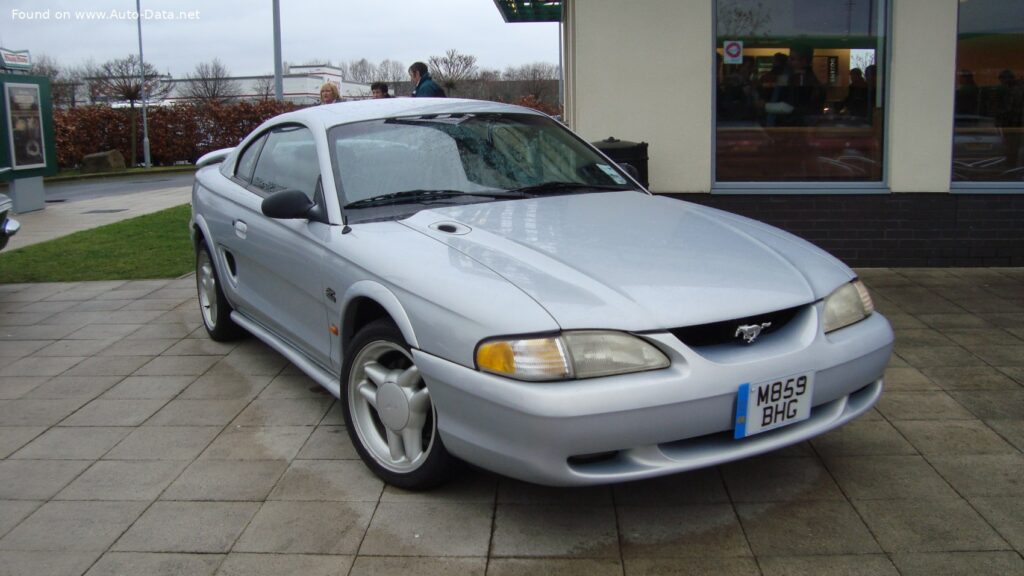
The Ford Mustang IV 4.6 V8 Cobra, producing 305 horsepower, represents a significant evolution of the iconic pony car. Introduced as a late 1993 model and continuing through 1997, this variant marked the debut of the SN95 generation, a complete redesign replacing the long-lived Fox Body platform. The Cobra stood as the performance leader of the SN95 lineup, showcasing Ford’s commitment to maintaining the Mustang’s position in a competitive market. It was developed by Ford’s Special Vehicle Team (SVT) to deliver a more refined and powerful driving experience than the standard Mustang GT, directly challenging rivals like the Chevrolet Camaro Z28 and Pontiac Firebird Trans Am.
Powertrain & Engine Architecture
The heart of the Mustang IV 4.6 V8 Cobra is its 4.6-liter (4601 cm³ or 280.77 cu. in.) modular V8 engine. This engine represented a departure from the traditional American pushrod V8s, including the 5.0-liter found in the standard GT. The Cobra’s engine featured a Dual Overhead Cam (DOHC) valvetrain with four valves per cylinder, a significant technological advancement for a mass-produced American performance car of the era. This configuration allowed for improved breathing and higher engine speeds.
The naturally aspirated V8 generated 305 horsepower at 5800 rpm and 407 Nm (300.19 lb.-ft.) of torque at 4800 rpm. Fuel delivery was managed by a multi-port manifold injection system. The engine was mounted longitudinally in the front of the vehicle, driving the rear wheels through a 5-speed manual transmission. The engine block was constructed from cast iron, while the cylinder heads were aluminum, contributing to a relatively lightweight design. The DOHC valvetrain utilized roller rocker arms and hydraulic lifters for reduced friction and improved reliability. The compression ratio was set at 9.9:1, optimized for pump gasoline.
Driving Characteristics
The 1994-1997 Mustang Cobra with the 4.6L V8 and 5-speed manual transmission offered a noticeably different driving experience compared to the standard Mustang GT. The DOHC engine provided a smoother, more linear power delivery, with a willingness to rev higher than the GT’s 5.0-liter pushrod V8. While the GT offered strong low-end torque, the Cobra excelled in the mid-to-upper RPM range. The 5-speed manual transmission featured gear ratios designed to maximize acceleration, with a relatively short final drive ratio. This resulted in brisk acceleration and responsive performance.
Compared to later iterations of the 4.6L engine, this early version felt less refined, with a slightly rougher idle and more noticeable engine noise. However, this contributed to the car’s raw, visceral feel. The suspension tuning was firmer than the GT, providing improved handling and reduced body roll. While not a dedicated track car, the Cobra offered a more engaging and rewarding driving experience for enthusiasts.
Equipment & Trim Levels
The Cobra trim level was positioned as the premium performance offering within the SN95 Mustang lineup. Standard features included unique Cobra badging, a distinctive front fascia with fog lights, a rear spoiler, and specific wheel designs. The interior featured bolstered sport seats upholstered in cloth or optional leather, a leather-wrapped steering wheel, and unique instrumentation, including a 160 mph speedometer and a tachometer with a 6,500 rpm redline.
Optional extras included a premium sound system, power windows and locks, air conditioning, and a sunroof. The Cobra also offered a limited number of exclusive paint colors not available on the GT. The interior trim was generally darker and more subdued than the GT, reflecting the Cobra’s performance-oriented focus. A key distinguishing feature was the gauge cluster, which featured additional gauges monitoring engine parameters.
Chassis & Braking
The SN95 Mustang Cobra utilized a modified chassis compared to the standard GT. The front suspension featured a wishbone design with coil springs and gas-charged shocks, providing improved handling and steering precision. The rear suspension retained the live axle design common to Mustangs, but with upgraded shocks and springs. The rear axle ratio was typically 3.55:1, optimized for both acceleration and fuel economy.
Braking performance was enhanced with disc brakes on all four wheels, complemented by an Anti-lock Braking System (ABS). The front brakes featured larger rotors and calipers than the GT, providing improved stopping power. Steering was managed by a rack and pinion system with hydraulic power assistance. The Cobra’s tires were 245/45R17, providing a wider contact patch and improved grip compared to the GT’s standard tires. Stabilizer bars were thicker than those found on the GT, further reducing body roll during cornering.
Market Reception & Comparison
The 1994-1997 Mustang Cobra was generally well-received by automotive critics. It was praised for its powerful engine, improved handling, and distinctive styling. However, some critics noted that the Cobra’s performance, while impressive, didn’t always translate into significantly faster lap times compared to its rivals, the Camaro Z28 and Firebird Trans Am. The DOHC engine, while technologically advanced, didn’t always deliver the same level of low-end torque as the GM’s larger-displacement pushrod V8s.
Fuel economy was rated at a combined 20.8 US mpg, which was respectable for a high-performance V8 coupe of the time. Reliability was generally good, although some owners reported issues with the early DOHC engine’s timing chain tensioners. Compared to the standard Mustang GT, the Cobra offered a more refined and engaging driving experience, but at a higher price point. The Cobra appealed to enthusiasts who were willing to pay a premium for increased performance and exclusivity.
Technical Specifications
| Category | Specification |
| Brand | Ford |
| Model | Mustang |
| Generation | Mustang IV |
| Type (Engine) | 4.6 V8 Cobra (305 Hp) |
| Start of Production | 1993 year |
| End of Production | 1997 year |
| Powertrain Architecture | Internal Combustion engine |
| Body Type | Coupe |
| Seats | 4 |
| Doors | 2 |
| Fuel Consumption (Combined) | 11.3 L/100 km (20.8 US mpg) |
| Fuel Type | Petrol (Gasoline) |
| Weight-to-Power Ratio | 5.1 kg/Hp (197.4 Hp/tonne) |
| Weight-to-Torque Ratio | 3.8 kg/Nm (263.4 Nm/tonne) |
| Power | 305 Hp @ 5800 rpm |
| Power per Liter | 66.3 Hp/L |
| Torque | 407 Nm (300.19 lb.-ft.) @ 4800 rpm |
| Engine Layout | Front, Longitudinal |
| Engine Displacement | 4601 cm³ (280.77 cu. in.) |
| Number of Cylinders | 8 |
| Engine Configuration | V-engine |
| Cylinder Bore | 90.2 mm (3.55 in.) |
| Piston Stroke | 90 mm (3.54 in.) |
| Compression Ratio | 9.9:1 |
| Valves per Cylinder | 4 |
| Fuel Injection System | Multi-port manifold injection |
| Engine Aspiration | Naturally aspirated engine |
| Valvetrain | DOHC |
| Engine Oil Capacity | 5.7 L (6.02 US qt) |
| Kerb Weight | 1545 kg (3406.14 lbs) |
| Trunk (boot) Space – minimum | 200 L (7.06 cu. ft.) |
| Fuel Tank Capacity | 58 L (15.32 US gal) |
| Length | 4636 mm (182.52 in.) |
| Width | 1824 mm (71.81 in.) |
| Height | 1351 mm (53.19 in.) |
| Wheelbase | 2573 mm (101.3 in.) |
| Front Track | 1524 mm (60 in.) |
| Rear Track | 1491 mm (58.7 in.) |
| Drivetrain Architecture | The Internal combustion engine (ICE) drives the rear wheels of the vehicle. |
| Drive Wheel | Rear wheel drive |
| Number of Gears and Type of Gearbox | 5 gears, manual transmission |
| Front Suspension | Wishbone |
| Rear Suspension | Coil spring |
| Front Brakes | Disc |
| Rear Brakes | Disc |
| Assisting Systems | ABS (Anti-lock braking system) |
| Steering Type | Steering rack and pinion |
| Power Steering | Hydraulic Steering |
| Tires Size | 245/45 R17 |
Legacy
The 1994-1997 Ford Mustang IV 4.6 V8 Cobra holds a significant place in Mustang history. It represented a bold step forward for the pony car, embracing modern engine technology and offering a more refined driving experience. The “Mod Motor” 4.6L DOHC engine became a cornerstone of Ford’s performance lineup for years to come, powering a wide range of vehicles. Today, these Cobras are sought after by collectors and enthusiasts, appreciating in value as examples of a pivotal era in Mustang development.
The early 4.6L DOHC engine is generally considered reliable, although preventative maintenance, particularly regarding the timing chain tensioners, is recommended. Parts availability is good, and the engine is relatively easy to work on for experienced mechanics. The SN95 platform as a whole is known for its durability and affordability, making the Cobra a viable option for enthusiasts looking for a classic American performance car. Its legacy is one of innovation, performance, and enduring appeal, solidifying the Mustang’s position as an automotive icon.