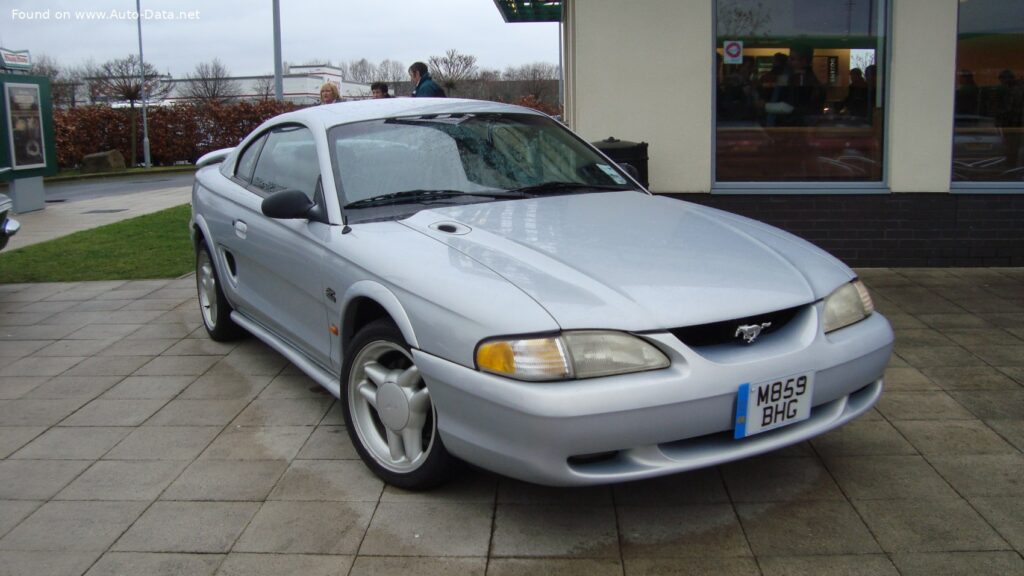
The Ford Mustang, an iconic nameplate in American automotive history, embarked on a new chapter with the introduction of its fourth generation, internally coded as the SN95, for the 1994 model year. The specific variant, the Ford Mustang IV 5.0 GT (218 Hp), represented a crucial evolution, bridging the gap between the long-running Fox body platform and a more modern interpretation of the pony car. Launched in late 1993 for the 1994 model year and produced through 1995 in this specific configuration, the SN95 Mustang aimed to recapture the aggressive styling and raw performance that defined its predecessors, while also addressing contemporary demands for improved refinement, safety, and driving dynamics.
Moving away from the angular lines of the Fox body, the SN95 adopted a more rounded, aerodynamic aesthetic, drawing inspiration from earlier Mustang generations and Ford’s “New Edge” design philosophy. Crucially, it retained the beloved 5.0-liter V8 engine in its GT trim, a powerhouse that had become synonymous with Mustang performance for over a decade. This generation of Mustang was exclusively offered in coupe and convertible body styles, maintaining its traditional 2-door, 4-seat configuration. The Ford Mustang IV 5.0 GT (218 Hp) was a direct competitor in the fiercely contested American muscle car segment, battling rivals like the Chevrolet Camaro and Pontiac Firebird, and cementing its place as an accessible performance vehicle for the masses.
Powertrain & Engine Architecture
At the core of the Ford Mustang IV 5.0 GT (218 Hp) lies the venerable 302 cubic inch (4.9-liter) V8 engine, a powerplant deeply rooted in Mustang lore. While the SN95 platform was new, Ford wisely chose to carry over and refine the High Output (HO) version of the 5.0-liter V8, which had powered the Fox body GTs to legendary status. This naturally aspirated, front-longitudinal V-engine delivered a robust 218 horsepower at 4200 rpm, providing ample thrust for the relatively lightweight coupe. Torque figures were equally impressive for the era, peaking at 284.7 lb-ft (386 Nm) at a low 3400 rpm, ensuring strong off-the-line acceleration and responsive mid-range power.
The engine’s architecture featured an eight-cylinder V-configuration with two valves per cylinder and a multi-port manifold injection system, a significant upgrade over older carbureted or throttle-body injected setups. With a compression ratio of 9:1, the engine was designed for reliable performance on readily available gasoline (petrol). Its power-per-liter rating of 44.1 horsepower per liter showcased a balance between brute force and everyday drivability. The engine was typically paired with a standard 5-speed manual transmission, but the automatic transmission option, a 4-speed AOD-E (Automatic Overdrive Electronic) unit, was also widely available. This automatic transmission was chosen for its durability and ability to handle the V8’s torque, though it did impact overall performance compared to the manual.
Automatic Transmission Details
The AOD-E transmission used in the Mustang IV 5.0 GT was a significant upgrade over previous Ford automatics. It featured electronic control for smoother shifting and improved fuel efficiency. Gear ratios were tailored to provide a balance between acceleration and highway cruising. First gear was relatively deep for strong launches, while the overdrive fourth gear allowed for lower engine speeds at highway speeds, contributing to better fuel economy. However, the AOD-E was known to be somewhat less responsive than the manual transmission, and its shift points were less aggressive, resulting in a slightly more relaxed driving experience.
Driving Characteristics
The Ford Mustang IV 5.0 GT with the automatic transmission offered a different driving experience compared to its manual counterpart or the later, higher-output Mustang trims. While the manual transmission provided a more engaging and direct connection to the engine, the automatic offered convenience and ease of use, particularly in city driving. The automatic’s shift points were calibrated for smooth transitions, but this came at the expense of some performance. Acceleration times were typically slower with the automatic, and the engine didn’t feel quite as eager to rev. However, the strong low-end torque of the 5.0-liter V8 still provided ample power for everyday driving and passing maneuvers.
Compared to later Mustang models with more powerful engines, such as the 4.6-liter modular V8s, the 5.0 GT felt less refined and had a more raw, visceral character. The suspension, while improved over the Fox body, was still relatively basic, resulting in a ride that was firm but not overly comfortable. The steering was precise, but lacked the feedback of more modern systems. Overall, the 5.0 GT automatic offered a classic muscle car experience – a powerful V8 engine, rear-wheel drive, and a relatively simple, straightforward driving experience.
Equipment & Trim Levels
The Mustang IV 5.0 GT occupied the mid-range position in the SN95 Mustang lineup. It sat above the base model Mustang and below any potential special edition or performance-oriented trims. Standard features for the GT included power windows, power locks, air conditioning, and a premium sound system. The interior typically featured cloth upholstery, although leather was available as an option. The dashboard was redesigned compared to the Fox body, with a more modern and driver-centric layout. Optional extras included a CD player, upgraded sound systems, and various cosmetic enhancements.
The GT trim also included some performance-oriented upgrades compared to the base model, such as a limited-slip differential, upgraded suspension components, and larger tires. These features contributed to the GT’s improved handling and overall driving experience. The exterior styling of the GT was also more aggressive, with a unique front fascia, side skirts, and a rear spoiler.
Chassis & Braking
The SN95 Mustang featured a redesigned chassis compared to the Fox body, with improved rigidity and handling characteristics. The front suspension utilized a modified MacPherson strut design, while the rear suspension featured a coil-spring setup, replacing the Fox body’s quadra-shock system. This resulted in a more comfortable and controlled ride. The braking system consisted of disc brakes at all four corners, a significant enhancement for stopping power and control compared to some earlier models. The braking system was also equipped with Anti-lock Braking System (ABS) as standard, improving safety and stability during hard braking.
The rear drums were still used on some base models, but the GT trim exclusively featured disc brakes all around. The steering system utilized a precise rack and pinion setup with hydraulic power steering, offering good feedback to the driver. The car rode on 225/55 ZR16 tires, providing a balance of grip and ride comfort.
Market Reception & Comparison
Critics generally viewed the Ford Mustang IV 5.0 GT favorably, praising its improved styling, handling, and interior compared to the Fox body. However, some criticized its relatively modest horsepower output compared to its rivals, particularly the Chevrolet Camaro Z28. Fuel economy was decent for a V8-powered muscle car, averaging around 19 mpg city and 25 mpg highway. Reliability was generally good, although the AOD-E automatic transmission was sometimes prone to issues if not properly maintained.
Compared to the manual transmission version, the automatic offered slightly lower fuel economy and slower acceleration. However, it was also more convenient and easier to drive in traffic. Compared to the later 4.6-liter Mustang GTs, the 5.0 GT felt less refined and had a more raw, visceral character. However, it also had a certain charm and appeal that many enthusiasts appreciated.
Technical Specifications
| Specification | Value |
| Brand | Ford |
| Model | Mustang |
| Generation | Mustang IV (SN95) |
| Type (Engine) | 5.0 GT (218 Hp) |
| Start of Production | 1993 year |
| End of Production | 1995 year |
| Powertrain Architecture | Internal Combustion engine |
| Body Type | Coupe |
| Seats | 4 |
| Doors | 2 |
| Fuel Type | Petrol (Gasoline) |
| Weight-to-power ratio | 6.8 kg/Hp (14.99 lbs/Hp) |
| Weight-to-torque ratio | 3.8 kg/Nm (8.38 lbs/Nm) |
| Power | 218 Hp @ 4200 rpm |
| Power per liter | 44.1 Hp/l |
| Torque | 386 Nm (284.7 lb-ft) @ 3400 rpm |
| Engine Layout | Front, Longitudinal |
| Engine Displacement | 4942 cm3 (301.58 cu. in.) |
| Number of Cylinders | 8 |
| Engine Configuration | V-engine |
| Cylinder Bore | 101.6 mm (4 in.) |
| Piston Stroke | 76.2 mm (3 in.) |
| Compression Ratio | 9:1 |
| Number of Valves per Cylinder | 2 |
| Fuel Injection System | Multi-port manifold injection |
| Engine Aspiration | Naturally aspirated engine |
| Kerb Weight | 1486 kg (3276.07 lbs) |
| Fuel Tank Capacity | 58 l (15.32 US gal) |
| Length | 4610 mm (181.5 in.) |
| Width | 1823 mm (71.77 in.) |
| Height | 1342 mm (52.83 in.) |
| Wheelbase | 2572 mm (101.26 in.) |
| Front Track | 1539 mm (60.59 in.) |
| Rear Track | 1501 mm (59.09 in.) |
| Drivetrain Architecture | The Internal combustion engine (ICE) drives the rear wheels of the vehicle. |
| Drive Wheel | Rear wheel drive |
| Number of Gears and Type of Gearbox | 4 gears, automatic transmission |
| Front Suspension | Wishbone |
| Rear Suspension | Coil spring |
| Front Brakes | Disc |
| Rear Brakes | Disc |
| Assisting Systems | ABS (Anti-lock braking system) |
| Steering Type | Steering rack and pinion |
| Power Steering | Hydraulic Steering |
| Tires Size | 225/55 ZR16 |
Legacy
The Ford Mustang IV 5.0 GT (218 Hp), particularly in its early SN95 guise (1994-1995), holds a significant place in the Mustang’s storied history. It represented a pivotal moment where Ford sought to modernize its beloved pony car while retaining its core identity. The 5.0L engine was also renowned for its robustness and immense aftermarket potential, making it a favorite among tuners and drag racers. This accessibility to performance and ease of modification significantly contributed to the Mustang GT’s cultural impact and enduring appeal.
Today, these early SN95 5.0 GT models are increasingly appreciated as modern classics, valued for their connection to the legendary 5.0 engine and their role in the Mustang’s ongoing evolution. While not the fastest or most technologically advanced Mustang ever built, the 5.0 GT automatic remains a popular choice among enthusiasts who appreciate its classic muscle car character and affordability. Properly maintained examples can still provide years of reliable service, and the abundance of aftermarket parts ensures that these cars can be easily customized to suit individual tastes.