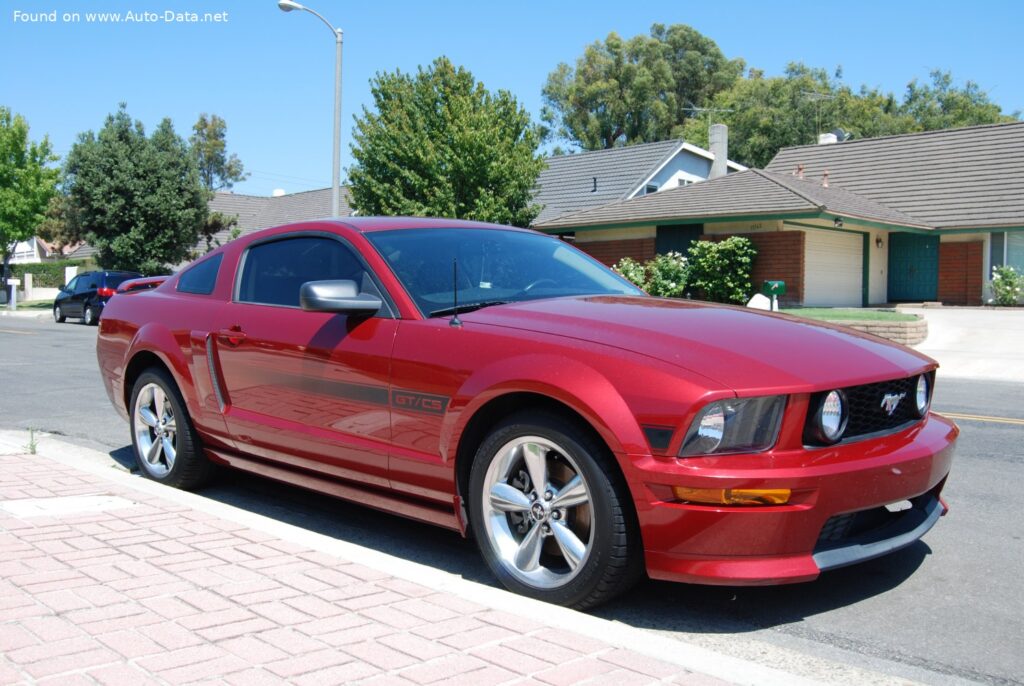
The fifth generation of the iconic Ford Mustang, often referred to by its internal codename S197, marked a pivotal moment in the history of the American pony car. Launched for the 2005 model year, this iteration proudly embraced its heritage with a “retro-futuristic” design that paid homage to the classic Mustangs of the 1960s, particularly the fastback models from 1967-1969. Among its initial offerings, the Ford Mustang V 4.0i V6 (205 Hp) served as the accessible entry point into the Mustang lineup, providing a compelling blend of classic styling, modern amenities, and a respectable level of performance for a broad spectrum of buyers.
Produced from 2004 to 2005 with this specific powertrain configuration, the Mustang V 4.0i V6 was a two-door coupe designed to seat four occupants. It represented a significant departure from the ‘New Edge’ styling of its SN95 predecessor, ushering in an era where Ford successfully reconnected the Mustang with its illustrious past while integrating contemporary engineering. This V6 model was crucial in drawing in customers who desired the Mustang’s legendary aesthetics and rear-wheel-drive dynamics without the higher cost and insurance premiums associated with the more powerful V8 variants. It quickly established itself as a strong contender in the sporty coupe segment, appealing to both enthusiasts and those seeking a stylish daily driver.
Powertrain & Engine Architecture
At the heart of the entry-level Mustang V was Ford’s venerable 4.0-liter Cologne V6 engine. This naturally aspirated, multi-port fuel injected powerplant was configured in a “V” shape with six cylinders, each featuring two valves per cylinder. With a bore of 3.95 inches (100.4 mm) and a stroke of 3.32 inches (84.4 mm), the engine displaced 244.64 cubic inches (4009 cm³). It delivered a solid 205 horsepower at 5250 rpm, providing a power-per-liter ratio of 51.1 hp/liter. More importantly for daily drivability, the engine produced a healthy 235.28 lb-ft (319 Nm) of torque at a relatively low 3500 rpm, ensuring responsive acceleration from a standstill and ample passing power on the highway.
The powertrain architecture of the Ford Mustang V 4.0i V6 (205 Hp) was classic American muscle car: a front-longitudinal engine layout driving the rear wheels. This configuration, coupled with a standard 5-speed manual transmission (a 5-speed automatic was also available, though less common), offered an engaging driving experience that resonated with the Mustang’s performance heritage. The 5-speed automatic transmission, a Ford 5R55E unit, was a relatively conventional torque converter automatic, offering smooth shifts but lacking the responsiveness of a manual gearbox. The automatic transmission’s gear ratios were tuned for fuel economy and comfortable cruising, prioritizing usability over outright performance. The final drive ratio typically ranged from 2.73:1 to 3.08:1 depending on the specific build.
Fuel economy for the 4.0-liter V6, while not class-leading by modern standards, was competitive for a sporty rear-wheel-drive coupe of its era. Owners could expect approximately 16.8 US mpg in urban driving conditions and a more efficient 29.4 US mpg on the highway. The engine’s compression ratio of 9.7:1 allowed it to run on regular unleaded gasoline, making it an economical choice for everyday use. The engine oil capacity was 4.97 US quarts (4.7 liters), and the cooling system held 12.47 US quarts (11.8 liters) of coolant, ensuring robust operation under various conditions.
Driving Characteristics
The Mustang V6 Automatic, while offering the Mustang experience, delivered a noticeably different driving experience compared to the manual transmission version or the higher-output V8 GT. The automatic transmission, while smooth, introduced some power loss and reduced driver engagement. Acceleration from 0 to 60 mph typically took around 7.5-8.5 seconds, significantly slower than the manual V6 or the V8 GT. The automatic’s shift points were programmed for comfort and fuel efficiency, often holding gears longer than a more performance-oriented setup. This resulted in a less immediate response to throttle inputs. However, for drivers prioritizing ease of use and comfortable cruising, the automatic provided a relaxed and enjoyable experience.
The V6 engine, while adequate, lacked the raw power and visceral sound of the V8. The torque curve was relatively flat, providing decent acceleration across a wide range of engine speeds, but it didn’t offer the same exhilarating surge of power as the 4.6L V8. The suspension tuning, while competent, was geared towards a balance of ride comfort and handling, rather than outright performance. The car felt planted and stable in corners, but lacked the sharp responsiveness of a dedicated sports car.
Equipment & Trim Levels
The Mustang V 4.0i V6 typically served as the base trim level. Standard features included air conditioning, power windows, power locks, an AM/FM stereo with a CD player, and cloth upholstery. The interior featured a dual-cowl dashboard design reminiscent of classic Mustangs, though constructed with more modern materials. Optional extras included a premium sound system, leather upholstery, power driver’s seat, and alloy wheels. The Deluxe trim package added some of these features as standard equipment. The exterior typically featured color-keyed mirrors and door handles, and a rear spoiler was often added as an option.
Chassis & Braking
Underpinning the Mustang V’s ride and handling were a MacPherson strut front suspension and a three-link solid axle rear suspension with coil springs. While some critics pointed to the live rear axle as an outdated technology, Ford engineers tuned it to deliver a surprisingly compliant ride and predictable handling characteristics, maintaining a connection to the car’s heritage. The braking system comprised ventilated discs on both the front and rear, providing reliable stopping power. Steering was managed by a rack and pinion system, offering direct feedback. The car rode on 215/65 R16 tires mounted on 7J x 16-inch wheel rims, providing a balance of comfort and grip for everyday driving. Rear drum brakes were sometimes found on base models, while the disc brake setup was more common on higher trim levels or with optional packages.
Market Reception & Comparison
Critics generally viewed the Mustang V6 Automatic as a competent and affordable entry-level pony car. It was praised for its retro styling, comfortable ride, and respectable fuel economy. However, it was often criticized for its relatively slow acceleration and lack of driver engagement compared to the manual transmission version or the V8 GT. Compared to the V8 GT, the V6 Automatic offered significantly lower insurance costs and a more manageable power delivery, making it a popular choice for younger drivers or those seeking a more practical daily driver. Fuel economy was also noticeably better with the V6, averaging around 20-22 mpg in mixed driving conditions compared to the V8’s 16-18 mpg.
Technical Specifications
| Category | Specification |
| Brand | Ford |
| Model | Mustang |
| Generation | Mustang V (S197) |
| Type (Engine) | 4.0i V6 (205 Hp) |
| Start of Production | 2004 year |
| End of Production | 2005 year |
| Powertrain Architecture | Internal Combustion Engine |
| Body Type | Coupe |
| Seats | 4 |
| Doors | 2 |
| Fuel Consumption (City) | 14 l/100 km (16.8 US mpg) |
| Fuel Consumption (Highway) | 8 l/100 km (29.4 US mpg) |
| Fuel Type | Petrol (Gasoline) |
| Maximum Speed | 180 km/h (111.85 mph) |
| Engine Specs | |
| Power | 205 Hp @ 5250 rpm |
| Power per Liter | 51.1 Hp/l |
| Torque | 319 Nm @ 3500 rpm (235.28 lb-ft @ 3500 rpm) |
| Engine Layout | Front, Longitudinal |
| Engine Model/Code | Cologne |
| Engine Displacement | 4009 cm³ (244.64 cu. in.) |
| Number of Cylinders | 6 |
| Engine Configuration | V-engine |
| Cylinder Bore | 100.4 mm (3.95 in.) |
| Piston Stroke | 84.4 mm (3.32 in.) |
| Compression Ratio | 9.7:1 |
| Number of Valves per Cylinder | 2 |
| Fuel Injection System | Multi-port manifold injection |
| Engine Aspiration | Naturally aspirated engine |
| Engine Oil Capacity | 4.7 l (4.97 US qt) |
| Coolant Capacity | 11.8 l (12.47 US qt) |
| Kerb Weight | 1495 kg (3295.91 lbs) |
| Trunk (Boot) Space – Minimum | 350 l (12.36 cu. ft.) |
Legacy
The Ford Mustang V6 Automatic, while not the most powerful or engaging version of the S197 Mustang, remains a popular choice in the used car market today. Its affordability, reliability, and iconic styling make it an attractive option for buyers seeking a classic American pony car experience without breaking the bank. The 4.0L V6 engine, while not known for its longevity like some of Ford’s V8s, is generally considered a reliable powerplant with proper maintenance. Common issues include oil leaks and occasional sensor failures, but these are typically inexpensive to repair. The automatic transmission, if properly maintained with regular fluid changes, is also generally reliable. The S197 Mustang, as a whole, has proven to be a durable and well-built vehicle, and the V6 Automatic continues to offer a compelling blend of style, comfort, and affordability for enthusiasts and everyday drivers alike.