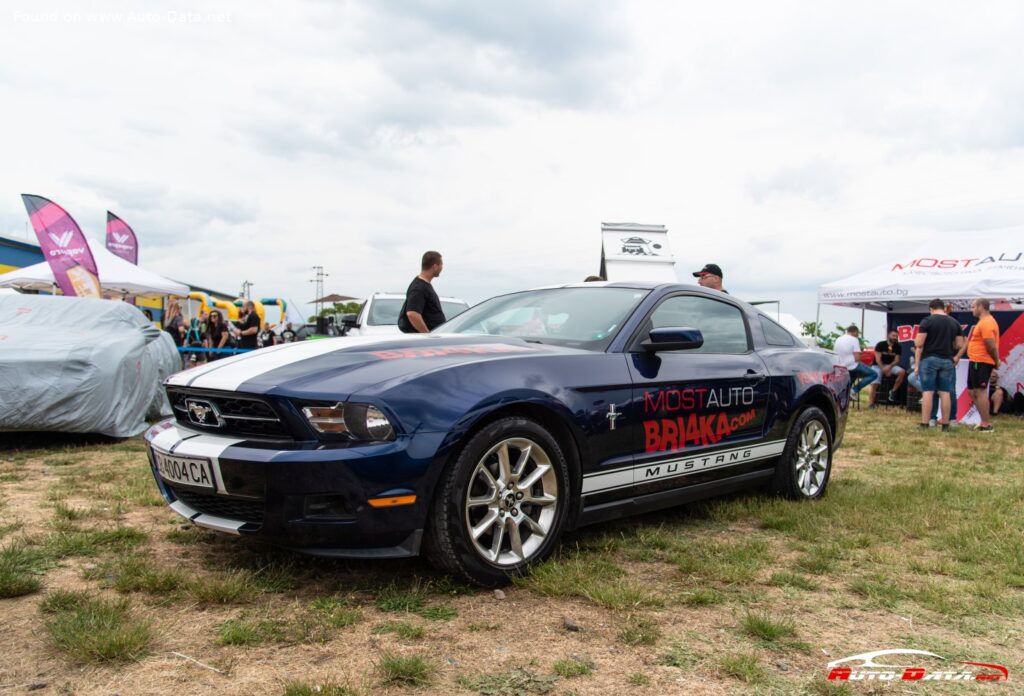
The Ford Mustang V (facelift 2009) 3.7 V6 (305 Hp) Automatic represents a significant evolution of an American automotive icon. This iteration, part of the fifth generation (S197) Mustang, debuted for the 2010 model year and offered a compelling blend of performance, efficiency, and classic styling. Positioned within the pony car segment, it aimed to broaden the Mustang’s appeal beyond traditional V8 enthusiasts, providing a more accessible and fuel-conscious option without sacrificing the core Mustang experience. The introduction of the 3.7-liter V6 engine, producing 305 horsepower and paired with a six-speed automatic transmission, marked a substantial upgrade over previous V6 models, redefining expectations for entry-level Mustangs.
Engine & Performance: The Duratec 37 V6
At the heart of the Ford Mustang V (facelift 2009) 3.7 V6 (305 Hp) Automatic lies the Duratec 37 engine, a 3.7-liter (227.44 cubic inch) naturally aspirated V6. This powerplant replaced the older 4.0-liter V6, offering a substantial leap in both power and technology. The Duratec 37 features a Dual Overhead Camshaft (DOHC) valvetrain equipped with Twin Independent Variable Cam Timing (Ti-VCT). This advanced system optimizes valve timing for improved performance and efficiency across the engine’s operating range. The engine generates 305 horsepower at 6500 rpm and 280.27 lb.-ft. of torque at 4250 rpm.
The Duratec 37’s 10.5:1 compression ratio and multi-port fuel injection contribute to its responsive character. Its power-to-liter ratio of 81.8 Hp/l highlights its efficient design. The engine is coupled with a six-speed automatic transmission, delivering smooth and efficient power transfer to the rear wheels. This transmission provides both comfortable cruising and quick downshifts for more spirited driving. Fuel economy figures are respectable for a performance car, achieving approximately 19 US mpg in urban driving and up to 30.9 US mpg on the highway, with a combined average of 23.1 US mpg. The vehicle’s weight-to-power ratio of 5.2 kg/Hp (approximately 10.3 lbs/Hp) demonstrates its ability to deliver strong acceleration.
Design & Features: A Modernized Pony Car
The 2009 facelift of the fifth-generation Mustang brought a more contemporary aesthetic to the vehicle’s retro-inspired design. The Ford Mustang V (facelift 2009) 3.7 V6 (305 Hp) Automatic retains the classic Mustang proportions – a long hood and short deck – but incorporates updated styling elements. The front fascia features a more prominent grille and a power-dome hood, enhancing the car’s muscular appearance. Revised headlights and taillights, including sequential turn signals, add a modern touch while paying homage to the Mustang’s heritage.
As a two-door coupe with seating for four, the Mustang offers a balance of practicality and sporty appeal. Its dimensions – 188.11 inches in length, 73.9 inches in width (80.12 inches including mirrors), and 55.79 inches in height – contribute to its commanding presence. The interior received updates with improved materials and ergonomics. The chassis utilizes an independent McPherson strut front suspension with a transverse stabilizer for precise steering and handling. The rear suspension employs a solid axle design with coil springs and a transverse stabilizer, refined to provide a predictable ride. Ventilated disc brakes at all four wheels, coupled with an Anti-lock Braking System (ABS), ensure confident stopping power. Electric power steering contributes to both efficiency and a modern driving feel. The car typically rides on 225/60 R17 or 235/50 R18 tires, mounted on 7J x 17 or 8J x 18 alloy wheels, respectively.
Technical Specifications: Ford Mustang V (facelift 2009) 3.7 V6 (305 Hp) Automatic
| Category | Specification |
|---|---|
| General Information | |
| Brand | Ford |
| Model | Mustang |
| Generation | Mustang V (facelift 2009) |
| Type (Engine) | 3.7 V6 (305 Hp) Automatic |
| Start of Production | 2010 year |
| End of Production | 2012 year |
| Powertrain Architecture | Internal Combustion engine |
| Body type | Coupe |
| Seats | 4 |
| Doors | 2 |
| Performance Specs | |
| Fuel Consumption (Urban) | 12.4 l/100 km (19 US mpg) |
| Fuel Consumption (Extra Urban) | 7.6 l/100 km (30.9 US mpg) |
| Fuel Consumption (Combined) | 10.2 l/100 km (23.1 US mpg) |
| Fuel Type | Petrol (Gasoline) |
| Weight-to-Power Ratio | 5.2 kg/Hp (10.3 lbs/Hp), 193.7 Hp/tonne |
| Weight-to-Torque Ratio | 4.1 kg/Nm (9.0 lbs/Nm), 241.3 Nm/tonne |
| Engine Specs | |
| Power | 305 Hp @ 6500 rpm |
| Power per liter | 81.8 Hp/l |
| Torque | 380 Nm (280.27 lb.-ft.) @ 4250 rpm |
| Maximum Engine Speed | 7000 rpm |
| Engine Layout | Front, Longitudinal |
| Engine Model/Code | Duratec 37 |
| Engine Displacement | 3727 cm3 (3.7 liters / 227.44 cu. in.) |
| Number of Cylinders | 6 |
| Engine Configuration | V-engine |
| Cylinder Bore | 95.5 mm (3.76 in.) |
| Piston Stroke | 86.7 mm (3.41 in.) |
| Compression Ratio | 10.5:1 |
| Number of Valves per Cylinder | 4 |
| Fuel Injection System | Multi-port manifold injection |
| Engine Aspiration | Naturally aspirated engine |
| Valvetrain | DOHC, Ti-VCT |
| Engine Oil Capacity | 5.7 l (6.02 US qt) |
| Coolant Capacity | 11.7 l (12.36 US qt) |
| Space, Volume and Weights | |
| Kerb Weight | 1575 kg (3472.28 lbs) |
| Trunk (Boot) Space – minimum | 379 l (13.38 cu. ft.) |
| Fuel Tank Capacity | 61 l (16.11 US gal) |
| Permitted Trailer Load (with brakes, 12%) | 454 kg (1000.9 lbs) |
| Dimensions | |
| Length | 4778 mm (188.11 in.) |
| Width | 1877 mm (73.9 in.) |
| Width including mirrors | 2035 mm (80.12 in.) |
| Height | 1417 mm (55.79 in.) |
| Wheelbase | 2720 mm (107.09 in.) |
| Front Track | 1582 mm (62.28 in.) |
| Rear (Back) Track | 1598 mm (62.91 in.) |
| Minimum Turning Circle (Turning Diameter) | 10.3 m (33.79 ft.) |
| Drivetrain, Brakes and Suspension Specs | |
| Drivetrain Architecture | The Internal combustion engine (ICE) drives the rear wheels of the vehicle. |
| Drive Wheel | Rear wheel drive |
| Number of Gears and Type of Gearbox | 6 gears, automatic transmission |
| Front Suspension | Independent type McPherson, Transverse stabilizer |
| Rear Suspension | Rigid axle suspension, Transverse stabilizer, Coil spring |
| Front Brakes | Ventilated discs, 316×30 mm |
| Rear Brakes | Ventilated discs, 300×19 mm |
| Assisting Systems | ABS (Anti-lock braking system) |
| Steering Type | Steering rack and pinion |
| Power Steering | Electric Steering |
| Tires Size | 225/60 R17; 235/50 R18 |
| Wheel Rims Size | 7J x 17; 8J x 18 |
Legacy and Market Impact of the Ford Mustang V (facelift 2009) 3.7 V6
The Ford Mustang V (facelift 2009) 3.7 V6 (305 Hp) Automatic significantly altered the landscape of the pony car segment. It transformed the V6 Mustang from a basic entry point into a genuinely desirable performance vehicle. Previous V6 Mustangs were often criticized for lacking the power and character of their V8 counterparts. The Duratec 37 engine’s 305 horsepower output rivaled, and sometimes exceeded, the power of older V8 Mustangs, offering a compelling alternative for buyers seeking a balance of performance and affordability.
Competing with the Chevrolet Camaro and Dodge Challenger in the North American market, the Mustang V6 distinguished itself through its combination of strong performance, improved fuel economy, and iconic styling. It appealed to a broader demographic, including younger buyers, those seeking a sporty daily driver, and enthusiasts who appreciated the Mustang’s heritage but desired modern efficiency. This model’s success demonstrated that a V6-powered Mustang could be a legitimate performance contender, paving the way for future generations where the V6, and later the EcoBoost four-cylinder, would play increasingly important roles. The 2010-2012 V6 Mustang is remembered as a pivotal moment, showcasing Ford’s commitment to innovation while honoring the legacy of one of America’s most beloved automobiles.