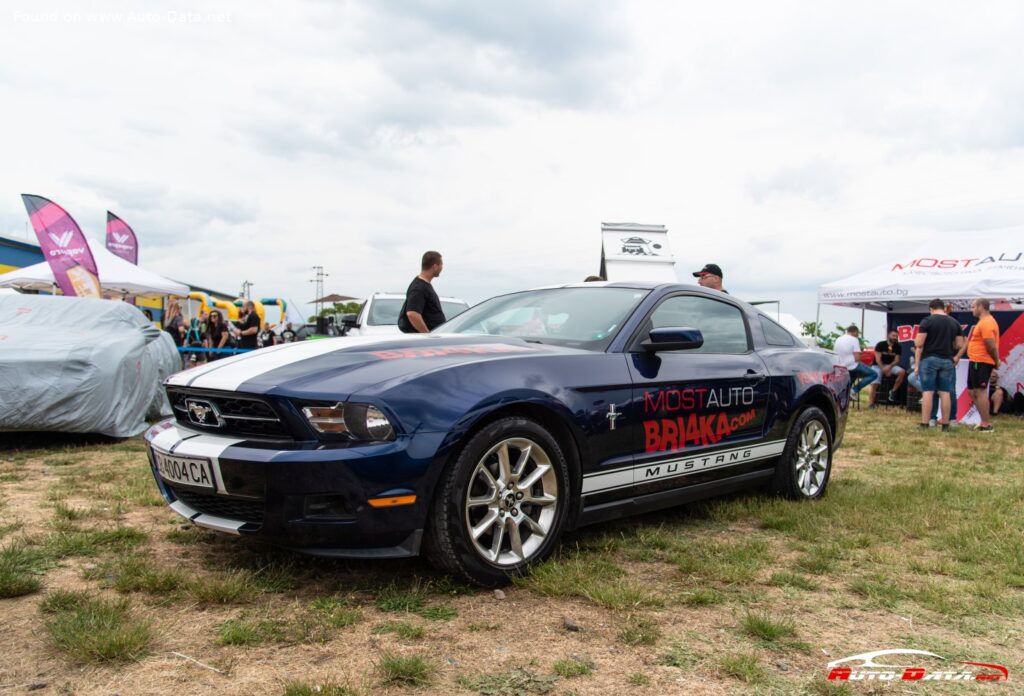
The 2009 Ford Mustang V (facelift) 4.0 V6 Automatic represents a refined iteration of an American icon. The Ford Mustang, a name synonymous with accessible performance and distinctive styling, has captivated automotive enthusiasts for generations. The fifth-generation Mustang, internally designated S197, signaled a deliberate return to the design principles of the original 1960s models. Introduced in 2005, the S197 proved highly successful, prompting a significant refresh for the 2009 model year (often marketed as a 2010 model, but technically released in late 2009). This updated version, specifically the Ford Mustang V (facelift 2009) 4.0 V6 Automatic, provided an attractive entry point into the Mustang family, blending classic aesthetics with modern enhancements and a dependable powertrain. As the base model coupe, it aimed to deliver the quintessential Mustang experience to a broad audience, balancing everyday usability with the inherent appeal of American muscle car heritage.
Engine & Performance
The 2009 Ford Mustang V (facelift) 4.0 V6 Automatic was powered by Ford’s well-established 4.0-liter Cologne V6 engine. This naturally aspirated, single overhead camshaft (SOHC) powerplant had a long history of reliable service in various Ford and Mercury vehicles. In this application, it generated 210 horsepower at 5300 rpm and 239.71 lb.-ft. of torque at 3500 rpm. While not possessing the raw power of the GT model’s V8, the V6 offered sufficient power for daily commutes and highway driving, delivering a smooth and predictable power delivery thanks to its multi-port manifold injection system.
The engine was mounted in a traditional front-longitudinal configuration, channeling power to the rear wheels – a defining characteristic of classic American performance cars. With a compression ratio of 9.7:1 and two valves per cylinder, the 4.0-liter V6 prioritized durability and low-end torque. The engine’s maximum operating speed was limited to 6100 rpm. A 5-speed automatic transmission was paired with the V6, offering a balance between efficiency and convenience. This automatic gearbox complemented the engine’s torque curve, providing smooth gear changes and contributing to the car’s relaxed cruising character.
Fuel economy for the Ford Mustang V (facelift 2009) 4.0 V6 Automatic was competitive within its class, with EPA estimates of 16 US mpg in city driving and 24 US mpg on the highway. The vehicle’s 16.11 US gallon fuel tank provided a reasonable driving range. The weight-to-power ratio was 7.5 kg/Hp (approximately 16.5 lbs/Hp), while the weight-to-torque ratio was 4.8 kg/Nm (approximately 10.6 lbs/Nm), highlighting its accessible performance capabilities.
Design & Features
The 2009 facelift introduced subtle but significant design updates to the already successful retro-futuristic styling of the Mustang. The coupe body style, featuring two doors and seating for four passengers, remained the primary offering. Exterior enhancements included a redesigned front fascia with a more assertive grille and new headlights incorporating integrated turn signals. The rear end received updated taillights, notably featuring sequential turn signals on all models – a distinctive and appreciated detail that paid homage to classic Mustangs. These changes refined the car’s appearance, giving it a more contemporary edge while preserving its unmistakable heritage.
The 2009 Mustang Coupe measured 188.11 inches in length, 73.9 inches in width (80.12 inches including mirrors), and 55.59 inches in height. Its 107.09-inch wheelbase contributed to a stable ride and classic proportions. The interior continued the retro theme, featuring a dual-cowl dashboard design reminiscent of 1960s Mustangs, but updated with modern materials and technology. Available features for the era included Ford’s SYNC infotainment system, ambient lighting, and improved material quality in select areas, enhancing the cabin experience. The trunk offered a practical 13.38 cubic feet of cargo space, making the Mustang a surprisingly versatile daily driver.
Technical Specifications: Ford Mustang V (facelift 2009) 4.0 V6 Automatic
| Category | Specification |
| General Information | |
| Brand | Ford |
| Model | Mustang |
| Generation | Mustang V (facelift 2009) |
| Type (Engine) | 4.0 V6 (210 Hp) Automatic |
| Start of Production | 2009 year |
| End of Production | 2010 year |
| Powertrain Architecture | Internal Combustion engine |
| Body Type | Coupe |
| Seats | 4 |
| Doors | 2 |
| Performance Specs | |
| Fuel Consumption (Urban) | 16 US mpg |
| Fuel Consumption (Extra Urban) | 24 US mpg |
| Fuel Type | Petrol (Gasoline) |
| Weight-to-Power Ratio | 7.5 kg/Hp (134 Hp/tonne) |
| Weight-to-Torque Ratio | 4.8 kg/Nm (207.4 Nm/tonne) |
| Engine Specs | |
| Power | 210 Hp @ 5300 rpm |
| Power per Liter | 52.4 Hp/l |
| Torque | 239.71 lb.-ft. @ 3500 rpm |
| Maximum Engine Speed | 6100 rpm |
| Engine Layout | Front, Longitudinal |
| Engine Model/Code | Cologne |
| Engine Displacement | 4.0 liters (244.64 cu. in.) |
| Number of Cylinders | 6 |
| Engine Configuration | V-engine |
| Cylinder Bore | 3.95 in. (100.4 mm) |
| Piston Stroke | 3.32 in. (84.4 mm) |
| Compression Ratio | 9.7:1 |
| Number of Valves per Cylinder | 2 |
| Fuel Injection System | Multi-port manifold injection |
| Engine Aspiration | Naturally aspirated engine |
| Valvetrain | SOHC |
| Engine Oil Capacity | 4.97 US qt (4.7 l) |
| Coolant Capacity | 12.47 US qt (11.8 l) |
| Space, Volume and Weights | |
| Kerb Weight | 3454.64 lbs. (1567 kg) |
| Trunk (boot) Space – Minimum | 13.38 cu. ft. (379 l) |
| Fuel Tank Capacity | 16.11 US gal (61 l) |
| Permitted Trailer Load (with brakes, 12%) | 1000.9 lbs. (454 kg) |
| Dimensions | |
| Length | 188.11 in. (4778 mm) |
| Width | 73.9 in. (1877 mm) |
| Width Including Mirrors | 80.12 in. (2035 mm) |
| Height | 55.59 in. (1412 mm) |
| Wheelbase | 107.09 in. (2720 mm) |
| Front Track | 62.28 in. (1582 mm) |
| Rear (Back) Track | 62.91 in. (1598 mm) |
| Minimum Turning Circle (Turning Diameter) | 33.46 ft. (10.2 m) |
| Drivetrain, Brakes and Suspension Specs | |
| Drivetrain Architecture | The Internal combustion engine (ICE) drives the rear wheels of the vehicle. |
| Drive Wheel | Rear wheel drive |
| Number of Gears and Type of Gearbox | 5 gears, automatic transmission |
| Front Suspension | Independent type McPherson, Transverse stabilizer |
| Rear Suspension | Rigid axle suspension, Transverse stabilizer, Coil spring |
| Front Brakes | Ventilated discs, 293×30 mm |
| Rear Brakes | Ventilated discs, 300×19 mm |
| Assisting Systems | ABS (Anti-lock braking system) |
| Steering Type | Steering rack and pinion |
| Power Steering | Hydraulic Steering |
| Tires Size | 215/60 R17; 235/50 R18 |
| Wheel Rims Size | 7J x 17; 8J x 18 |
Legacy and Market Standing
The 2009 Ford Mustang V (facelift) 4.0 V6 Automatic held a crucial position within the Mustang lineup and the broader American automotive market. It served as the accessible entry point, offering the iconic styling and spirit of the Mustang at a more affordable price and with improved fuel economy compared to the V8-powered GT. This made it a popular choice for younger buyers, daily commuters, or those who simply desired the Mustang aesthetic without needing ultimate performance. Competitors included the Chevrolet Camaro (introduced in 2010) and the Dodge Challenger (relaunched in 2008). While the Camaro and Challenger often offered more powerful V6 options, the Mustang’s established legacy, continuous production, and refined retro styling provided a strong competitive advantage.
The S197 generation, and particularly this facelifted model, is significant for bridging the gap between the “New Edge” SN95 generation and the more technologically advanced, Coyote V8-powered S197 that followed in 2011. The 2009 model represented the final iteration of the Cologne 4.0-liter V6 in the Mustang, marking the end of an era before Ford transitioned to its more modern, powerful, and efficient 3.7-liter Cyclone V6. Despite being the base model, the Ford Mustang V (facelift 2009) 4.0 V6 Automatic contributed significantly to the Mustang’s enduring appeal, offering a compelling blend of classic American styling, a comfortable ride, and reliable performance that resonated with a wide range of buyers and cemented its place as a beloved part of automotive history. Its robust construction and ample aftermarket support ensure it remains a popular choice for enthusiasts seeking an iconic and customizable American coupe.