The Ford Mustang, an iconic American pony car, received a significant refresh for its sixth generation in 2017, introducing a host of enhancements to its design, technology, and powertrain options. Among the most compelling choices for enthusiasts and daily drivers alike was the 2.3 GTDi EcoBoost variant, a sophisticated turbocharged four-cylinder engine that defied traditional Mustang expectations while delivering impressive performance and efficiency. This iteration of the Mustang, produced from 2017 to 2023, continued the model’s global expansion, offering a more accessible yet spirited entry point into the legendary lineage. The Ford Mustang VI (facelift 2017) EcoBoost model represented a strategic move by Ford to cater to a broader international audience, providing a balance of modern engineering, classic styling, and improved fuel economy without compromising the driving excitement the Mustang is known for.
Ford Mustang VI (Facelift 2017) 2.3 GTDi EcoBoost: A Detailed Overview
The sixth-generation Ford Mustang, launched in 2015, marked a significant departure from its predecessors, embracing independent rear suspension and a more modern design language. The 2017 facelift refined this platform, addressing initial criticisms and enhancing the car’s overall appeal. The 2.3 GTDi EcoBoost model occupied a crucial position in the lineup, offering a compelling alternative to the traditional V8-powered Mustangs, particularly for buyers prioritizing fuel efficiency and a more accessible price point. This model was instrumental in expanding the Mustang’s global reach, proving its adaptability to diverse market preferences.
Engine & Performance
At the heart of the Ford Mustang VI (facelift 2017) 2.3 GTDi EcoBoost lies a 2.3-liter (2254 cm³) inline-four cylinder engine. This engine utilizes direct injection (GTDi) and turbocharging with an intercooler to achieve a robust 310 horsepower at 5500 rpm. The engine’s power output per liter is an impressive 137.5 horsepower, demonstrating its advanced design and efficiency. The engine is longitudinally mounted at the front of the vehicle, driving the rear wheels – a configuration consistent with the classic Mustang formula.
Torque output is equally noteworthy, with the EcoBoost engine delivering 350.34 lb.-ft. of torque at 3000 rpm. This broad torque band provides brisk acceleration and responsive performance across the rev range. Power is transmitted through a standard six-speed manual transmission, offering drivers a direct and engaging driving experience. An automatic transmission was also available as an option. The vehicle’s weight-to-power ratio of 5.2 kg/Hp (192.9 Hp/tonne) contributes to its agile handling. Fuel economy is rated at 21 US mpg (11.2 l/100 km) in urban conditions, 31.4 US mpg (7.5 l/100 km) in extra-urban driving, and 25 US mpg (9.4 l/100 km) combined, making it a relatively efficient sports coupe.
Design & Features
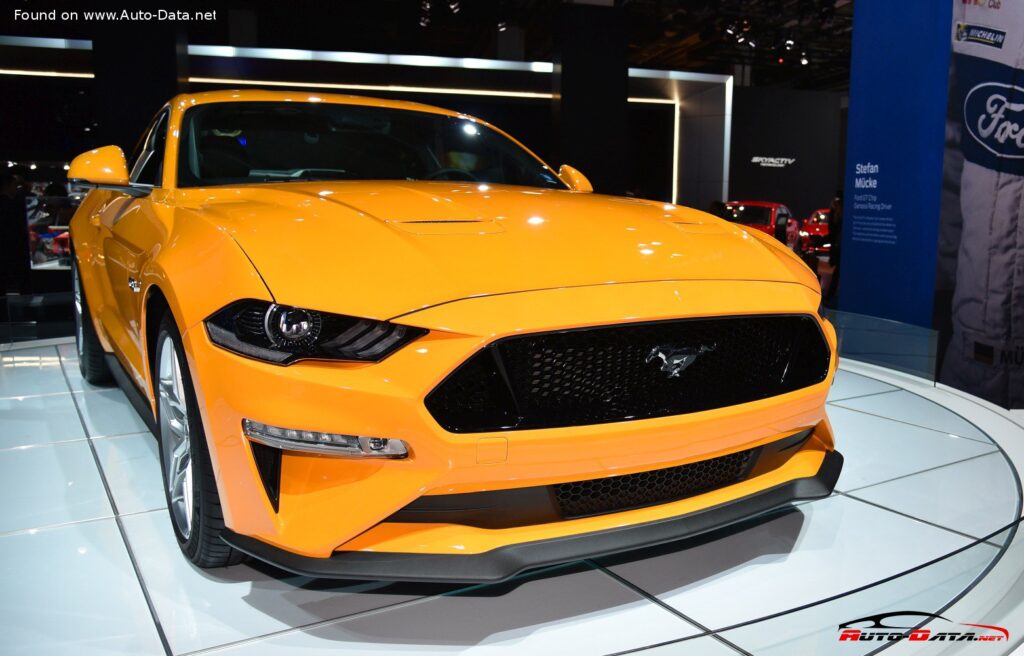
The 2017 facelift brought a more aggressive and aerodynamic aesthetic to the Mustang’s Fastback body style. The front fascia features a sharper, lower-set hood, a revised grille, and redesigned LED headlamps. At the rear, new LED taillights and a restyled bumper maintain the iconic triple-bar design while incorporating modern elements. The Mustang EcoBoost’s dimensions – 188.5 inches in length, 75.39 inches in width, and 54.29 inches in height – contribute to its muscular stance.
The suspension system is fully independent, with a McPherson strut setup at the front and a multi-link spring suspension at the rear. This configuration significantly improves ride quality and handling compared to previous generations. Ventilated disc brakes with ABS provide strong stopping power. The trunk offers 13.49 cubic feet of space, providing practical utility for a sports coupe. Inside, the Mustang features a driver-focused cockpit with modern infotainment systems and available features like leather upholstery, premium audio systems, and advanced driver-assistance technologies.
Technical Specifications
| Category | Specification |
| Brand | Ford |
| Model | Mustang |
| Generation | Mustang VI (facelift 2017) |
| Type (Engine) | 2.3 GTDi EcoBoost (310 Hp) |
| Start of Production | 2017 year |
| End of Production | 2023 year |
| Powertrain Architecture | Internal Combustion engine |
| Body type | Fastback |
| Seats | 4 |
| Doors | 2 |
| Fuel Consumption (Urban) | 21 US mpg (11.2 l/100 km) |
| Fuel Consumption (Extra Urban) | 31.4 US mpg (7.5 l/100 km) |
| Fuel Consumption (Combined) | 25 US mpg (9.4 l/100 km) |
| Fuel Type | Petrol (Gasoline) |
| Weight-to-Power Ratio | 5.2 kg/Hp (192.9 Hp/tonne) |
| Weight-to-Torque Ratio | 3.4 kg/Nm (295.6 Nm/tonne) |
| Power | 310 Hp @ 5500 rpm |
| Power per Liter | 137.5 Hp/l |
| Torque | 350.34 lb.-ft. @ 3000 rpm (475 Nm) |
| Engine Layout | Front, Longitudinal |
| Engine Model/Code | EcoBoost |
| Engine Displacement | 2.3 liters (2254 cm³ / 137.55 cu. in.) |
| Number of Cylinders | 4 |
| Engine Configuration | Inline |
| Cylinder Bore | 3.44 in. (87.5 mm) |
| Piston Stroke | 3.7 in. (94 mm) |
| Compression Ratio | 9.5:1 |
| Fuel Injection System | Direct injection |
| Engine Aspiration | Turbocharger, Intercooler |
| Engine Oil Capacity | 5.99 US qt (5.67 l) |
| Coolant Capacity | 9.47 US qt (8.96 l) |
| Kerb Weight | 3542.83 lbs. (1607 kg) |
| Trunk (boot) space – minimum | 13.49 cu. ft. (382 l) |
| Fuel Tank Capacity | 15.59 US gal (59 l) |
| Length | 188.5 in. (4788 mm) |
| Width | 75.39 in. (1915 mm) |
| Width with mirrors folded | 76.1 in. (1933 mm) |
| Width including mirrors | 81.89 in. (2080 mm) |
| Height | 54.29 in. (1379 mm) |
| Wheelbase | 107.09 in. (2720 mm) |
| Front Track | 62.4 in. (1585 mm) |
| Rear (Back) Track | 65.12 in. (1654 mm) |
| Drivetrain Architecture | The Internal combustion engine (ICE) drives the rear wheels of the vehicle. |
| Drive Wheel | Rear wheel drive |
| Number of Gears and Type of Gearbox | 6 gears, manual transmission |
| Front Suspension | Independent, type McPherson with coil spring and anti-roll bar |
| Rear Suspension | Independent multi-link spring suspension with stabilizer |
| Front Brakes | Ventilated discs |
| Rear Brakes | Ventilated discs |
| Assisting Systems | ABS (Anti-lock braking system) |
| Steering Type | Steering rack and pinion |
Legacy and Market Impact
The introduction of the EcoBoost engine in the sixth-generation Mustang, and refined with the 2017 facelift, marked a pivotal moment in the model’s history. It expanded the Mustang’s appeal beyond its traditional customer base, attracting buyers who valued efficiency and modern technology. The 2.3 GTDi EcoBoost Mustang proved that a Mustang could be both powerful and pragmatic, solidifying its position as a global icon and demonstrating its ability to adapt to changing market demands.