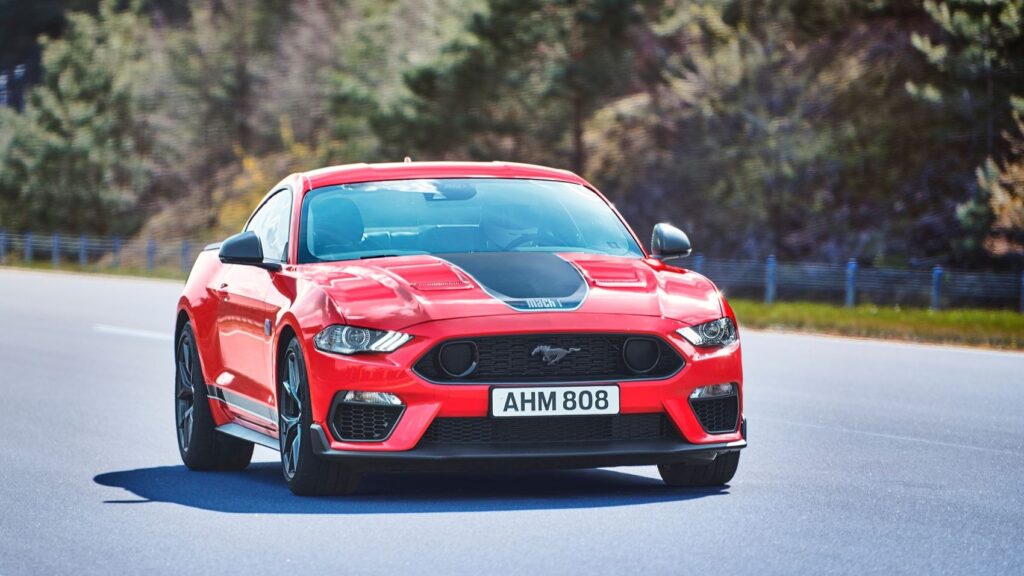
The Ford Mustang, an icon of American automotive prowess, continued its storied legacy with the sixth generation (S550), which debuted for the 2015 model year. The facelifted version, introduced in 2017, brought a host of aesthetic and performance enhancements, further solidifying its position in the highly competitive pony car segment. Among the most revered variants of this refreshed generation was the Ford Mustang VI (facelift 2017) Mach 1 5.0 Ti-VCT V8 (460 Hp), a nameplate that evokes a rich history of track-focused performance and distinctive styling. Produced from 2020 to 2023, the Mach 1 served as a potent bridge between the standard Mustang GT and the more extreme Shelby models, offering a compelling blend of everyday usability and genuine track capability.
The Mach 1 designation, first introduced in 1969, has always signified a Mustang engineered for superior performance and handling. The 2020-2023 iteration upheld this tradition, incorporating a range of performance-oriented upgrades derived from the Shelby GT350 and GT500 parts bins. This particular model, a Fastback with two doors and seating for four, was designed to appeal to enthusiasts seeking a raw, engaging driving experience without venturing into the supercharged territory of the top-tier Shelbys. Its powertrain architecture is centered around a formidable naturally aspirated internal combustion engine driving the rear wheels, a classic setup for American muscle cars.
Engine & Performance: The Heart of the Ford Mustang VI (facelift 2017) Mach 1 5.0 Ti-VCT V8 (460 Hp)
At the core of the Mach 1’s exhilarating performance lies Ford’s renowned 5.0-liter Coyote V8 engine, specifically the Ti-VCT (Twin Independent Variable Cam Timing) variant. In this application, the engine produces a robust 460 horsepower at a high 7250 rpm, showcasing its free-revving nature and impressive power delivery. Torque output stands at 390.17 lb.-ft. at 4900 rpm, providing a broad powerband that makes the car responsive across the rev range. This engine, designated with a 5038 cm³ (307.44 cu. in.) displacement, features an advanced DOHC (Dual Overhead Camshaft) valvetrain with four valves per cylinder and a high 12:1 compression ratio, optimizing combustion efficiency.
Fuel delivery is handled by a sophisticated system that combines both direct injection and multi-port manifold injection, a strategy known as port and direct injection (PDI), which helps achieve both power and efficiency. The engine’s layout is front-longitudinal, contributing to the Mustang’s classic rear-wheel-drive dynamics. Power is transmitted to the rear wheels via a highly acclaimed TREMEC 6-speed manual transmission, a choice that underscores the Mach 1’s driver-focused philosophy and provides an engaging, tactile shifting experience.
The performance figures for the Ford Mustang VI (facelift 2017) Mach 1 5.0 Ti-VCT V8 (460 Hp) are certainly impressive. It can accelerate from 0 to 60 mph in a swift 4.6 seconds, with 0 to 100 km/h achieved in 4.8 seconds. The top speed is electronically limited to 165.91 mph (267 km/h), a testament to its aerodynamic tuning and potent engine. The car’s weight-to-power ratio of 3.8 kg/Hp (260.8 Hp/tonne) highlights its athletic build. Despite its performance credentials, Ford also considered fuel economy, with a combined WLTP rating of 19 US mpg (12.4 l/100 km), and 14 US mpg in urban settings, which is respectable for a V8 engine of this caliber. Emissions are rated at 284 g/km CO2, indicating its powerful nature.
Design & Features
The design of the Ford Mustang VI (facelift 2017) Mach 1 is a purposeful blend of classic Mustang aesthetics and modern aerodynamic functionality. As a Fastback, its silhouette is instantly recognizable, characterized by a sloping roofline that seamlessly integrates into the rear deck. The Mach 1 differentiates itself with specific styling cues that pay homage to its predecessors while enhancing its performance. These typically include unique front fascias with revised grilles, prominent air intakes, specific badging, and aerodynamic elements like a front splitter and rear spoiler, all designed to improve airflow and downforce on the track.
Measuring 188.86 inches in length, 75.43 inches in width (81.93 inches including mirrors), and 54.41 inches in height, the Mach 1 maintains a muscular stance. Its 107.09-inch wheelbase contributes to both stability and agile handling. The curb weight of 3888.95 lbs (1764 kg) is efficiently managed by a sophisticated chassis. The independent McPherson strut front suspension with coil springs and an anti-roll bar, combined with an independent multi-link rear suspension with a stabilizer, provides a balanced ride that is firm enough for track duty yet compliant enough for daily driving.
Braking performance is crucial for a car of this capability, and the Mach 1 delivers with large ventilated discs all around: 380×34 mm at the front and 330×25 mm at the rear. These are complemented by an Anti-lock Braking System (ABS) for optimal stopping power and control. The steering system utilizes a rack and pinion setup with electric power steering, offering precise feedback and adjustability. The car rides on staggered wheel and tire sizes, with 255/40 R19 tires on 9.5J x 19 rims at the front and wider 275/40 R19 tires on 10J x 19 rims at the rear, optimizing traction for the rear-wheel-drive powertrain. The trunk space of 14.41 cu. ft. (408 liters) offers practical utility, while a 16.11 US gallon (61 liter) fuel tank provides a decent range for spirited drives.
A Legacy Revived
The revival of the Mach 1 nameplate in 2020 was a deliberate move by Ford to capitalize on the model’s historical significance and offer a more focused performance experience than the standard Mustang GT. By incorporating components from the higher-performance Shelby models, the Mach 1 bridged the gap between everyday usability and track capability, appealing to a wider range of enthusiasts.
Technical Specifications
| Category | Specification |
| Brand | Ford |
| Model | Mustang |
| Generation | Mustang VI (facelift 2017) |
| Type (Engine) | Mach 1 5.0 Ti-VCT V8 (460 Hp) |
| Start of Production | 2020 year |
| End of Production | 2023 year |
| Powertrain Architecture | Internal Combustion engine |
| Body type | Fastback |
| Seats | 4 |
| Doors | 2 |
| Combined Fuel Consumption (WLTP) | 12.4 l/100 km (19 US mpg) |
| CO2 emissions (WLTP) | 284 g/km |
| Fuel Consumption (Urban) | 16.8 l/100 km (14 US mpg) |
| Fuel Consumption (Extra Urban) | 10.7 l/100 km (22 US mpg) |
| Fuel Consumption (Combined) | 13.8 l/100 km (17 US mpg) |
| Fuel Type | Petrol (Gasoline) |
| Acceleration 0 – 60 mph | 4.6 sec |
| Maximum Speed | 267 km/h (165.91 mph) |
| Braking Distance 100 km/h – 0 | 31.8 m |
| Weight-to-Power Ratio | 3.8 kg/Hp (260.8 Hp/tonne) |
| Weight-to-Torque Ratio | 3.3 kg/Nm (299.9 Nm/tonne) |
| Power | 460 Hp @ 7250 rpm |
| Power per liter | 91.3 Hp/l |
| Torque | 529 Nm @ 4900 rpm (390.17 lb.-ft. @ 4900 rpm) |
| Engine Layout | Front, Longitudinal |
| Engine Displacement | 5038 cm³ (307.44 cu. in.) |
| Number of Cylinders | 8 |
| Engine Configuration | V-engine |
| Cylinder Bore | 93 mm (3.66 in.) |
| Piston Stroke | 92.7 mm (3.65 in.) |
| Compression Ratio | 12:1 |
| Number of Valves per Cylinder | 4 |
| Fuel Injection System | Direct injection and Multi-port manifold injection |
| Valvetrain | DOHC, Ti-VCT |
| Engine Oil Capacity | 9.5 l (10.04 US qt) |
| Coolant Capacity | 12.88 l (13.61 US qt) |
| Engine Systems | Particulate filter |
| Kerb Weight | 1764 kg (3888.95 lbs.) |
| Max. Weight | 2114 kg (4660.57 lbs.) |
| Max Load | 350 kg (771.62 lbs.) |
| Trunk (boot) space – minimum | 408 l (14.41 cu. ft.) |
| Fuel Tank Capacity | 61 l (16.11 US gal) |
| Length | 4797 mm (188.86 in.) |
| Width | 1916 mm (75.43 in.) |
| Width with mirrors folded | 1957 mm (77.05 in.) |
| Width including mirrors | 2081 mm (81.93 in.) |
| Height | 1382 mm (54.41 in.) |
| Wheelbase | 2720 mm (107.09 in.) |
| Front Track | 1594 mm (62.76 in.) |
| Rear Track | 1646 mm (64.8 in.) |
| Ride Height (ground clearance) | 120 mm (4.72 in.) |
| Minimum Turning Circle (turning diameter) | 12.2 m (40.03 ft.) |
| Drivetrain Architecture | The Internal combustion engine (ICE) drives the rear wheels of the vehicle. |
| Drive Wheel | Rear wheel drive |
| Number of Gears and Type of Gearbox | 6 gears, manual transmission TREMEC |
| Front Suspension | Independent, type McPherson with coil spring and anti-roll bar |
| Rear Suspension | Independent multi-link spring suspension with stabilizer |
| Front Brakes | Ventilated discs, 380×34 mm |
| Rear Brakes | Ventilated discs, 330×25 mm |
| Assisting Systems | ABS (Anti-lock braking system) |
| Steering Type | Steering rack and pinion |
| Power Steering | Electric Steering |
| Front Wheel Tires | 255/40 R19 |
| Rear Wheel Tires | 275/40 R19 |
| Front Wheel Rims | 9.5J x 19 |
| Rear Wheel Rims | 10J x 19 |
The Ford Mustang VI (facelift 2017) Mach 1 5.0 Ti-VCT V8 (460 Hp), produced from 2020 to 2023, successfully revived a beloved nameplate, bringing its track-focused ethos to a new generation of enthusiasts. Its role in the market was distinct: it offered a compelling performance package that sat comfortably above the standard Mustang GT but below the more extreme and often limited-production Shelby GT350 and GT500 models. This strategic positioning allowed Ford to cater to a broader audience seeking high-performance capabilities without the full commitment to a dedicated track car.
In the competitive American muscle car landscape, the Mach 1 faced formidable rivals such as the Chevrolet Camaro SS 1LE and the Dodge Challenger Scat Pack. Each offered its unique blend of power, styling, and driving dynamics. The Mach 1 distinguished itself with its direct lineage to historic performance models, unique styling cues, and a carefully curated selection of performance parts from Ford Performance, including components from the Shelby GT350 and GT500. This included enhanced cooling systems, stiffer suspension components, and aerodynamic aids that made it genuinely capable on a road course.
Beyond its domestic market, the sixth-generation Mustang marked a significant shift for Ford, as it was designed from the outset to be a global vehicle. The Mach 1, therefore, also played a role in showcasing American performance engineering to an international audience, particularly in Europe and Asia, where the Mustang had gained considerable popularity. Its availability with a manual transmission further appealed to purists worldwide. The Mach 1’s reputation is one of a well-rounded performance machine that honors its past while delivering modern capabilities. It represents a pinnacle of the naturally aspirated V8 Mustang, offering a visceral driving experience that few modern cars can match. Its relatively short production run from 2020-2023 also adds to its collectibility and enduring appeal among enthusiasts who appreciate its blend of heritage, power, and track-ready engineering.