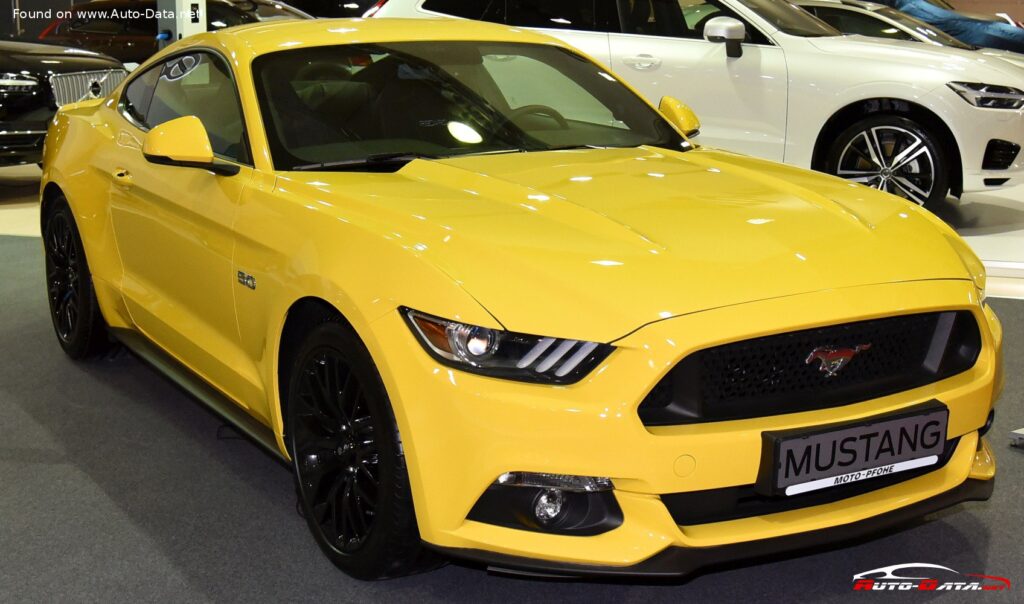
The Ford Mustang VI GT 5.0 Ti-VCT V8 (421 Hp), produced between 2015 and 2017, represents a pivotal moment in the storied history of the iconic American pony car. As the sixth generation of the Mustang, internally codenamed S550, this iteration marked a significant departure from its predecessors by being engineered from the ground up as a global vehicle, officially sold in markets across Europe, Asia, and beyond. This strategic shift necessitated a more sophisticated design and a substantial upgrade in its mechanical underpinnings, particularly the introduction of an independent rear suspension (IRS) across the entire lineup, a long-awaited feature for enthusiasts and critics alike.
The Ford Mustang VI GT: A Global Pony Car
Positioned firmly in the performance-oriented GT trim, the 2015-2017 Mustang VI GT embodied the quintessential American muscle car spirit, blending raw power with improved handling dynamics. Its fastback body style, a timeless silhouette synonymous with the Mustang nameplate, was reimagined with modern aesthetics while retaining recognizable heritage cues. The heart of this model, the 5.0-liter Coyote V8 engine, delivered formidable power, making it a compelling choice for drivers seeking exhilarating performance, whether on the open highway or a winding back road. This generation aimed to broaden the Mustang’s appeal beyond its traditional North American fan base, establishing it as a truly competitive sports coupe on the international stage.
Engine & Performance: The Coyote V8
At the core of the Ford Mustang VI GT 5.0 Ti-VCT V8 (421 Hp) lies the formidable 5.0-liter “Coyote” V8 engine, a powerplant celebrated for its robust output and distinctive exhaust note. This naturally aspirated, front-longitudinal engine features a V-engine configuration with eight cylinders, each equipped with four valves, totaling 32 valves. The engine’s displacement measures 4951 cubic centimeters (302.13 cubic inches), harkening back to the legendary “302” cubic inch engines of Mustang lore.
The “Coyote” V8 in this iteration produces a potent 421 horsepower at 6500 rpm, with a power-per-liter rating of 85 Hp/l, showcasing its efficient power delivery. Torque output is equally impressive, peaking at 390.91 lb.-ft. (530 Nm) at 4250 rpm, providing a broad powerband that makes the car incredibly responsive. This power is managed through a standard 6-speed manual transmission, offering an engaging driving experience that connects the driver directly to the vehicle’s performance capabilities. The engine’s advanced technology, including Twin Independent Variable Cam Timing (Ti-VCT), optimizes valve overlap for improved power and fuel efficiency across the rpm range, contributing to its strong performance characteristics.
Performance figures for the Ford Mustang VI GT 5.0 Ti-VCT V8 (421 Hp) are impressive, with an acceleration time from 0 to 60 mph calculated at a brisk 4.6 seconds, and 0-100 km/h in 4.8 seconds. This rapid acceleration, combined with a weight-to-power ratio of 4.1 kg/Hp (244.8 Hp/tonne), underscores the car’s athletic prowess. Despite its high-performance nature, Ford aimed for a degree of everyday usability, though fuel economy, at a combined 17.4 US mpg (13.5 l/100 km), reflects its V8 appetite. CO2 emissions stand at 299 g/km, typical for a powerful sports car of this caliber.
Design & Features: Modern Muscle with Global Appeal
The design of the Ford Mustang VI GT 5.0 Ti-VCT V8 (421 Hp) represents a masterful blend of classic Mustang heritage and modern, global automotive styling. The chosen body type, a two-door fastback with seating for four, is instantly recognizable as a Mustang, yet its proportions are more contemporary and aerodynamic. Measuring 188.35 inches in length, 75.43 inches in width (81.89 inches including mirrors), and 54.37 inches in height, the S550 Mustang possesses a muscular stance that hints at its performance capabilities. The wheelbase of 107.09 inches contributes to both its stability and interior space.
A significant engineering advancement for this generation was the adoption of an independent rear suspension (IRS) system, replacing the live rear axle found in previous Mustangs. This change dramatically improved the car’s handling, ride comfort, and overall refinement, allowing it to better compete with sports coupes from European and Asian manufacturers. The front suspension features an independent MacPherson strut setup, while the rear utilizes a sophisticated multi-link spring suspension with a stabilizer, working in tandem to provide a balanced and engaging driving experience.
Braking performance is handled by ventilated discs at both the front and rear, complemented by an Anti-lock Braking System (ABS) for enhanced safety and control. The car rides on 19-inch wheels, with a staggered tire setup of 255/40 R19 at the front and wider 275/40 R19 tires at the rear, optimizing grip and handling dynamics. The steering system is a precise rack and pinion type, offering direct feedback to the driver. Inside, the cabin was designed with a focus on driver engagement, featuring a modern interpretation of the classic dual-cowl dashboard and an array of contemporary amenities for its production era.
Technical Specifications
| Category | Specification |
| General Information | |
| Brand | Ford |
| Model | Mustang |
| Generation | Mustang VI |
| Type (Engine) | GT 5.0 Ti-VCT V8 (421 Hp) |
| Start of Production | 2015 year |
| End of Production | 2017 year |
| Powertrain Architecture | Internal Combustion engine |
| Body Type | Fastback |
| Seats | 4 |
| Doors | 2 |
| Performance Specs | |
| Fuel Consumption (Combined) | 17.4 US mpg (13.5 l/100 km) |
| CO2 Emissions | 299 g/km |
| Fuel Type | Petrol (Gasoline) |
| Acceleration 0 – 60 mph | 4.6 sec |
| Acceleration 0 – 100 km/h | 4.8 sec |
| Weight-to-Power Ratio | 4.1 kg/Hp (244.8 Hp/tonne) |
| Weight-to-Torque Ratio | 3.2 kg/Nm (308.1 Nm/tonne) |
| Engine Specs | |
| Power | 421 Hp @ 6500 rpm |
| Power Per Liter | 85 Hp/l |
| Torque | 390.91 lb.-ft. (530 Nm) @ 4250 rpm |
| Engine Layout | Front, Longitudinal |
| Engine Model/Code | Coyote |
| Engine Displacement | 302.13 cu. in. (4951 cm3) |
| Number of Cylinders | 8 |
| Engine Configuration | V-engine |
| Cylinder Bore | 3.63 in. (92.2 mm) |
| Piston Stroke | 3.65 in. (92.7 mm) |
| Compression Ratio | 11:1 |
| Number of Valves Per Cylinder | 4 |
| Fuel Injection System | Multi-port manifold injection |
| Engine Aspiration | Naturally aspirated engine |
| Valvetrain | DOHC |
| Engine Oil Capacity | 8.03 US qt (7.6 l) |
| Coolant Capacity | 13.61 US qt (12.88 l) |
| Space, Volume, and Weights | |
| Kerb Weight | 3791.95 lbs. (1720 kg) |
| Trunk (Boot) Space – Minimum | 14.41 cu. ft. (408 l) |
| Fuel Tank Capacity | 16.11 US gal (61 l) |
| Dimensions | |
| Length | 188.35 in. (4784 mm) |
| Width | 75.43 in. (1916 mm) |
| Width with Mirrors Folded | 77.01 in. (1956 mm) |
| Width Including Mirrors | 81.89 in. (2080 mm) |
| Height | 54.37 in. (1381 mm) |
| Wheelbase | 107.09 in. (2720 mm) |
| Front Track | 62.28 in. (1582 mm) |
| Rear (Back) Track | 65.16 in. (1655 mm) |
| Minimum Turning Circle (Turning Diameter) | 40.03 ft. (12.2 m) |
| Drivetrain, Brakes, and Suspension Specs | |
| Drivetrain Architecture | The Internal combustion engine (ICE) drives the rear wheels of the vehicle. |
| Drive Wheel | Rear wheel drive |
| Number of Gears and Type of Gearbox | 6 gears, manual transmission |
| Front Suspension | Independent type McPherson |
| Rear Suspension | Independent multi-link spring suspension with stabilizer |
| Front Brakes | Ventilated discs |
| Rear Brakes | Ventilated discs |
| Assisting Systems | ABS (Anti-lock braking system) |
| Steering Type | Steering rack and pinion |
| Tires Size | 255/40 R19 (Front); 275/40 R19 (Rear) |
| Wheel Rims Size | 19 inches |
Legacy and Market Impact
The Ford Mustang VI GT 5.0 Ti-VCT V8 (421 Hp) carved out a significant legacy, not just for the Mustang brand but for the entire pony car segment. Its introduction in 2015 marked a paradigm shift, transforming the Mustang from a regional icon into a truly global performance car. For decades, the Mustang’s appeal outside North America was largely limited to enthusiasts importing models or buying grey-market vehicles. The S550 generation, however, was designed from its inception to meet international safety and emissions standards, and crucially, to offer right-hand drive options, opening up vast new markets.
This global strategy profoundly impacted the car’s engineering, most notably with the universal adoption of an independent rear suspension (IRS). This change finally silenced critics who had long lambasted the Mustang’s traditional live rear axle for its perceived deficiencies in handling and ride quality compared to its European and Japanese rivals. With the IRS, the Mustang GT could genuinely compete on twisty roads, offering a level of sophistication and refinement previously unseen in the model. This enhanced dynamic capability, combined with the potent Coyote V8, garnered critical acclaim and widespread sales success, particularly in markets like Europe and Australia, where the Mustang quickly became a best-seller in its segment.
In its home market, the Ford Mustang VI GT 5.0 Ti-VCT V8 (421 Hp) continued its fierce rivalry with domestic competitors such as the Chevrolet Camaro SS and the Dodge Challenger R/T Scat Pack. While the Camaro often offered slightly sharper handling and the Challenger boasted brute force, the Mustang struck a compelling balance, offering a blend of heritage, performance, and modern technology. Its refined interior, advanced features for the time, and accessible price point for a V8-powered sports coupe ensured its continued dominance in sales.
The historical significance of this specific model lies in its role as an ambassador for American performance globally. It demonstrated that a car with deep American roots could evolve, adapt, and succeed on the world stage without sacrificing its core identity. The 2015-2017 Mustang VI GT 5.0 Ti-VCT V8 (421 Hp) solidified the Mustang’s reputation as a legitimate sports car, capable of delivering thrilling performance and engaging dynamics, while also being a symbol of automotive freedom and passion that resonated with enthusiasts across continents. Its success paved the way for future Mustang iterations and cemented its place as one of the most iconic and enduring vehicles in automotive history.