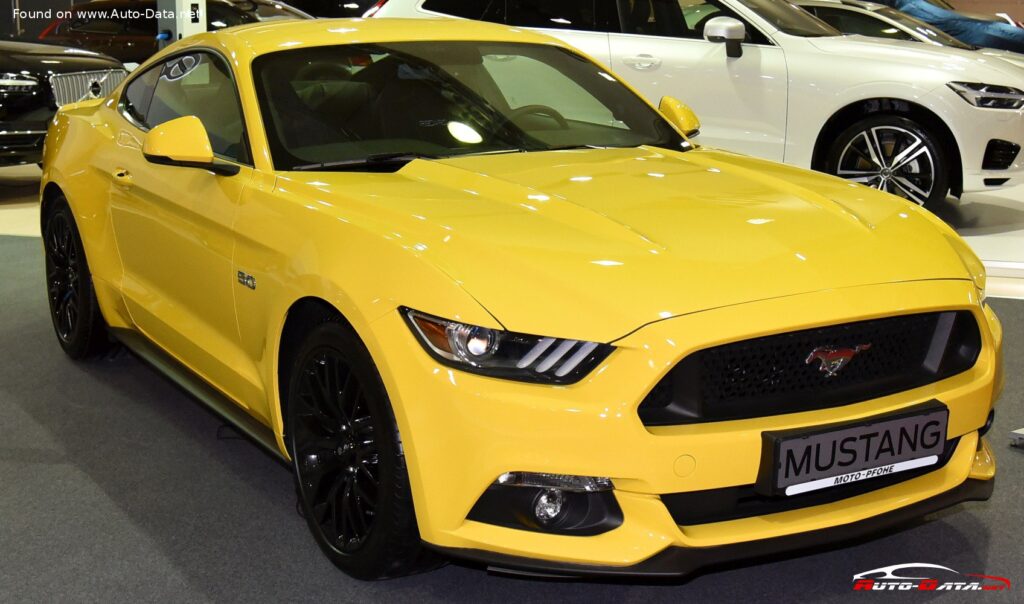
The Ford Mustang, an icon of American automotive culture, entered its sixth generation, internally designated S550, with a global launch that marked a significant departure from its predecessors. Unveiled for the 2015 model year, this generation was the first in the Mustang’s storied history to be officially sold in right-hand drive markets and distributed globally, making it a truly international pony car. Among its most celebrated variants was the Ford Mustang VI GT 5.0 Ti-VCT V8 (421 Hp) Automatic, a powerful fastback that combined traditional American muscle with modern engineering and sophistication. Produced from 2015 to 2017, this particular iteration represented the core performance offering of the S550 lineup, embodying the spirit of the Mustang with its potent V8 engine, rear-wheel-drive architecture, and unmistakable styling.
The Ford Mustang VI GT 5.0: A Global Pony Car
The S550 generation was engineered from the ground up to appeal to a broader audience while retaining the essential character that has defined the Mustang since its inception in 1964. Key to its global appeal was the adoption of an independent rear suspension (IRS) system, a long-awaited upgrade that significantly improved ride comfort and handling dynamics compared to the live axle setup of previous generations. The GT model, powered by the renowned 5.0-liter Coyote V8 engine, delivered a compelling blend of raw power and refined performance, making it a formidable competitor in the sports coupe segment both at home and abroad.
Engine & Performance
At the heart of the Ford Mustang VI GT 5.0 Ti-VCT V8 (421 Hp) Automatic lies the legendary “Coyote” engine, a 5.0-liter (4951 cm3 or 302.13 cu. in.) naturally aspirated V8. This iteration of the Coyote engine, known for its robust performance and distinctive exhaust note, generated an impressive 421 horsepower at 6500 rpm and a substantial 390.91 lb.-ft. of torque at 4250 rpm. The engine’s specification includes a DOHC (Dual Overhead Camshaft) valvetrain with Ti-VCT (Twin Independent Variable Cam Timing), which allows for precise control over valve timing on both intake and exhaust camshafts. This technology optimizes engine breathing across the rev range, enhancing both power output and fuel efficiency.
The V8 engine, with its front, longitudinal layout, features an 11:1 compression ratio and a multi-port manifold injection system. With 4 valves per cylinder and a bore and stroke nearly identical (92.2 mm / 3.63 in. bore, 92.7 mm / 3.65 in. stroke), it’s designed for responsive power delivery and high-revving capability. Power is channeled to the rear wheels through a sophisticated 6-speed automatic transmission, offering smooth and rapid gear changes that enhance both acceleration and cruising comfort. This drivetrain architecture, combined with the V8’s inherent power, results in a weight-to-power ratio of 4.1 kg/Hp (243.1 Hp/tonne) and a weight-to-torque ratio of 3.3 kg/Nm (306 Nm/tonne), indicative of its strong performance potential. While performance is a primary focus, the Mustang GT also offered a respectable combined fuel economy for a vehicle of its class, rated at 19.6 US mpg (12 l/100 km). CO2 emissions stood at 281 g/km, reflecting the output of a high-performance V8 engine. The vehicle’s independent McPherson front suspension and independent multi-link spring rear suspension with a stabilizer bar provided a compliant ride and sharp handling, a significant improvement over previous generations and crucial for its global market appeal.
Design & Features
The design of the Ford Mustang VI GT 5.0 Ti-VCT V8 (421 Hp) Automatic maintains the classic Mustang fastback silhouette while incorporating modern design language. Its aggressive stance, long sculpted hood, and short rear deck are instantly recognizable, yet the S550 generation introduced a more aerodynamic and sophisticated aesthetic. The two-door, four-seat fastback body style exudes muscularity and sportiness, with distinctive tri-bar taillights and a prominent grille that pays homage to its heritage.
Dimensionally, the vehicle measures 188.35 inches (4784 mm) in length, 75.43 inches (1916 mm) in width (81.89 inches / 2080 mm including mirrors), and 54.37 inches (1381 mm) in height. Its 107.09-inch (2720 mm) wheelbase contributes to both stability and interior space. The curb weight stands at 3818.41 lbs (1732 kg), a testament to its solid construction. The interior offers a blend of retro-inspired design cues and contemporary features, including comfortable seating for four and a minimum trunk space of 14.41 cu. ft. (408 l), making it practical for daily use or weekend getaways. Safety and driver aids for this era included standard ABS (Anti-lock Braking System), complemented by ventilated disc brakes at both the front and rear for robust stopping power. The steering system utilizes a responsive rack and pinion setup. The car rides on 19-inch wheels, typically shod with staggered tire sizes: 255/40 R19 at the front and 275/40 R19 at the rear, optimizing grip and handling balance.
Technical Specifications
| Category | Specification |
| General Information | |
| Brand | Ford |
| Model | Mustang |
| Generation | Mustang VI |
| Type (Engine) | GT 5.0 Ti-VCT V8 (421 Hp) Automatic |
| Start of Production | 2015 year |
| End of Production | 2017 year |
| Powertrain Architecture | Internal Combustion engine |
| Body Type | Fastback |
| Seats | 4 |
| Doors | 2 |
| Performance Specs | |
| Fuel Consumption (combined) | 19.6 US mpg (12 l/100 km) |
| CO2 Emissions | 281 g/km |
| Fuel Type | Petrol (Gasoline) |
| Weight-to-Power Ratio | 4.1 kg/Hp, 243.1 Hp/tonne |
| Weight-to-Torque Ratio | 3.3 kg/Nm, 306 Nm/tonne |
| Engine Specs | |
| Power | 421 Hp @ 6500 rpm |
| Power per Liter | 85 Hp/l |
| Torque | 390.91 lb.-ft. @ 4250 rpm (530 Nm @ 4250 rpm) |
| Engine Layout | Front, Longitudinal |
| Engine Model/Code | Coyote |
| Engine Displacement | 302.13 cu. in. (4951 cm3) |
| Number of Cylinders | 8 |
| Engine Configuration | V-engine |
| Cylinder Bore | 3.63 in. (92.2 mm) |
| Piston Stroke | 3.65 in. (92.7 mm) |
| Compression Ratio | 11:1 |
| Number of Valves per Cylinder | 4 |
| Fuel Injection System | Multi-port manifold injection |
| Engine Aspiration | Naturally aspirated engine |
| Valvetrain | DOHC (Ti-VCT) |
| Engine Oil Capacity | 8.03 US qt (7.6 l) |
| Coolant Capacity | 13.61 US qt (12.88 l) |
| Space, Volume and Weights | |
| Kerb Weight | 3818.41 lbs (1732 kg) |
| Trunk (boot) Space – minimum | 14.41 cu. ft. (408 l) |
| Fuel Tank Capacity | 16.11 US gal (61 l) |
| Dimensions | |
| Length | 188.35 in. (4784 mm) |
| Width | 75.43 in. (1916 mm) |
| Width with Mirrors Folded | 77.01 in. (1956 mm) |
| Width Including Mirrors | 81.89 in. (2080 mm) |
| Height | 54.37 in. (1381 mm) |
| Wheelbase | 107.09 in. (2720 mm) |
| Front Track | 62.28 in. (1582 mm) |
| Rear (Back) Track | 65.16 in. (1655 mm) |
| Minimum Turning Circle | 40.03 ft. (12.2 m) |
| Drivetrain, Brakes and Suspension Specs | |
| Drivetrain Architecture | Internal Combustion engine (ICE) drives the rear wheels. |
| Drive Wheel | Rear wheel drive |
| Number of Gears and Type of Gearbox | 6 gears, automatic transmission |
| Front Suspension | Independent type McPherson |
| Rear Suspension | Independent multi-link spring suspension with stabilizer |
| Front Brakes | Ventilated discs |
| Rear Brakes | Ventilated discs |
| Assisting Systems | ABS (Anti-lock braking system) |
| Steering Type | Steering rack and pinion |
| Tires Size | Front: 255/40 R19; Rear: 275/40 R19 |
| Wheel Rims Size | 19 inches |
Legacy and Market Impact of the Ford Mustang VI GT 5.0
The Ford Mustang VI, particularly the GT 5.0 Ti-VCT V8 (421 Hp) Automatic, holds a significant place in the Mustang’s storied legacy. It was instrumental in transforming the Mustang from a regional icon into a globally recognized and desired performance coupe. The S550 generation’s independent rear suspension was a game-changer, addressing a long-standing critique and significantly enhancing the car’s handling prowess, making it more competitive against European and Asian sports cars on twisty roads, not just drag strips.
In its primary market, the United States, the Mustang GT continued its fierce rivalry with the Chevrolet Camaro SS and the Dodge Challenger R/T and Scat Pack models. The S550 GT positioned itself as a balanced performer, offering a blend of traditional V8 muscle car appeal with modern driving dynamics and technology. Its strong sales, particularly the GT variant, underscored the enduring appeal of the V8 engine and the Mustang brand. Globally, the Mustang VI GT 5.0 faced a diverse set of competitors, including the Nissan 370Z, BMW 4-Series, and Audi A5, particularly in markets where it was officially sold for the first time. Its relative affordability, striking design, and robust performance made it an attractive alternative to more expensive European coupes, carving out a unique niche. The availability of a powerful V8, coupled with the choice of manual or automatic transmissions, ensured its broad appeal. The 2015-2017 Mustang VI GT 5.0 Ti-VCT V8 (421 Hp) Automatic established a reputation for being a highly capable and engaging driver’s car. It successfully married the raw excitement of a traditional American V8 with the refinement and technological advancements expected of a modern sports car. Its impact extended beyond sales figures; it solidified the Mustang’s position as a global performance icon, proving that American muscle could indeed compete on the world stage without compromising its distinct identity. This generation paved the way for even more potent future iterations and cemented the Mustang’s status as a formidable force in the performance car segment for years to come.