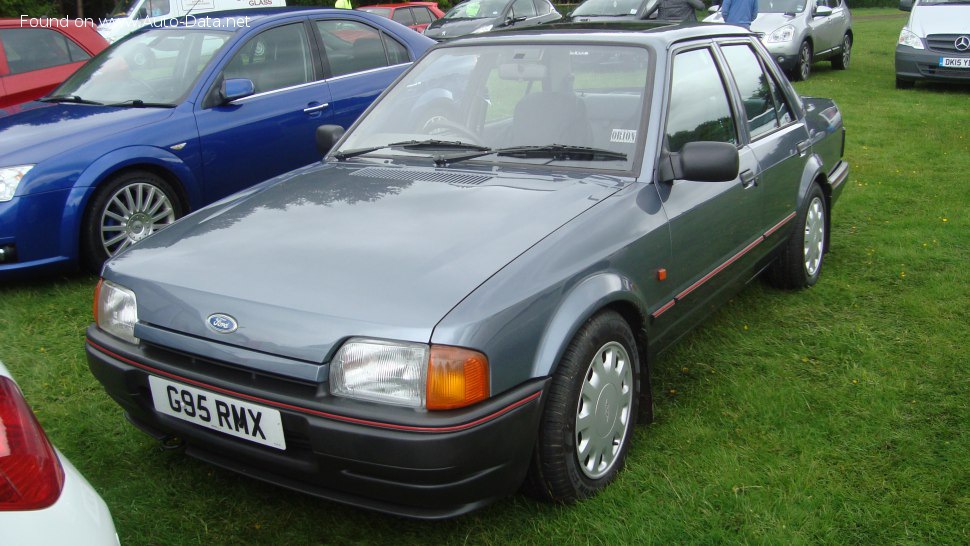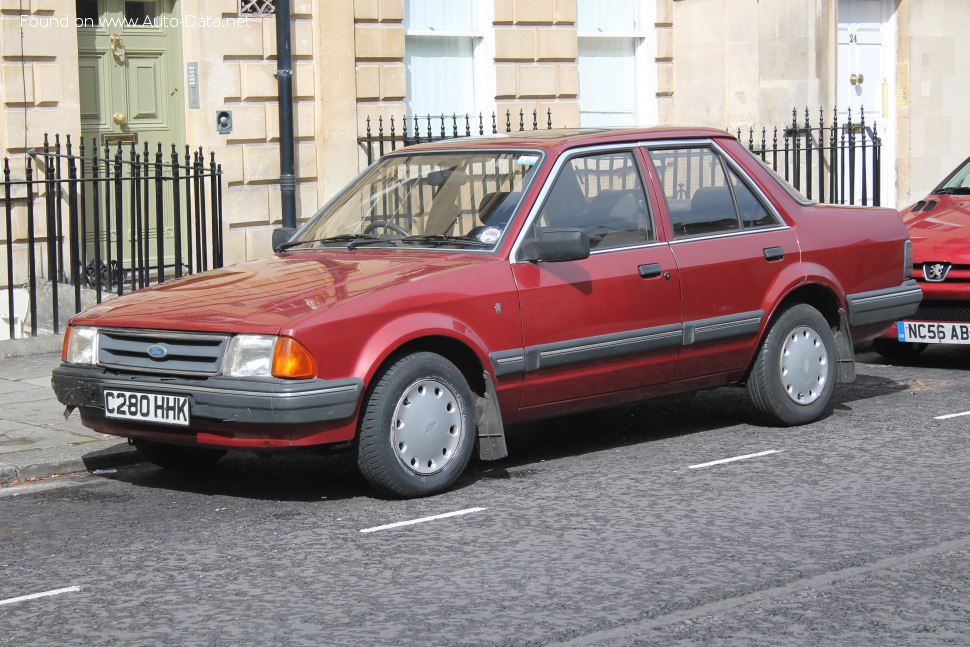
The Ford Orion I (AFD) represents a significant chapter in Ford’s European automotive strategy during the mid-1980s. Launched in 1983, shortly after the Ford Escort Mk3, the Orion was designed to address a demand for a traditional, three-box sedan based on the popular compact hatchback. While Ford of Europe already offered sedan versions of larger models like the Sierra and Granada, the Orion aimed to provide a more refined, conventional alternative to the Escort hatchback for buyers who favored a separate trunk and a more formal appearance.
The Ford Orion I (AFD): A European Compact Sedan
The Orion I, internally designated AFD, was fundamentally a Ford Escort Mk3 from the B-pillar forward, sharing its platform, powertrains, and much of its interior. However, its unique rear styling, featuring a conventional trunk and extended rear overhang, gave it a distinct identity. The 1.6 D variant, produced from 1984 to 1986 and delivering 54 horsepower, exemplified the focus on economy and practicality common in the European market during that period. Notably, the Ford Orion was never officially sold in the United States, remaining exclusively a European offering where it competed with models like the Opel Kadett sedan (known as the Vauxhall Astra in the UK) and the Volkswagen Jetta.
Design Philosophy and Market Positioning
Ford of Europe recognized that despite the rising popularity of hatchbacks, a substantial portion of the market still preferred the perceived security and status associated with a sedan. The Orion was therefore positioned slightly above the Escort in terms of trim levels and pricing, often featuring more refined interiors and standard equipment. This strategy allowed Ford to broaden its appeal, attracting families and company car drivers who desired the Escort’s compact dimensions but preferred the more formal silhouette and secure, separate luggage compartment of a sedan.
Engine & Performance: The 1.6 D Powertrain
The Ford Orion I (AFD) 1.6 D was powered by a naturally aspirated 1.6-liter diesel engine, producing 54 horsepower. In an era preceding common-rail direct injection and widespread turbocharging for compact diesels, this engine represented a straightforward and reliable approach to fuel efficiency. The 1.6 D unit, shared with the Escort and other Ford models, prioritized durability and low running costs over outright performance.
With 54 horsepower, the Orion 1.6 D wasn’t designed for spirited driving. Its performance characteristics were typical of naturally aspirated diesels of the mid-1980s: a relatively slow acceleration time, but excellent fuel economy and robust low-end torque, making it suitable for urban commuting and highway cruising. The engine’s simple design also contributed to lower maintenance costs and a reputation for longevity, qualities highly valued by European consumers during times of economic uncertainty and fluctuating fuel prices. The powertrain was a conventional front-wheel-drive setup, consistent with the Escort platform, providing predictable handling and good traction in various conditions.
The emphasis on diesel power in this model reflected a broader trend in Europe, where diesel engines were favored for their superior fuel economy and lower emissions (at the time, CO2 was the primary concern). For the Ford Orion I (AFD), the 1.6 D engine offered a compelling proposition for buyers seeking to minimize running costs without sacrificing the practicality of a compact sedan.
Design & Features: European Practicality and Aesthetics
The Ford Orion I (AFD) was a typical example of 1980s European automotive design, blending practicality with a modern aesthetic. As a sedan, it differed from the Escort hatchback primarily from the C-pillar rearward. The addition of a conventional trunk not only increased luggage capacity but also contributed to a quieter cabin by isolating the passenger compartment from road noise from the rear wheels and cargo area. The styling was clean and angular, consistent with the “Jelly Mould” aerodynamic design philosophy Ford introduced with the Sierra and later applied to the Escort Mk3.
Inside, the Orion shared much of its cabin design with the Escort, featuring a straightforward and functional dashboard layout. Controls were logically placed and easy to operate, reflecting Ford’s commitment to user-friendliness. Depending on the trim level, features included cloth upholstery, a basic radio-cassette player, and manual windows. While luxury wasn’t a primary focus, the Orion offered a comfortable and reasonably spacious interior for a compact car of its era, accommodating four adults with adequate legroom and headroom. Safety features, typical for the mid-1980s, included seatbelts for all occupants and a robust body structure for crash protection, though advanced active or passive safety systems were still years away from becoming standard.
Technical Specifications: Ford Orion I (AFD) 1.6 D (54 Hp)
| Category | Specification |
| Brand | Ford |
| Model | Orion |
| Generation | Orion I (AFD) |
| Engine Type | 1.6 D (54 Hp) |
| Start of Production | 1984 |
| End of Production | 1986 |
| Powertrain Architecture | Internal Combustion Engine |
| Body Type | Sedan |
| Fuel Type | Diesel |
| Power | 54 Hp |
| Engine Aspiration | Naturally aspirated |
Legacy and Market Impact in Europe
The Ford Orion I (AFD) established a significant niche in the competitive European compact car market. Its strategy of offering a traditional sedan body style based on a successful hatchback platform proved effective, providing a compelling option for buyers who found the Escort hatchback too utilitarian or who preferred the aesthetics and perceived security of a separate trunk. The Orion quickly became a popular choice for families and fleet operators across Western Europe, particularly in the UK, Germany, and Spain.
Competition and Cultural Significance
The Orion faced competition from European rivals, including the Opel Kadett sedan (Vauxhall Astra in the UK), the Volkswagen Jetta (based on the Golf), and the Renault 9/11 series. Each offered similar propositions: a compact platform with a conventional sedan body, prioritizing practicality, economy, and everyday usability. The Orion distinguished itself with Ford’s reputation for robust engineering, a widespread dealer network, and competitive pricing.
Culturally, the Orion became a common sight on European roads, often associated with a sensible, family-oriented demographic. Its diesel variants, like the 1.6 D, were particularly valued for their ability to cover long distances economically, a crucial factor for many European drivers. The Orion’s success demonstrated Ford’s ability to segment the market and offer tailored products to meet diverse consumer preferences. While it didn’t achieve the iconic status of the Escort, the Orion played a vital role in broadening Ford’s appeal in the compact segment, bridging the gap between the utilitarian hatchback and the larger, more executive sedans. Its legacy is one of quiet competence and enduring practicality, representing a quintessential European family car of the 1980s.